Klaviyo vs Privy (2026): Pop-Up Tool or Retention Platform?
Klaviyo vs Privy in 2026: email prices from 1,500 to 50,000 contacts, SMS and pop-up costs, and when Klaviyo's built-in forms make a pop-up app unnecessary.

Table of contents
- Klaviyo vs Privy at a Glance
- Klaviyo vs Privy Pricing (October 2026)
- SMS and pop-ups
- Why is Klaviyo so expensive?
- Privy Is Built for Capture; Klaviyo Is Built for Retention
- Where Privy Wins
- Where Klaviyo Wins
- Pros and Cons
- Klaviyo
- Privy
- What are the weaknesses of Klaviyo?
- When to Choose Privy
- When to Choose Klaviyo
- Who is Klaviyo’s biggest competitor?
- Migration Either Direction
- Practical Recommendation
- Sources
Klaviyo is the better choice once email and SMS are meant to drive real repeat revenue, and its built-in forms usually make a separate pop-up tool unnecessary. Privy is the better choice for very small stores that mainly need pop-ups and simple emails, or for a pop-ups-only tool on top of another email platform.
Privy and Klaviyo started from opposite ends of the funnel. Privy made its name as the pop-up and on-site display tool for small ecommerce stores, then added email and SMS. Klaviyo started with customer data and email automation, then built out sign-up forms. So the real question is: do you want a capture-first tool with email attached, or a retention platform with capture built in?
A note on where we stand: we’re an official Klaviyo partner, so we have a stake. That’s why the cases where Privy wins are spelled out below, and why every price comes from the vendors’ own pricing pages, checked on 10 October 2026.
Klaviyo vs Privy at a Glance
| Klaviyo | Privy | |
|---|---|---|
| Starting point | Customer data and automation | Pop-ups and on-site displays |
| Free plan | Yes: 250 profiles, 500 emails a month | No: 15-day free trial, no card |
| Email pricing basis | Active profiles; ten sends per profile a month | Mailable contacts; unlimited sends |
| Price at 1,500 / 10,000 / 50,000 | $45 / $150 / $720 | $30 / $165 / $540 |
| Sign-up forms | Popup, flyout, full page, embed, banner, in every plan | Pop-ups and displays; also sold alone from $24 a month |
| SMS | Monthly plan: $15 for 1,000 US toll-free texts | Credits: $20 for 1,250 ($0.016 per US text), 250 included |
| Predictive analytics | Yes (data thresholds apply) | Not a core feature |
| Platforms | Shopify, WooCommerce, BigCommerce, Magento and more | Shopify, BigCommerce, Wix, Squarespace, WooCommerce, Weebly |
| Works with the other | Yes | Yes, native Klaviyo integration |
Monthly prices in USD, as of October 2026.
Klaviyo vs Privy Pricing (October 2026)
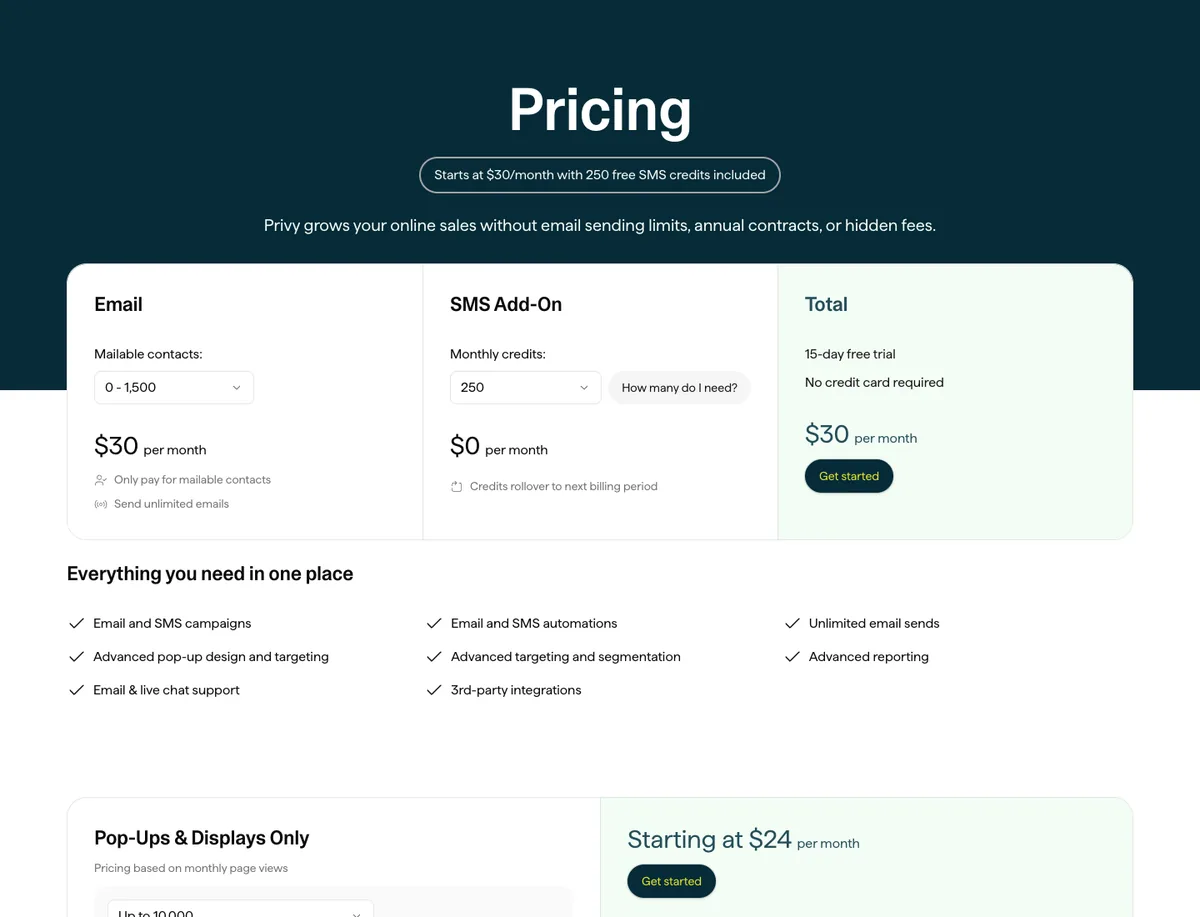
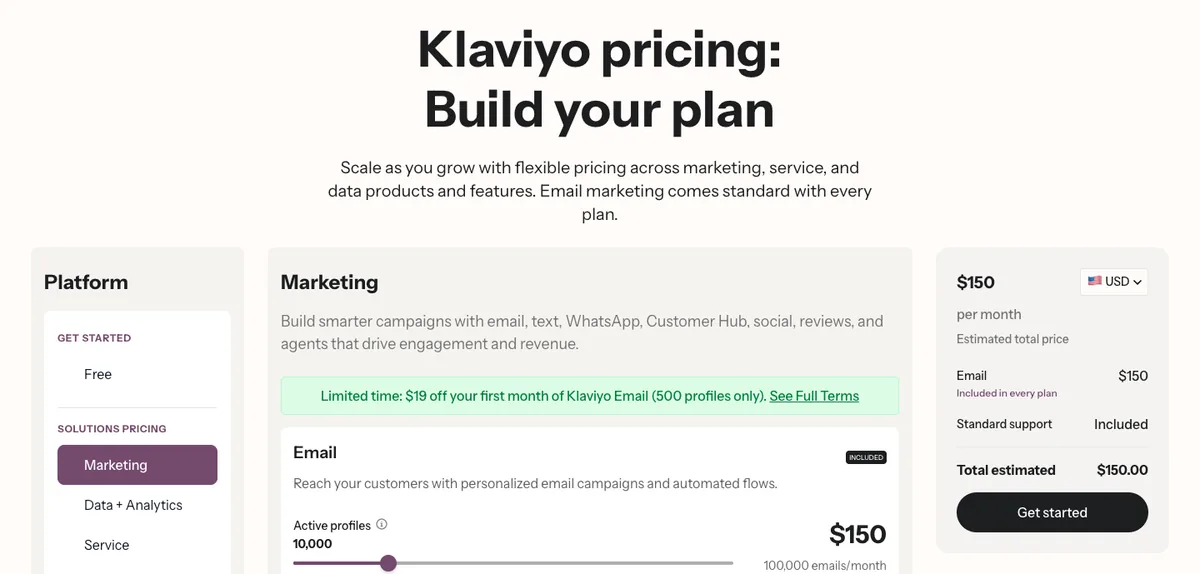
Privy prices on mailable contacts with unlimited sends. Klaviyo prices on active profiles and includes ten sends a month per profile. Monthly list prices in USD, from each vendor’s pricing page on 10 October 2026:
| Contacts | Privy (email) | Klaviyo (email) |
|---|---|---|
| 1,500 | $30 | $45 |
| 5,000 | $90 | $100 |
| 10,000 | $165 | $150 |
| 25,000 | $390 | $400 |
| 50,000 | $540 | $720 |
Privy’s tiers are bands (for example 4,001 to 5,000 contacts). Klaviyo is free up to 250 profiles and $20 at 500; Privy has no free plan.
SMS and pop-ups
- Privy SMS: 250 credits a month included, then $20 a month for 1,250 credits or $40 for 2,500, at $0.016 per US text including carrier fees. Unused credits roll over.
- Klaviyo SMS: a monthly plan added to your email plan: $15 for 1,000 US toll-free texts, carrier fees included. Unused spend doesn’t roll over.
- Privy pop-ups and displays only: $24 a month for up to 10,000 page views, $84 for 50,000, $168 for 100,000.
- Klaviyo forms: included in every plan.
So the email plans are close up to 25,000 contacts: Privy is $10 to $15 cheaper at most sizes and Klaviyo is $15 cheaper at 10,000. At 50,000, Privy is well ahead, $540 against $720. Privy’s unlimited sends suit high-frequency senders. The bigger cost is running both tools: Privy for pop-ups plus Klaviyo for email means paying twice for capture. Full Klaviyo detail is in our Klaviyo pricing guide.
Why is Klaviyo so expensive?
Against Privy it mostly isn’t: within $15 a month up to 25,000 contacts, and cheaper at 10,000. It feels expensive because it bills on active profiles, everyone you can email, and since February 2025 your plan has to cover that full count. A list carrying people who never open pushes you up tiers. Suppress them and the bill drops.
Privy Is Built for Capture; Klaviyo Is Built for Retention
Privy’s strength is on-site: pop-ups and other displays, designed for small teams. Its email and SMS products cover the core automations a small store needs. Privy is independent (it states it divested from Attentive in 2023), has since acquired Emotive and Sendlane, and says it serves more than 6,000 ecommerce brands.
Klaviyo is a B2C CRM: every visitor who signs up gets a real-time profile with browsing, orders and engagement, and flows and segments can use all of it. Its form builder is part of that same system.
Where Privy Wins
Pop-up flexibility for small teams. Displays are Privy’s heritage: lots of formats, easy targeting, simple setup.
Unlimited email sends on every email plan, which is predictable for small lists that send often.
Page-view pricing for pop-ups only. If you only want capture and already have an email platform, the displays-only plan is a clean option.
Credits that roll over. Unused SMS credits carry into the next billing period.
Broad site-builder support, including Wix, Squarespace and Weebly as well as Shopify, BigCommerce and WooCommerce.
Where Klaviyo Wins
Everything after the sign-up. Flows with conditional logic on any profile property, event or prediction; real-time segments; predicted lifetime value and churn risk. That’s where repeat revenue comes from.
Forms that write to the full profile. A Klaviyo form submission lands on a profile that already knows what the visitor browsed and bought. Targeting can use list membership, cart contents, location and UTM parameters.
Unified email and SMS. One profile, one consent record, one flow builder, one attribution model.
Reporting built around revenue. Revenue per recipient, placed order rate, flow versus campaign contribution.
Fewer scripts on your site. Using Klaviyo’s native forms removes a separate pop-up script and a sync to maintain.
Ecosystem. 350+ integrations and the largest pool of ecommerce email specialists.
Pros and Cons
Klaviyo
Pros
- Forms, flows, segments and SMS on one profile
- Predictive analytics and revenue reporting
- Free plan up to 250 profiles, with forms included
- Cheaper than Privy around 10,000 contacts
Cons
- A little dearer than Privy at most list sizes, and $180 a month dearer at 50,000
- Ten sends per profile a month, where Privy is unlimited
- Steeper learning curve past basic flows
Privy
Pros
- Flexible, easy pop-ups and displays
- Unlimited email sends
- Pop-ups-only plan from $24 a month
- SMS credits roll over
Cons
- No free plan
- Simpler automation and segmentation
- Running it alongside an email platform means paying twice for capture
What are the weaknesses of Klaviyo?
Against Privy, the weaknesses are small-store cost and complexity: it costs a little more at the smallest list sizes, caps monthly sends by profile count, and takes longer to learn. Across the board, cost rises with every active profile, SMS is billed on top of email, and default attribution windows can flatter email if left unchanged. Our Klaviyo review covers each one.
When to Choose Privy
- You’re a very small store that mainly needs capture and simple emails, and you value an easy all-in-one.
- You want a displays-only tool on top of an email platform with weak forms.
- You’re on a site builder like Squarespace or Weebly where Privy’s support decides it.
When to Choose Klaviyo
For most growing ecommerce brands:
- Email and SMS are meant to be a real share of revenue
- You want segments and flows that use browsing and purchase data
- You’d rather run one platform than a pop-up tool plus an email tool
- You’re planning to scale past a few thousand contacts
Using both? The Privy-to-Klaviyo integration syncs sign-ups, custom properties and Privy coupon codes into Klaviyo flows. It works. But test Klaviyo’s native forms first: for most brands they do the job and simplify the stack. See our Klaviyo sign-up forms guide and email popup best practices.
Who is Klaviyo’s biggest competitor?
Privy competes at the small end, mainly on capture. Klaviyo’s main rivals overall are Mailchimp and Omnisend for small and mid-size stores, Attentive and Postscript for SMS, and Braze and Iterable at enterprise scale. Our Klaviyo alternatives guide compares them by use case.
Migration Either Direction
Privy to Klaviyo: Export contacts with consent status and sign-up source, import to Klaviyo with SMS consent preserved, rebuild pop-ups as Klaviyo forms (keep your winning offers and timing), and rebuild flows. Remove the Privy script once the Klaviyo forms are live, to avoid double pop-ups. Typically one to three weeks.
Klaviyo to Privy: The same steps in reverse. Expect to lose predictive segments and some flow logic, since Privy’s automation is simpler.
Practical Recommendation
Small stores under a few thousand contacts that mostly need capture: Privy is a reasonable all-in-one, and so is Klaviyo’s free or entry plan. Compare both on your actual contact count.
Growing brands where retention revenue matters: Klaviyo, with its native forms. One platform, one profile, one report.
Brands already running Privy pop-ups into Klaviyo: test Klaviyo forms head to head. If they match Privy’s conversion rate, drop the second tool.
If you want capture rebuilt inside Klaviyo, our list growth service builds and tests the forms, and the free Klaviyo audit shows what your current setup is leaving on the table.
Sources
Prices checked 10 October 2026; company background checked September 2026:
/ Frequently Asked Questions
Q.01 Is Privy or Klaviyo better? +
/ Answer
For list capture on a small store, Privy's pop-ups and displays are flexible and easy. For everything after the sign-up (flows, segmentation, predictive analytics, SMS and revenue reporting), Klaviyo is the stronger platform. Many brands either use Klaviyo's native forms and skip Privy, or use Privy for pop-ups and pass subscribers into Klaviyo.
Q.02 How does Privy's cost compare with Klaviyo's? +
/ Answer
As of October 2026, Privy's email plan costs $30 a month for up to 1,500 mailable contacts, $90 at 5,000, $165 at 10,000 and $540 at 50,000, with unlimited sends. Klaviyo's email plan is $45 at 1,500 profiles, $100 at 5,000, $150 at 10,000 and $720 at 50,000. Privy's pop-ups-only plan starts at $24 a month for 10,000 page views; Klaviyo includes sign-up forms in every plan, free included.
Q.03 Can you use Privy with Klaviyo? +
/ Answer
Yes. Privy's Klaviyo integration syncs sign-ups into a chosen Klaviyo list, passes custom properties and Privy coupon codes into Klaviyo flows, and turns on Klaviyo session tracking after a form is submitted. It's a common setup for brands that like Privy's display tools but run their email in Klaviyo.
Q.04 Does Klaviyo have pop-ups like Privy? +
/ Answer
Yes. Klaviyo's form builder includes popups, flyouts, full-page forms, embedded forms and banners, with teasers, multi-step email and SMS capture, coupons, countdown timers, spin-to-win, targeting rules and A/B testing. For most brands it removes the need for a separate pop-up app.
Q.05 Who is Klaviyo's biggest competitor? +
/ Answer
Privy competes with Klaviyo at the small end, mainly on capture. Klaviyo's main rivals overall are Mailchimp and Omnisend for small and mid-size stores, Attentive and Postscript for SMS, and Braze and Iterable at enterprise scale. Privy is closer to a pop-up tool with email attached than to any of those.
Q.06 Why is Klaviyo so expensive compared with Privy? +
/ Answer
Up to about 5,000 contacts it costs a little more than Privy's email plan; at 10,000 it's cheaper, $150 against $165; from 25,000 Privy is cheaper again, by $180 a month at 50,000. Klaviyo bills on active profiles, everyone you can email, and since February 2025 your plan must cover that full count, so contacts who never engage push you up tiers. Suppressing them is the quickest saving.
Shows our articles higher in your Google results. Takes one click.