Klaviyo Review 2026: An Agency's Honest Verdict
Our Klaviyo review from 800+ brands: real pros, real cons, hidden costs, and who Klaviyo is wrong for. Written by an official Klaviyo partner agency.

Table of contents
- Klaviyo review: the short verdict
- How we reviewed Klaviyo
- What is Klaviyo? (quick context)
- Klaviyo pros
- 1. The data model is the real product
- 2. Shopify integration depth
- 3. Flows that actually carry revenue
- 4. Reporting built around revenue
- 5. Ecosystem and talent pool
- Klaviyo cons: the weaknesses to plan for
- 1. Cost grows with every emailable profile
- 2. The learning curve is real
- 3. Default templates and editor are only average
- 4. Add-on and usage pricing
- 5. Support on lower tiers is thin
- 6. Default attribution flatters email
- 7. The AI is uneven
- 8. Some categories are off-limits
- How to work around them
- Klaviyo pricing in brief
- Who Klaviyo is right for
- Who Klaviyo is wrong for
- What is a better alternative to Klaviyo?
- Is email marketing still worth it in 2026?
- Our verdict
- Sources
Most Klaviyo reviews are written by software reviewers who tested it for a fortnight, or by competitors who would like you to leave. This one is from an agency that has run Klaviyo across 800+ brands and $250M+ in attributed email and SMS revenue. We are an official Klaviyo partner, so read this knowing we have a stake. That is also why we are specific about where it falls short and who should not use it.
Klaviyo review: the short verdict
Klaviyo is the best email and SMS platform for most ecommerce brands that take retention seriously, and the wrong choice for businesses that don’t. Its strength is data: every customer’s orders, browsing and engagement in real time, driving flows and segments no mid-market rival matches. Its weaknesses are cost that grows with your list, a real learning curve, and add-on pricing.
Our overall score: 3.9 out of 5. That’s the plain average of the nine area scores below. Read the rows, not the average: Klaviyo scores 5 where ecommerce revenue is made (data, flows, segmentation) and 3 on editor, AI, price and support.
| Area | Our rating | Why |
|---|---|---|
| Ecommerce data and integrations | 5/5 | Real-time, event-level Shopify data; 350+ integrations |
| Flows and automation | 5/5 | Conditional logic on any property, event or prediction |
| Segmentation | 5/5 | Real-time segments, predictive metrics on paid plans |
| Reporting and attribution | 4/5 | Revenue per recipient built in; default windows need tightening |
| Email editor and templates | 3/5 | Capable, but defaults need design work |
| SMS | 4/5 | Unified with email; specialists still lead on SMS-only depth |
| AI features | 3/5 | Predictive tools are proven; generative agents are early |
| Pricing and value | 3/5 | Fair for engaged lists, punishing for bloated ones |
| Support | 3/5 | Limited on free and low tiers; paid packages extra |
These scores are our judgement from running accounts, not a lab test.
How we reviewed Klaviyo
This isn’t a two-week trial. It’s what years of building on Klaviyo for 800+ brands have taught us.
- What it’s based on. The accounts we build, run and audit. The cons below are the ones that come up audit after audit, not edge cases.
- What we checked, and when. Prices against Klaviyo’s pricing calculator and help centre (October 2026), the acceptable use policy (last updated 9 April 2026), Klaviyo’s Q2 2026 results and the Shopify App Store listing. Every source is linked at the end.
- How we scored. Each of the nine areas gets 1 to 5, judged for an ecommerce brand that will actually build flows and segments. The overall score is the unweighted average.
- What we didn’t do. We didn’t survey users or average other sites’ star ratings. The only third-party rating on this page is the Shopify App Store’s, dated and linked.
- Our stake. We’re an official Klaviyo partner and an official Omnisend partner. When Omnisend fits a brand better, we build on Omnisend. That’s why the “wrong for” list below is real.
What is Klaviyo? (quick context)
Klaviyo is a B2C CRM and marketing automation platform built for ecommerce. It connects to your store, builds a profile for every customer, and sends automated email, SMS, WhatsApp and push messages based on what they do. If you need the full explainer first, read what is Klaviyo.
A note on the keyword: “Klaviyo reviews” also refers to Klaviyo Reviews, the company’s product reviews app. We cover its pricing below, but this page is a review of Klaviyo.
Klaviyo pros
1. The data model is the real product
Klaviyo’s advantage is not the email editor. It is that every profile carries real-time events: viewed product, added to cart, started checkout, placed order, opened, clicked. Flows and segments can use all of it. A win-back that only targets customers with two or more orders, a high predicted lifetime value and no purchase in 90 days is a two-minute build. On list-based tools it is a workaround or impossible.
2. Shopify integration depth
The Shopify integration syncs customers, orders, products and catalogue data, and the on-site script captures browsing. That is what powers dynamic product blocks, abandoned cart contents and purchase-based segments. The Klaviyo app holds a 4.7-star rating from more than 3,300 reviews on the Shopify App Store (October 2026). We cover the setup details most brands miss in connecting Klaviyo to Shopify.
3. Flows that actually carry revenue
Welcome, abandoned cart, browse abandonment, post-purchase, replenishment, back-in-stock and win-back flows, with conditional splits on anything in the profile. In our experience this is where the platform pays for itself: the flows fire at the moment of intent, 24/7, without anyone pressing send.
4. Reporting built around revenue
Klaviyo reports revenue per recipient, placed order rate and flow versus campaign contribution out of the box. That lets you manage email as a revenue channel rather than an open-rate channel. On Better Body Co., surfacing the gap between flow and campaign revenue per recipient in the reporting was the lever that moved email from about 10% of revenue to the 20-25% target range.
5. Ecosystem and talent pool
350+ integrations (reviews, loyalty, subscriptions, helpdesk, analytics) feed data into the same profile. And because it is the default in DTC, it is easy to hire people and agencies who know it. That matters more than most feature grids admit.
Klaviyo cons: the weaknesses to plan for
What are the weaknesses of Klaviyo? Cost that rises with every profile you can email, a real learning curve past the basics, average default templates, add-on and usage pricing, thin support on lower tiers, default attribution that flatters email, uneven AI, and an acceptable use policy that rules out some categories. Here is each one, and how to work around it.
1. Cost grows with every emailable profile
Klaviyo bills on active profiles: anyone who can be emailed, whatever their consent status. Since 18 February 2025, your plan must match or exceed that count, and Klaviyo auto-upgrades you at the next billing cycle. A list full of people who have not opened in a year is now a line on your invoice as well as a drag on deliverability. We break down the tiers in Klaviyo pricing.
2. The learning curve is real
Anyone can publish a form and a welcome flow. Running Klaviyo well means understanding flow filters versus trigger filters, smart sending, attribution windows, segment definitions and deliverability. Most underperforming accounts we audit are not on the wrong platform; they are using 20% of it.
3. Default templates and editor are only average
The drag-and-drop editor is capable and has improved, but the stock templates look like stock templates. Good-looking, on-brand Klaviyo emails need design time or a design system. Our Klaviyo email templates guide covers how to build a set that holds up.
4. Add-on and usage pricing
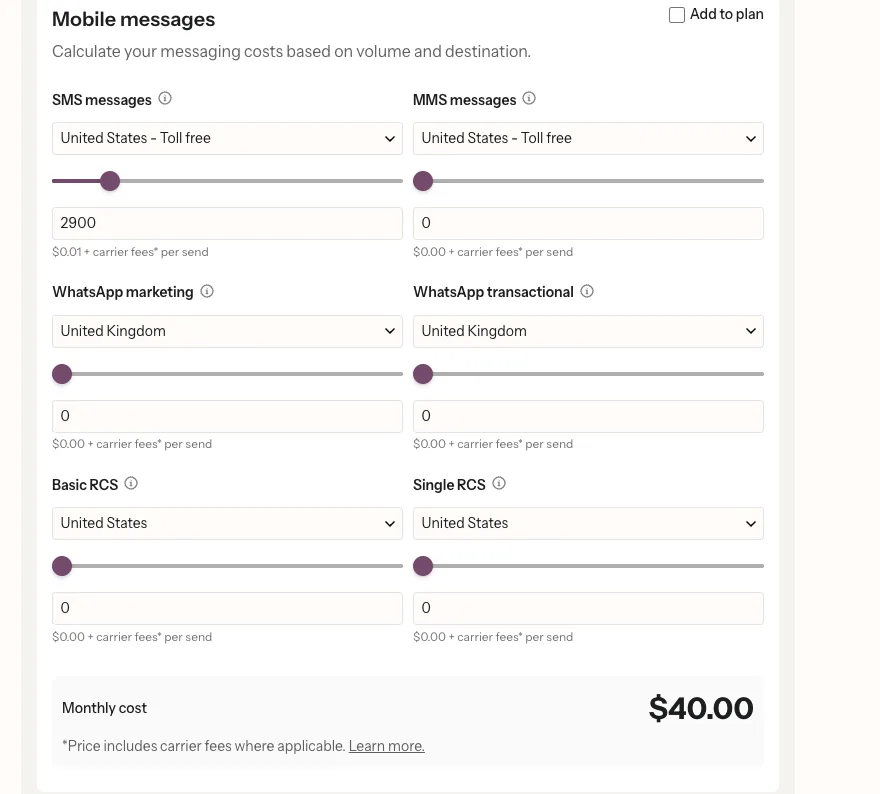
SMS, WhatsApp and other mobile messages are billed per message on top of the email plan. Composer, Customer Agent, Helpdesk, Customer Hub, Reviews above the free tier and the Personalisation analytics package are separate line items, and premium support packages start at $500 a month (Klaviyo pricing page, October 2026). None of this is unusual, but the total is rarely the number on the first tier.
5. Support on lower tiers is thin
The free plan gets email support for the first 60 days only. Paid plans get email and chat support. If you need a named contact and fast escalations, you pay for a support package or lean on a partner.
6. Default attribution flatters email
Klaviyo’s default attribution counts revenue from people who opened or clicked within a window. It is useful, but it overstates email’s true incremental contribution. Tighten the windows and add holdout testing before you use the dashboard to make budget decisions. We explain how in email revenue attribution in Klaviyo.
7. The AI is uneven
Predictive analytics (lifetime value, churn risk, next order date) are mature and useful. The newer generative and agent features, such as Composer, which Klaviyo labels as public beta, save time on drafts but still need human judgement. Our Klaviyo AI review goes feature by feature.
8. Some categories are off-limits
Klaviyo’s acceptable use policy (last updated 9 April 2026) prohibits prescription medications, pharmaceutical products, medical therapies and telehealth, along with gambling and cryptocurrency, and bars US and Canadian texts about CBD and cannabis. If your catalogue sits near those lines, check the policy before you build: a suspended account takes your list and flows with it. For those brands we usually build on Omnisend instead, after checking its terms against the catalogue.
How to work around them
Apart from the category rules, none of these is a reason for an ecommerce brand to avoid Klaviyo. They are reasons to run it deliberately: suppress profiles that never engage before they reach your invoice, tighten attribution before you report on it, build a template system once instead of redesigning every send, and size SMS and add-ons to what you will actually use. That is the day-to-day work of our Klaviyo agency team.
Klaviyo pricing in brief
As of October 2026 (USD per month, from Klaviyo’s pricing page):
| Active profiles | Email plan |
|---|---|
| Up to 250 | Free (500 emails a month, Klaviyo branding) |
| 500 | $20 |
| 1,000 | $30 |
| 5,000 | $100 |
| 10,000 | $150 |
| 25,000 | $400 |
| 50,000 | $720 |
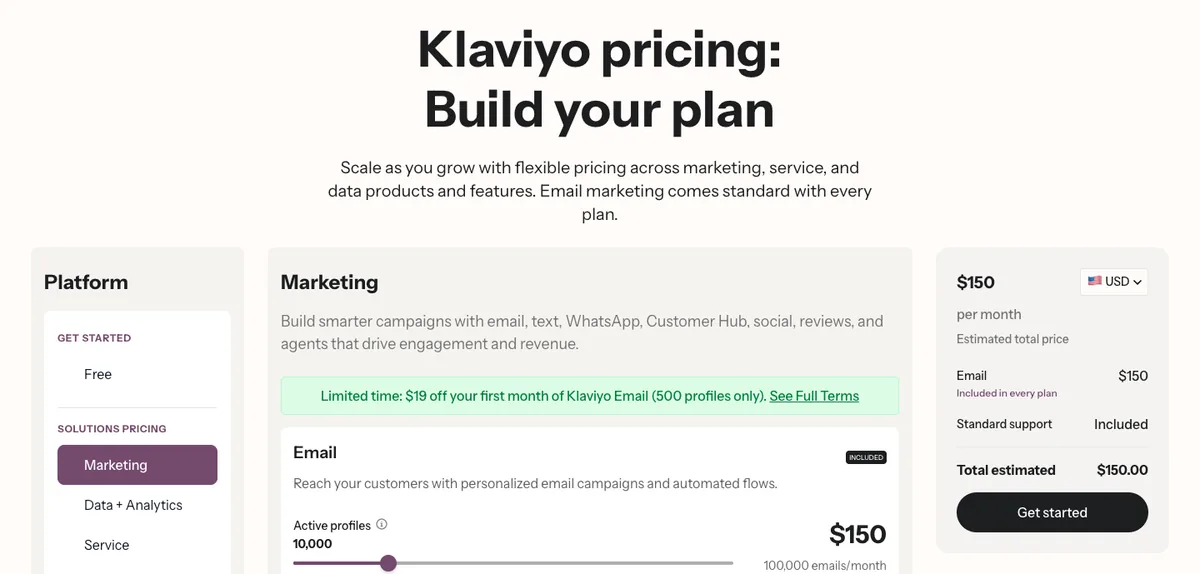
Mobile messaging is billed per message on top (see our Klaviyo SMS pricing guide). Klaviyo Reviews, the reviews app, is free up to 50 orders a month, then $25 a month for up to 250 orders, $90 for 1,000 and $175 for 2,000.
Why is Klaviyo so expensive? Mostly because it charges for profiles you are not using. Suppress anyone who has not engaged in six months or more, run a sunset flow, and many brands drop a tier. See how to clean your Klaviyo list.
Who Klaviyo is right for
- Ecommerce and DTC brands on Shopify, WooCommerce, BigCommerce and similar, especially from roughly a few thousand profiles upward, where segmentation starts to pay.
- Brands with repeat-purchase products: supplements, skincare, coffee, pet, apparel. Replenishment and post-purchase flows do heavy lifting here.
- Teams that will invest in it, in-house or with a partner. Klaviyo rewards effort.
- Brands that want email and SMS on one profile with one attribution model.
Who Klaviyo is wrong for
We would steer these businesses elsewhere:
- Newsletter-only senders. If you send one email a month and never build a flow, you are paying for data depth you won’t use. Mailchimp, MailerLite or Shopify Email will do it cheaper.
- Very small stores on tight budgets. Under a few thousand profiles, Omnisend or Shopify Email can be the smarter spend until email is a meaningful revenue line.
- B2B companies with a sales team. You need a sales CRM with pipeline and deals. See Klaviyo vs HubSpot.
- SMS-first brands on Shopify where text drives most retention revenue. A specialist like Attentive or Postscript can justify the second platform. See Klaviyo vs Postscript.
- Pure transactional or app email. Use a developer email service like SendGrid. See Klaviyo vs SendGrid.
- Large enterprises needing cross-channel orchestration beyond ecommerce, such as apps and in-product messaging, often at Braze or Iterable scale.
What is a better alternative to Klaviyo?
There is no universal “better”. There is better for a specific situation: Omnisend for cost-conscious Shopify stores, Mailchimp for simple newsletters, Attentive or Postscript for SMS-first brands, Braze or Iterable for app-heavy enterprise, and Listrak for retailers that want a managed-service relationship. We compare them honestly, including when not to switch, in Klaviyo alternatives.
Mailchimp or Klaviyo? For ecommerce revenue, Klaviyo. For a content newsletter or service business, Mailchimp is simpler and usually cheaper (see Mailchimp pricing). The full comparison is in Klaviyo vs Mailchimp.
Is email marketing still worth it in 2026?
Yes. Email and SMS are owned channels: no bidding against competitors for every impression, and the audience is yours. For DTC brands, they should be a major share of revenue. Our own client results show the range: Popl moved email and SMS from under 20% to 50–60% of revenue over 21 months, and Relaxium added $3M in incremental annual revenue from email and SMS.
Our verdict
Klaviyo is the right platform for most ecommerce brands that treat retention as a revenue engine. It is not the cheapest, not the easiest, and its AI is a work in progress. But its data model is the reason brands on it can do things their competitors can’t, and that gap shows up in the revenue.
The honest caveat: the platform does not do the work. A badly built Klaviyo account earns less than a well-built Omnisend one. If you want to see how your account measures up, our free Klaviyo audit puts a dollar figure on the gaps, and our Klaviyo experts can close them if you want help.
Sources
- Klaviyo, Pricing
- Klaviyo Help Center, Billing and active profiles
- Klaviyo Help Center, FAQ: Feb 18 billing changes
- Klaviyo Help Center, Free plan branding and support
- Klaviyo, Acceptable Use Policy (last updated 9 April 2026)
- Klaviyo Investor Relations, Q2 2026 results
- Shopify App Store, Klaviyo: Email Marketing & SMS
- Shopify App Store, Klaviyo: Product Reviews
/ Frequently Asked Questions
Q.01 Is Klaviyo worth it in 2026? +
/ Answer
For ecommerce brands that will actually build flows and segment their list, yes. The subscription is small next to the revenue a well-built account drives. For a newsletter-only business, a very small store, or a team that will never touch the automation, Klaviyo is more platform than you need and a cheaper tool will do the same job.
Q.02 What are the weaknesses of Klaviyo? +
/ Answer
Cost rises with every emailable profile, so an unmanaged list gets expensive. The learning curve is real once you move past basic flows. Default templates are average, support on lower tiers is limited, SMS and AI features add usage costs, and the default attribution settings flatter email's contribution. Its acceptable use policy also rules out some categories, such as prescription medications and telehealth. Apart from the category rules, none of these are deal-breakers, but all of them need managing.
Q.03 Why is Klaviyo so expensive? +
/ Answer
Klaviyo bills on active profiles, meaning everyone you can email, not just the people you do email. Since February 2025 your plan must match your active profile count, so large unengaged lists push you up tiers. Suppressing profiles that never engage is the fastest way to cut the bill, and it improves deliverability at the same time.
Q.04 What are the hidden costs with Klaviyo? +
/ Answer
The email plan is the visible cost. On top sit per-message SMS and WhatsApp fees, paid add-ons like Composer, Customer Agent, Helpdesk, Reviews above the free tier and the Personalisation analytics package, optional support packages, and automatic tier upgrades when your profile count grows. The biggest hidden cost is usually time: design, strategy and build.
Q.05 How much does Klaviyo Reviews cost per month? +
/ Answer
Klaviyo Reviews, Klaviyo's product reviews app, is free for up to 50 orders a month. Paid tiers start at $25 a month for up to 250 orders, rising to $90 for 1,000 orders and $175 for 2,000 orders, according to Klaviyo's pricing page as of October 2026.
Q.06 Is Klaviyo a good company? +
/ Answer
By the usual measures, yes. Klaviyo was founded in 2012, has been listed on the NYSE as KVYO since September 2023, and reported more than 205,000 customers and 26% year-on-year revenue growth in its Q2 2026 results. The platform is actively developed, and its Shopify app held a 4.7-star rating from more than 3,300 reviews in October 2026.
Q.07 Is Klaviyo hard to learn? +
/ Answer
Setting up forms and the core flows is straightforward, and many teams manage it in a day. The hard part is running it well: segment logic, flow filters, attribution windows, deliverability and testing. That is why a lot of brands either invest in training someone properly or bring in a Klaviyo partner for the build and strategy.
Q.08 Who is Klaviyo's biggest competitor? +
/ Answer
It depends on the job. For small ecommerce stores it is Mailchimp and Omnisend. For SMS it is Attentive and Postscript. At enterprise scale it is Braze, Iterable and Salesforce Marketing Cloud. For B2B and sales-led teams it is HubSpot and ActiveCampaign. For Shopify-native ecommerce email and SMS at growth stage, Omnisend is the closest like-for-like alternative.
Q.09 Who owns Klaviyo? +
/ Answer
Klaviyo is a public company listed on the New York Stock Exchange under the ticker KVYO since its September 2023 IPO, so it is owned by its shareholders. It was founded in 2012 by Andrew Bialecki and Ed Hallen and is headquartered in Boston.
Shows our articles higher in your Google results. Takes one click.