Klaviyo vs HubSpot (2026): Which Wins for Ecommerce?
Klaviyo vs HubSpot in 2026: prices at 5,000 to 50,000 contacts (checked 10 October), Shopify depth, CRM features, pros and cons, and when to run both.

Table of contents
- Klaviyo vs HubSpot at a glance
- Who should pick which
- The architectural difference
- Where HubSpot genuinely wins
- Where Klaviyo wins for ecommerce
- Klaviyo vs HubSpot pricing (October 2026)
- Pros and cons
- Klaviyo pros
- Klaviyo cons
- HubSpot pros
- HubSpot cons
- The hybrid approach: HubSpot CRM + Klaviyo email
- Klaviyo questions HubSpot users ask
- What are the weaknesses of Klaviyo?
- Why is Klaviyo so expensive?
- Who is Klaviyo’s biggest competitor?
- When to stay on HubSpot for ecommerce email
- What migration looks like
- Practical recommendation
- Sources
Klaviyo is the better choice for ecommerce brands that want email and SMS to run on order, cart and browsing data, and it costs a fraction of HubSpot Marketing Hub Professional at every list size. HubSpot is the better choice for B2B and sales-led businesses that need a CRM, deal pipelines and marketing automation in one platform, and brands with both models often run the two side by side.
HubSpot is one of the most capable marketing platforms ever built. It dominates B2B marketing automation and has a CRM that sales teams actually use. Very little of that is aimed at a DTC store selling repeat orders. This page shows where each one fits, what they cost at real list sizes (checked on HubSpot’s and Klaviyo’s own pages on 10 October 2026), and how the hybrid setup works.
A note on where we stand: we’re a Klaviyo partner agency and we run HubSpot to Klaviyo migrations, so we have a stake. That’s why the cases where HubSpot wins are spelled out below.
Klaviyo vs HubSpot at a glance
| Klaviyo | HubSpot Marketing Hub | |
|---|---|---|
| Built for | B2C ecommerce email and SMS | B2B marketing, on a CRM shared with sales and service |
| Data model | Shopper profile with orders, products, browsing and predictions | CRM contact record linked to companies, deals and tickets |
| Sales CRM | None: no deal pipelines, quotes or rep tasks | Smart CRM under every plan; pipelines and sales tools through Sales Hub |
| Shopify connection | Native, real time, with order backfill and on-site browsing | Data sync for contacts, products, orders and abandoned checkouts, within 10 minutes of a change |
| Predictive features | Predicted lifetime value, churn risk, next order date | Lead scoring on Professional and up |
| Channels | Email, SMS, push and WhatsApp, with reviews, helpdesk and social add-ons | Email, landing pages, ads, social, chat and the website, in one workflow engine |
| Billed on | Active profiles you can email | Seats plus marketing contacts; non-marketing contacts are free |
| Entry price | Free to 250 profiles, then $20 at 500 | Starter from $7 a seat on promotion ($20 list), 1,000 marketing contacts |
| Price at 10,000 contacts | $150 | About $1,300 on Professional (annual) |
| Onboarding fee | None | $3,000 on Professional, $7,000 on Enterprise |
| Connects to the other | No built-in HubSpot integration | Via marketplace app, Zapier or API |
USD a month, as of 10 October 2026. HubSpot figures above Starter are our estimates from HubSpot’s published rates.
Who should pick which
| If you… | Pick | Why |
|---|---|---|
| Run a DTC store where repeat orders drive revenue | Klaviyo | Flows and segments run on order, cart and browsing data, at a fraction of the price. |
| Sell to businesses with a sales team working deals | HubSpot | CRM, pipelines and marketing automation share one record. |
| Run wholesale or B2B alongside a Shopify store | Both | HubSpot for the CRM and B2B marketing, Klaviyo for ecommerce email and SMS. |
| Want landing pages, ads, social and email in one workflow engine | HubSpot | Klaviyo doesn’t try to cover all of that. |
| Want SMS on the same profile and in the same flows as email | Klaviyo | One flow, one report, one attribution model. |
| Have a team fluent in HubSpot and email under 10% of revenue | Stay on HubSpot, for now | The switching cost may outweigh the gain. |
The architectural difference
HubSpot is a unified platform: CRM, email, landing pages, ads, social, analytics and a service hub on one database. That unification is powerful for B2B, where sales pipeline, marketing automation and revenue attribution need to share the same record.
Klaviyo is an ecommerce-native email and SMS platform. It does one job, retention marketing, and connects to the rest of your stack rather than replacing it.
That shows up in three places:
- The record. HubSpot models a contact as a CRM record with marketing properties. Klaviyo models a shopper with purchase history, product affinity and predicted values on the profile.
- The triggers. HubSpot workflows fire on form submissions, page views, deal stages and email engagement. Klaviyo flows fire on those plus purchases, carts, product views, predicted churn and predicted next order date.
- The reports. HubSpot reports on marketing-attributed pipeline. Klaviyo reports on revenue per recipient, flow contribution and attributed orders.
For B2B SaaS, HubSpot’s model is right. For ecommerce, Klaviyo’s is.
Where HubSpot genuinely wins
You run B2B alongside ecommerce. Wholesale, B2B subscriptions or corporate accounts benefit from HubSpot’s CRM, deal pipeline and lead scoring. Klaviyo positions itself as a B2C CRM, but it is not a sales CRM: there are no deal pipelines, quotes or rep task management.
You want one engine across many channels. HubSpot Marketing Hub covers landing pages, ads, social media and chat as well as email, with workflows across them. Professional allows up to 300 workflows. Klaviyo has added reviews, helpdesk and social add-ons, but email and SMS are its core.
Service matters to you. HubSpot’s Service Hub (tickets, knowledge base, live chat) runs on the same CRM. Ecommerce helpdesks need an integration to match that.
If any of these fit, HubSpot stays. The question is whether to add Klaviyo for ecommerce email or keep email in HubSpot.
Where Klaviyo wins for ecommerce
Store data on the profile. HubSpot’s Shopify data sync is better than its reputation: per HubSpot’s knowledge base (June 2026), contacts and products sync both ways, orders and abandoned checkouts come into HubSpot, and records update within 10 minutes of a change. Klaviyo goes further for retention. Orders backfill on install, on-site browsing (viewed product, active on site) lands on the profile in real time, and every event and its properties can drive a flow trigger, filter or split.
Predictive analytics for repeat purchase. Klaviyo calculates predicted lifetime value, churn risk and next order date on every profile from purchase history. HubSpot’s scoring is built around leads, deals and companies.
Product feeds in email. Klaviyo’s templates have drag-and-drop blocks fed by your live catalogue on Shopify, WooCommerce or BigCommerce: cart items, recommendations, back-in-stock. HubSpot can show abandoned cart data in marketing emails; product recommendations beyond that take more build work.
Reporting that maps to revenue. Klaviyo shows revenue per recipient, attributed orders and revenue by flow, campaign and segment. HubSpot’s email reports centre on engagement and pipeline attribution, which is right for B2B.
SMS built for ecommerce. Klaviyo SMS runs abandoned cart, post-purchase and BFCM sends from the same profile and flows as email, with consent stored on that profile.
Klaviyo vs HubSpot pricing (October 2026)
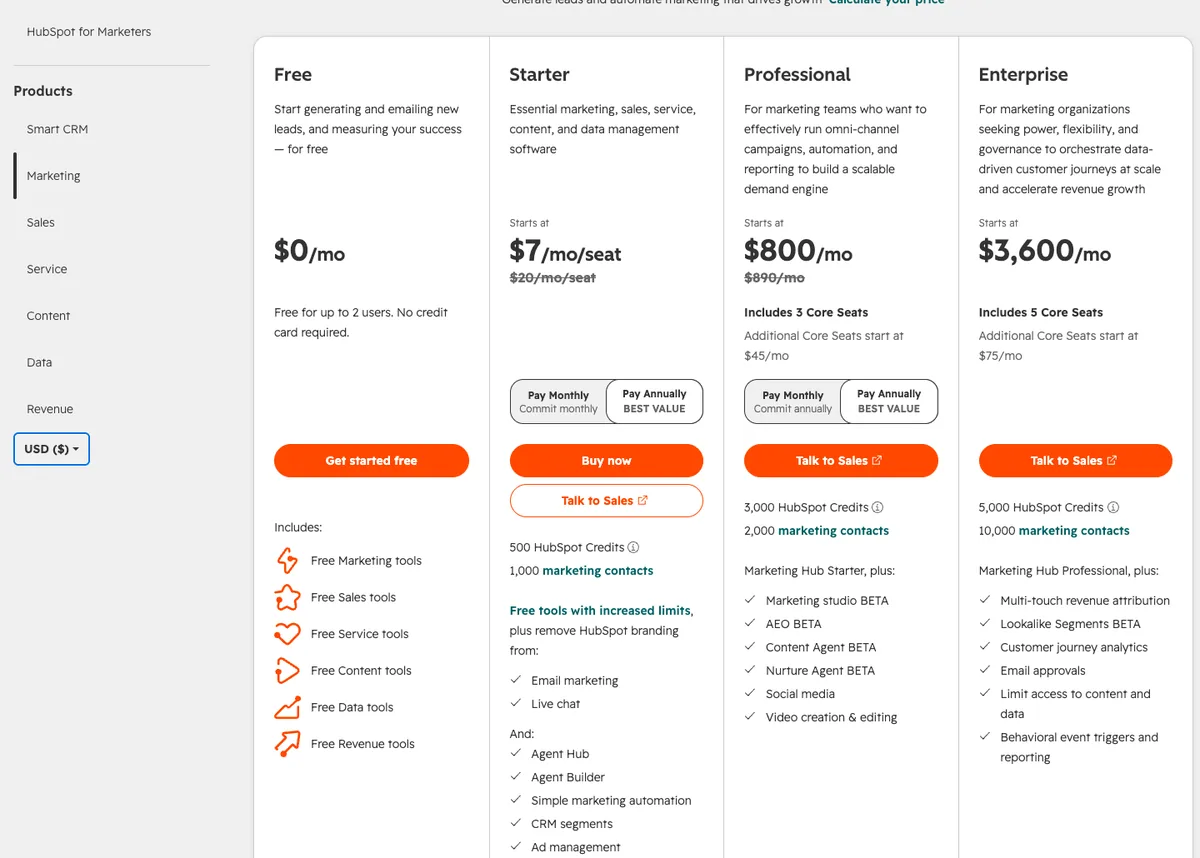
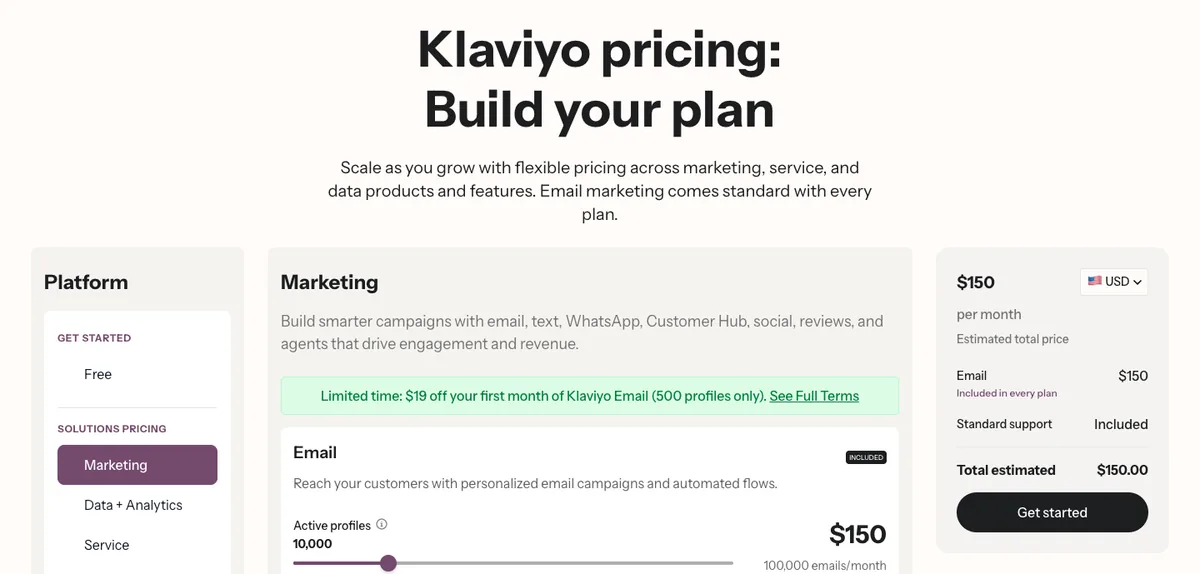
HubSpot prices Marketing Hub on seats plus marketing contacts. Non-marketing contacts are free, so you only pay for contacts you mark as marketing. Klaviyo prices on active profiles: everyone you can email.
Monthly prices in USD, as of 10 October 2026:
| Marketing contacts | Klaviyo (email) | HubSpot Starter (1 seat) | HubSpot Professional (annual) |
|---|---|---|---|
| 5,000 | $100 | ~$210 | ~$1,050 |
| 10,000 | $150 | ~$410 | ~$1,300 |
| 25,000 | $400 | ~$1,010 | ~$2,025 |
| 50,000 | $720 | ~$2,010 | ~$3,100 |
How we built the HubSpot columns: Professional starts at $800 a month billed annually ($890 on a monthly commitment) with 3 core seats and 2,000 marketing contacts. HubSpot’s product catalogue prices extra Professional contacts in blocks of 5,000: $250 a block up to 22,000, $225 to 42,000, then $200 to 62,000. Starter is one seat at its $20 list price with 1,000 contacts, plus $50 per 1,000 contacts to 3,000, $45 to 5,000 and $40 after that. HubSpot charges a blended rate, so treat these as estimates and get a quote.
What the table doesn’t show:
- Onboarding. Professional carries a one-time $3,000 onboarding fee and Enterprise $7,000. Klaviyo has none.
- Seats. Extra Professional core seats start at $45 a month on HubSpot’s pricing page. Klaviyo’s plans are priced on profiles, not seats.
- Send limits. HubSpot Starter allows 5 times your marketing contact tier in emails a month and Professional 10 times. Klaviyo allows 10 per profile.
- Promotions. Starter was showing $7 a seat against a $20 list price. Budget on list.
- SMS on Klaviyo is a separate monthly plan, from $15 for 1,000 US texts.
Klaviyo is cheaper at every size for ecommerce, and the gap widens as the list grows. HubSpot’s pricing makes sense where each contact is a potential deal; for a store where most contacts are buyers and subscribers, Klaviyo’s pricing model fits better.
Pros and cons
Klaviyo pros
- Built on ecommerce data: orders, carts, browsing and predictions on every profile
- Native Shopify, WooCommerce, BigCommerce and Magento integrations with order backfill
- A fraction of HubSpot Professional’s price at every list size, with no onboarding fee
- SMS in the same flows and reports as email
- Free plan with flows included
Klaviyo cons
- No sales CRM, deal pipelines or quotes
- Doesn’t run landing pages, ads and service tickets in one engine
- No built-in HubSpot integration
- Bills every emailable profile, including buyers who never subscribed
HubSpot pros
- Marketing, sales and service on one CRM record
- Strong B2B tooling: lead scoring, pipelines, sales workspace
- Landing pages, ads, social and chat alongside email
- Non-marketing contacts are free
- Shopify data sync for contacts, products, orders and abandoned checkouts
HubSpot cons
- Professional starts at $800 a month plus a $3,000 onboarding fee
- Contact and seat costs climb fast as a consumer list grows
- Scoring is built around leads, deals and companies, not repeat orders
- Ecommerce flows take more build work than in Klaviyo
The hybrid approach: HubSpot CRM + Klaviyo email
The most common setup for ecommerce brands that have outgrown HubSpot’s email side but need HubSpot for CRM and B2B:
- HubSpot stays as the CRM, deal pipeline and B2B marketing hub
- Klaviyo handles ecommerce email and SMS: welcome, abandoned cart, post-purchase, replenishment, win-back, campaigns and segmentation
- Contact data syncs through a partner app from HubSpot’s marketplace, a sync tool, Zapier or a custom API build, because Klaviyo has no built-in HubSpot integration
Decide which system owns each field (consent, lifecycle stage, customer type) before anything syncs, or the two will overwrite each other. The integration overhead is real but manageable for brands where both functions matter.
Klaviyo questions HubSpot users ask
What are the weaknesses of Klaviyo?
For a HubSpot user, the gaps are on the sales side. Klaviyo has no deal pipelines, quotes or rep tasks, it doesn’t connect to HubSpot without a third-party app or API work, and it won’t run your landing pages or ads. It also bills every profile you can email, SMS is billed per message on top, and its default attribution windows can make email look bigger than it is. Our Klaviyo review covers each weakness and the workarounds.
Why is Klaviyo so expensive?
Next to HubSpot, it isn’t: $720 a month at 50,000 profiles against roughly $3,100 for Marketing Hub Professional. Where Klaviyo does feel expensive is the billing model. It charges for every profile you can email, and since February 2025 your plan must cover the full count, so a list full of people who never engage pushes you up tiers. HubSpot lets you mark contacts non-marketing for free; the Klaviyo equivalent is suppressing profiles that never engage. Our Klaviyo pricing guide shows how.
Who is Klaviyo’s biggest competitor?
For B2B and sales-led teams, HubSpot and ActiveCampaign. For small ecommerce stores, Mailchimp and Omnisend. For SMS-first brands, Attentive and Postscript, and at enterprise scale, Braze and Iterable. Our Klaviyo alternatives guide ranks twelve by use case.
When to stay on HubSpot for ecommerce email
HubSpot is fine for ecommerce email when:
- Email is a small contributor (under about 10% of revenue) and the store is a side channel
- B2B is a large share of revenue and one automation engine across both is worth more than ecommerce depth
- Your team knows HubSpot deeply and the switching cost outweighs the email-side gain
Outside those cases the gap shows up in revenue per recipient. Better flow architecture, deeper segmentation and order-level reporting are where Klaviyo earns its keep.
What migration looks like
Moving ecommerce email from HubSpot to Klaviyo while keeping HubSpot as the CRM is a 3 to 4 week project for most brands:
- Klaviyo account set up with the native store integration
- HubSpot to Klaviyo bridge configured and tested for contact sync
- HubSpot ecommerce workflows rebuilt as Klaviyo flows
- Subscribers, consent and engagement data migrated
- Cutover and deliverability monitoring
The detail is on our HubSpot to Klaviyo migration service page.
Practical recommendation
Pure ecommerce brands, any size: Klaviyo. Native store events, predictive analytics and revenue reporting close gaps HubSpot’s marketing engine wasn’t designed to fill, at a fraction of the price.
Ecommerce brands with real B2B exposure: hybrid. HubSpot for CRM and B2B, Klaviyo for ecommerce email and SMS.
B2B-first brands with light ecommerce: HubSpot everywhere. The unified platform outweighs the ecommerce gaps.
The setup that consistently underperforms is an ecommerce-first brand running its store email through HubSpot Marketing Hub. Not because HubSpot is bad, but because it wasn’t built for that work. Book a free audit and we’ll tell you which setup fits, including when HubSpot should stay.
Sources
- HubSpot, Marketing Hub pricing (10 October 2026)
- HubSpot, Product and Services Catalog: Marketing Hub base prices, marketing contact tiers, onboarding fees, send limits and workflow limits (10 October 2026)
- HubSpot Knowledge Base, Connect HubSpot and Shopify (Data Sync) (updated 22 June 2026)
- HubSpot Knowledge Base, Use abandoned cart data in marketing emails
- Klaviyo Pricing (October 2026)
- Klaviyo Help Center, How Klaviyo billing works
- Klaviyo Help Center, How to migrate from HubSpot
/ Frequently Asked Questions
Q.01 Can Klaviyo replace HubSpot? +
/ Answer
For ecommerce email and SMS, yes, and it usually costs far less. For a sales team, no. Klaviyo has no deal pipelines, quotes or rep task management, and it doesn't run landing pages, ads and service tickets in one workflow engine the way HubSpot does. Brands with a B2B or wholesale side often keep HubSpot as the CRM and move ecommerce email and SMS to Klaviyo.
Q.02 Is Klaviyo cheaper than HubSpot? +
/ Answer
Yes, by a wide margin for ecommerce. As of 10 October 2026, Klaviyo's email plan is $100 a month at 5,000 profiles and $720 at 50,000. HubSpot Marketing Hub Professional starts at $800 a month billed annually with 2,000 marketing contacts and 3 core seats; adding contacts at HubSpot's published rates takes it to about $1,050 at 5,000 and $3,100 at 50,000, plus a one-time $3,000 onboarding fee.
Q.03 Does HubSpot integrate with Shopify? +
/ Answer
Yes. HubSpot's Shopify data sync connects contacts and products both ways and brings orders and abandoned checkouts into HubSpot, and after the first sync records update within 10 minutes of a change, per HubSpot's knowledge base. Abandoned cart data can go into marketing emails. Klaviyo's integration goes further for retention, adding on-site browsing and order history backfill on every profile in real time.
Q.04 Does Klaviyo integrate with HubSpot? +
/ Answer
Not natively. Klaviyo's own help centre says it has no built-in HubSpot integration. Brands that run both connect them with a partner app from HubSpot's marketplace, a sync tool or Zapier, or a custom API build, and decide which system owns each field before anything syncs.
Q.05 Is HubSpot worth it for an ecommerce brand? +
/ Answer
If you sell to businesses as well as consumers, run a sales team, or want marketing, sales and service on one CRM, it can be. If you are a DTC store whose revenue comes from repeat orders, HubSpot Marketing Hub Professional costs several times more than Klaviyo and wasn't built around order, cart and browsing data, so the money usually goes further on Klaviyo.
Shows our articles higher in your Google results. Takes one click.