Klaviyo vs Shopify Email (2026): When Free Isn't Enough
Klaviyo vs Shopify Email, now Shopify Messaging, in 2026: costs at 2,500 to 50,000 subscribers, where Shopify's free tier is enough, and when to switch.

Table of contents
- Klaviyo vs Shopify Email at a Glance
- Klaviyo vs Shopify Email Pricing (October 2026)
- Why is Klaviyo so expensive?
- What Shopify Email Is Good At
- Where Klaviyo Pulls Ahead
- Depth of the logic
- Testing
- Segmentation and predictions
- SMS
- Reporting
- Pros and Cons
- Klaviyo
- Shopify Messaging
- What are the weaknesses of Klaviyo?
- Should You Switch? A Decision Framework
- Who is Klaviyo’s biggest competitor?
- The Migration Path
- The Bottom Line
- Sources
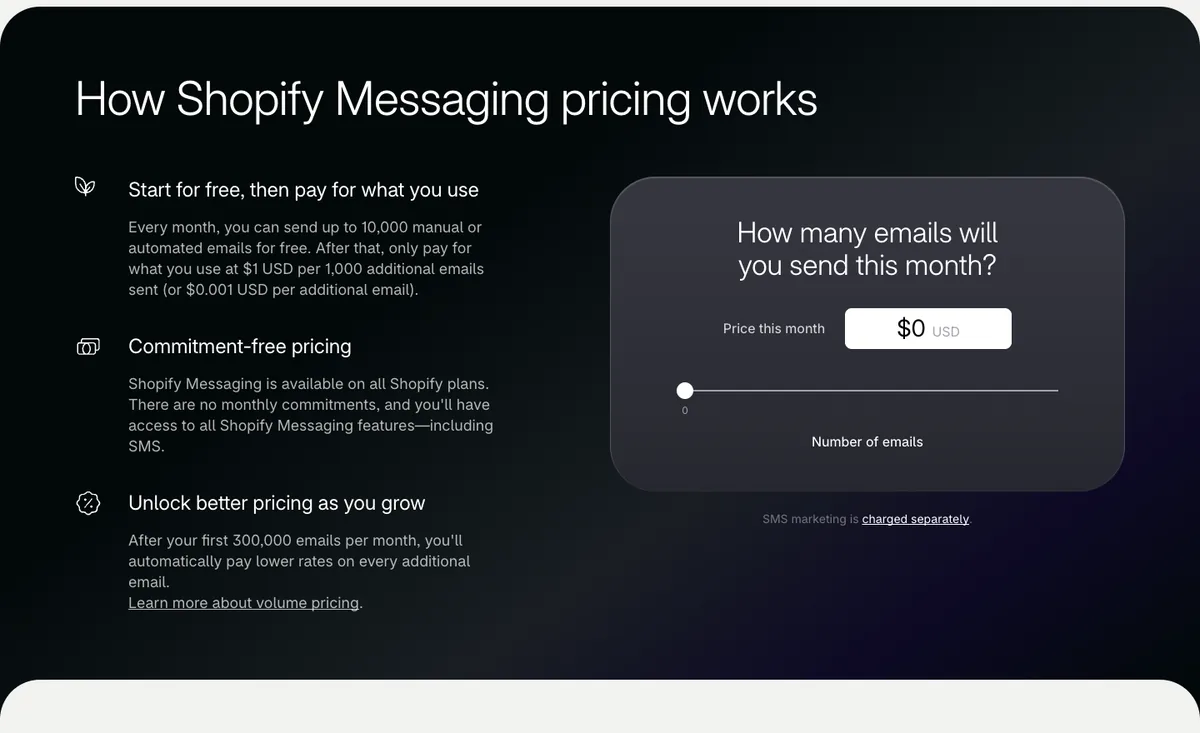
Shopify Messaging, the new name for Shopify Email, is the better choice for small Shopify stores that send a few campaigns a month: 10,000 emails a month are free and extra emails cost $1 per 1,000, as of October 2026. Klaviyo is the better choice once email has to earn real repeat revenue, because its flows, segments and predictions go much deeper on the same store data, and its reporting ties every send to revenue.
Shopify’s email tool has become competent. Early versions were barely functional, but Shopify has invested in it: automations now include custom workflows with conditions and wait steps, and SMS is available in some countries. For a specific kind of store at a specific stage, it’s genuinely fine. The mistake is staying on it past that stage without knowing what you’re giving up.
A note on where we stand: we’re an official Klaviyo partner and we run Shopify Email to Klaviyo migrations, so we have a stake. That’s why the case for staying is spelled out below, and why every price comes from the vendors’ own sites, checked on 10 October 2026.
Klaviyo vs Shopify Email at a Glance
| Klaviyo | Shopify Messaging (Shopify Email) | |
|---|---|---|
| Works with | Shopify, WooCommerce, BigCommerce, Magento and more | Shopify only |
| Pricing basis | Active profiles | Emails sent |
| Free tier | 250 profiles, 500 emails a month | 10,000 emails a month, on any Shopify plan |
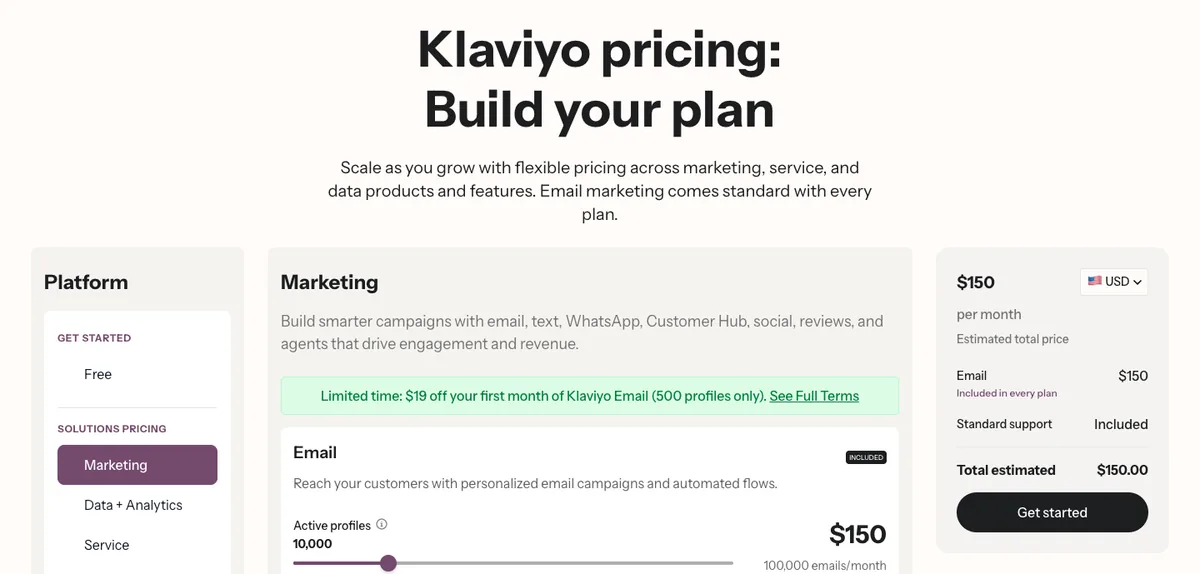
| Paid pricing | $60 a month at 2,500 profiles, $150 at 10,000, $400 at 25,000 | $1 per 1,000 emails above 10,000; $0.65 above 300,000; $0.55 above 750,000 |
| Abandoned checkout emails | A flow, inside your plan’s send allowance | Always free; don’t count toward the limit |
| Automations | Ecommerce flow library; splits on any event, profile property or prediction | Templates (welcome, win-back, upsell) and custom workflows with conditions and wait steps |
| Predictions | Predicted CLV, churn risk and next order date per profile | Predicted spend tier (high, medium, low) in customer segments |
| SMS | Monthly plan priced per message, many countries | Pay per message in select countries: $0.012 per US SMS, plus $2.15 a month per toll-free number |
| Reporting | Revenue per recipient, flow contribution, attributed orders | Sent, opens, conversions, delivery rate and sales |
Prices in USD, as of October 2026.
Klaviyo vs Shopify Email Pricing (October 2026)
The two charge for different things. Shopify charges per email sent; Klaviyo charges per active profile and includes ten sends a month for each. So the fair comparison is what a typical sending pattern costs. Here’s four campaigns a month to the whole list, using each vendor’s list prices in USD:
| Subscribers | Emails a month | Shopify Messaging | Klaviyo (email) |
|---|---|---|---|
| 2,500 | 10,000 | $0 | $60 |
| 10,000 | 40,000 | $30 | $150 |
| 25,000 | 100,000 | $90 | $400 |
| 50,000 | 200,000 | $190 | $720 |
Shopify: first 10,000 emails free, then $1 per 1,000. Klaviyo’s plans include 25,000, 100,000, 250,000 and 500,000 sends at these sizes. Automated emails count toward Shopify’s total, except abandoned checkout emails.
At every size, Shopify is cheaper. At 10,000 subscribers the gap is $120 a month, $1,440 a year. Put that against revenue: at a $60 average order, Klaviyo pays for itself if its flows and segments produce two extra orders a month. Whether they do depends on how well the account is run, which is why we audit before recommending a switch.
Why is Klaviyo so expensive?
Next to a tool whose first 10,000 emails are free, anything looks expensive. Klaviyo bills on active profiles, everyone you can email, and since February 2025 your plan has to cover that full count, so years of subscribers who never open push you up tiers. Suppress them and the bill drops. What you pay for is depth on the same store data: predictions, deeper segments, testing and revenue reporting. Every tier is in our Klaviyo pricing guide.
What Shopify Email Is Good At
It’s fair to start here.
Shopify Messaging is built into your admin, uses your Shopify customer and product data with no setup, and is free for the first 10,000 emails a month. Abandoned checkout emails don’t even count toward that. For a small store that sends a promotional campaign once or twice a month and runs a handful of automations, it covers the essentials without another platform to learn.
The automations have improved. You can switch on ready-made welcome, win-back and upsell automations, or build custom workflows with triggers, conditions, conditional logic and wait steps. Segments use Shopify’s customer segment editor, including a predicted spend tier.
If your store does under about $200K a year, sends fewer than 10,000 emails a month and your email plan is mostly launch announcements, Shopify Messaging may be the right tool right now.
Where Klaviyo Pulls Ahead
Depth of the logic
Both tools can now branch. The difference is what the branches can use. Klaviyo flows can split on any profile property, event or prediction: how many orders someone has placed, what they browsed, their predicted lifetime value, their expected next order date. Its flow library covers welcome, abandoned cart, browse abandonment, post-purchase, replenishment, win-back and back in stock, and you can add SMS steps to the same flow.
That’s where flow revenue comes from. Klaviyo’s benchmarks show flows generate around 41% of email revenue from about 5.3% of sends, and abandoned cart flows average $3.65 in revenue per recipient against $0.11 for campaigns.
Testing
Klaviyo can A/B test messages inside flows, so you can test two subject lines on your abandoned cart email, the timing of a welcome series, or an offer. Shopify’s email marketing page doesn’t list testing for automations, as of October 2026. Programmes that can’t test can’t learn, and flows are where the leverage is highest.
Segmentation and predictions
Shopify’s segment editor is decent: customers who bought in the last 90 days, customers in a country, customers who spent over a set amount, and a predicted spend tier of high, medium or low. Klaviyo segments update in real time on engagement and behaviour, and calculate predicted CLV, churn risk and expected next order date for each profile. A “high-value customers who haven’t bought in 60 days” segment, fed into a win-back flow, is a few clicks in Klaviyo. That’s what a serious retention programme runs on.
SMS
Shopify Messaging now sells SMS in select countries, at $0.012 per US message plus $2.15 a month per toll-free number. Klaviyo sells SMS as a monthly plan in many more countries, and its texts can branch on the same predictions and segments as your email, in the same flow, with one attribution report. If SMS is part of your retention strategy, that shared logic matters.
Reporting
Shopify reports sends, opens, conversions, delivery rate and sales. Klaviyo reports revenue per recipient, flow contribution and attributed orders, by flow, campaign and segment. That’s what tells you where the next dollar of effort should go.
Pros and Cons
Klaviyo
Pros
- Flows that branch on any event, property or prediction, with SMS steps
- A/B testing inside flows
- Predicted CLV, churn risk and next order date per profile
- Revenue reporting by flow, campaign and segment
- Works beyond Shopify if you ever move platforms
Cons
- Costs more at every list size: $150 against about $30 at 10,000 subscribers sending weekly
- Another platform to learn, with a steeper curve past basic flows
- SMS billed on top
Shopify Messaging
Pros
- Free for 10,000 emails a month; abandoned checkout emails always free
- Built into the Shopify admin, no setup
- Templates plus custom workflows with conditions and wait steps
- SMS in select countries, pay as you go
Cons
- Shopify only
- Shallower segmentation and predictions
- Reporting focused on sends and sales, not revenue per recipient
- Testing for automations not listed on its marketing page
What are the weaknesses of Klaviyo?
Against Shopify’s free tool, the weakness is cost and effort: you pay from your first 250 profiles, and you need someone to build the flows and segments that justify it. More broadly, Klaviyo’s cost rises with every active profile, SMS is billed per message, and default attribution windows can flatter email if left unchanged. Our Klaviyo review goes through each one.
Should You Switch? A Decision Framework
Stay on Shopify Messaging if:
- Your store does under about $500K a year
- Your list has fewer than about 5,000 active subscribers
- You send fewer than 10,000 emails a month
- Nobody on the team has time to run a more complex platform
- Email is a supporting channel, not a main revenue driver
Switch to Klaviyo if:
- Your store does over $500K a year and email is a small share of it
- You have 5,000+ subscribers and the list is growing
- You want more than three or four flows that branch on purchase history and predictions
- You want to test and improve flows systematically
- You want SMS in the same flows and reports as email
Who is Klaviyo’s biggest competitor?
For Shopify stores, Shopify’s own tool is the free default, and the paid rivals are Mailchimp and Omnisend for small and mid-size stores, Attentive and Postscript for SMS, and Braze and Iterable at enterprise scale. Our Klaviyo alternatives guide compares them by use case.
The Migration Path
Switching from Shopify Email to Klaviyo is one of the simplest migrations there is, because both read the same Shopify data.
- Install Klaviyo from the Shopify App Store. The integration is native and takes minutes, and Klaviyo’s free plan covers up to 250 profiles. Here’s whether Klaviyo is free on Shopify beyond that.
- Let your data sync. Klaviyo syncs your recent Shopify data first, then backfills your full order history, customer records and product catalogue. Depending on store size, that takes minutes to several days.
- Import any extra subscriber lists exported from Shopify as CSV, and tag them in Klaviyo.
- Turn off Shopify Messaging automations before your Klaviyo flows go live. Running both creates duplicate sends and muddled attribution.
- Launch your core flows (abandoned cart, welcome, post-purchase) in Klaviyo before moving campaign sends over.
You don’t need to do everything at once. Launch the flows first; campaigns can follow.
The Bottom Line
Shopify Messaging is a capable, nearly free tool for small stores with simple needs, and it’s better than it was. But its segmentation, predictions, testing and reporting stop short of what a store needs once email is a serious revenue channel.
When the revenue you’re not making exceeds the platform cost you’re avoiding, the free tool stops being free. For a store past a few thousand subscribers, that point usually comes sooner than expected.
Book a free audit and we’ll tell you what your email should be earning, and whether Klaviyo would close the gap.
Sources
Checked 10 October 2026:
/ Frequently Asked Questions
Q.01 Is Shopify Email free? +
/ Answer
Mostly. Shopify Email is now called Shopify Messaging, and as of October 2026 every store on the Basic, Grow, Advanced and Plus plans gets 10,000 free emails a month. After that it costs $1 per 1,000 emails, falling to $0.65 above 300,000 and $0.55 above 750,000. Abandoned checkout automations are always free and don't count toward the limit. Unused emails don't roll over, and SMS is charged separately.
Q.02 Is Shopify Email better than Klaviyo? +
/ Answer
For a small Shopify store sending a few campaigns a month, it can be: it's free or close to free, built into the admin, and its automations now cover welcome, win-back, upsell and abandoned checkout. Klaviyo is better once email has to drive real repeat revenue, because its flows, segments and predictions use more of your store data and its reporting ties every send to revenue.
Q.03 Can Shopify Email do automations? +
/ Answer
Yes. Shopify Messaging has ready-made automations such as welcome, win-back and upsell emails, and custom workflows where you set the trigger and conditions and add conditional logic and wait steps. Klaviyo goes further: flows can branch on any profile property, event or prediction, such as predicted lifetime value or expected next order date, and can mix email and SMS steps.
Q.04 When should I switch from Shopify Email to Klaviyo? +
/ Answer
When email is meant to be a primary revenue channel rather than an occasional newsletter. Signs include a list past about 5,000 active subscribers, wanting more than three or four flows that branch on purchase history, wanting to test inside flows, or wanting reporting that shows revenue per recipient. Moving from Shopify's tool to Klaviyo is one of the simplest migrations, because both read the same Shopify data.
Q.05 What are the weaknesses of Klaviyo compared with Shopify Email? +
/ Answer
Cost, mainly. Shopify Messaging is free for 10,000 emails a month, while Klaviyo costs $60 a month at 2,500 profiles and $150 at 10,000, with SMS on top. Klaviyo is another platform to learn, with a steeper learning curve once you move past basic flows. Its value only shows up if you build the flows and segments that use your store data.
Shows our articles higher in your Google results. Takes one click.