ActiveCampaign vs Klaviyo (2026): Which Is Better for Ecommerce?
ActiveCampaign vs Klaviyo in 2026: prices at four list sizes (checked 10 October), CRM vs ecommerce features, pros and cons, and who should pick which.

Table of contents
- ActiveCampaign vs Klaviyo at a glance
- Who should pick which
- The data model: where the real difference lives
- Ecommerce integration depth
- Automation for ecommerce
- CRM features: ActiveCampaign wins here
- ActiveCampaign vs Klaviyo pricing (October 2026)
- Deliverability and reporting
- Pros and cons
- Klaviyo pros
- Klaviyo cons
- ActiveCampaign pros
- ActiveCampaign cons
- Klaviyo questions ActiveCampaign buyers ask
- What are the weaknesses of Klaviyo?
- Why is Klaviyo so expensive?
- Who is Klaviyo’s biggest competitor?
- If you’re ready to switch
- The bottom line
- Sources
Klaviyo is the better choice for ecommerce brands whose email and SMS run on order, browse and cart data. ActiveCampaign is the better choice, and usually the cheaper one, for B2B, services and brands that need a sales CRM with deal pipelines, because one vendor covers the marketing automation and the CRM that Klaviyo would need a second tool for.
On list price alone it’s closer than most comparisons admit. ActiveCampaign Starter is cheaper than Klaviyo up to 10,000 contacts, Plus is dearer until about 25,000, and Pro is dearer throughout. The real decision is your business model, not the invoice.
A note on where we stand: we’re a Klaviyo partner agency and we run ActiveCampaign to Klaviyo migrations, so we have a stake. That’s why the table below includes the cases where ActiveCampaign wins, and why every price here comes from the vendors’ own pricing pages, checked on 10 October 2026.
ActiveCampaign vs Klaviyo at a glance
| Klaviyo | ActiveCampaign | |
|---|---|---|
| Built for | B2C ecommerce and DTC | B2B, services and mixed businesses; marketing automation plus a CRM |
| Data model | Profiles with native ecommerce events: Placed Order, Viewed Product, Started Checkout | Contacts with tags, custom fields and lists; ecommerce data arrives through integrations |
| Sales CRM | None: no deal pipelines, quotes or rep tasks | Pipelines add-on on Plus, Pro and Enterprise: deals, accounts, lead scoring |
| Ecommerce integrations | Shopify, WooCommerce, BigCommerce and Magento, native | Shopify, WooCommerce and Square on every plan; BigCommerce, Magento and Shopify Plus on Pro and Enterprise |
| Browse abandonment | Yes, from on-site tracking | Plus and up |
| Predictive features | Predicted lifetime value, churn risk, next order date (paid plans) | Predictive sending and content on Pro and Enterprise |
| SMS | Monthly messaging plan, from $15 for 1,000 US texts | Paid add-on bought in credit bundles |
| Free plan | Yes: 250 profiles, 500 emails a month | No: 14-day trial |
| Price at 1,000 contacts | $30 | Starter $15, Plus $49, Pro $79 |
| Price at 10,000 contacts | $150 | Starter $149, Plus $189, Pro $375 |
| Sweet spot | Stores where email and SMS drive a real share of revenue | B2B pipelines, lead nurture, services, low-volume ecommerce |
USD a month, as of 10 October 2026. ActiveCampaign prices are billed annually; Klaviyo bills monthly.
Who should pick which
| If you… | Pick | Why |
|---|---|---|
| Sell physical products and rely on abandoned cart, browse and post-purchase flows | Klaviyo | Flows can branch on any order, product or browsing event on the profile. |
| Run Shopify and want order history on every profile from day one | Klaviyo | The integration backfills orders and keeps them current. |
| Want SMS on the same profile and in the same flows as email | Klaviyo | One flow, one report, one attribution model. |
| Have a sales team working deals, accounts or wholesale buyers | ActiveCampaign | Pipelines, deal records and lead scoring sit next to the automation. |
| Run a B2B, SaaS or services business with long lead nurture | ActiveCampaign | Tags, lead scoring and sales follow-up fit that funnel. |
| Have under 10,000 contacts and simple email needs | ActiveCampaign Starter | $15 at 1,000 contacts against Klaviyo’s $30, billed annually. |
| Mix B2B and DTC revenue | Usually both | Klaviyo for the store, a CRM for the sales team. |
The data model: where the real difference lives
ActiveCampaign is built around contacts, lists, tags and custom fields. Behaviour is tracked by tagging contacts and updating fields, then segments combine them. For B2B and SaaS, where the sales cycle is long and contact-level nuance matters, that works well. For ecommerce it means maintaining tags that stand in for order data.
Klaviyo is built around a profile with a native ecommerce event history: Placed Order, Viewed Product, Started Checkout, Added to Cart, Refunded Order. These are first-class data, not tags you apply. Shopify sends them through the native integration, and Klaviyo stores them in a form that segments, flows and reports can query without setup.
In practice: a segment of customers who bought Product A, never bought Product B, have a predicted lifetime value over $500 and opened an email in the last 60 days takes minutes in Klaviyo. In ActiveCampaign it means custom fields fed by your integration and tags applied by automations. It can be done. It isn’t native.
Ecommerce integration depth
ActiveCampaign has closed some of the gap. As of October 2026, its pricing page lists Shopify, WooCommerce and Square integrations on every plan, with browse abandonment, a product catalogue with product blocks, and historical order sync from Plus up. BigCommerce, Magento and Shopify Plus need Pro or Enterprise.
Klaviyo’s integration still goes further for a store. It pulls orders, the product catalogue, customer properties, checkout, refund and fulfilment events, and on-site browsing through Klaviyo’s tracking snippet, all onto the same profile in real time. Klaviyo maintains it and keeps it current with Shopify’s API.
For product recommendations in flows, browse abandonment, replenishment timing and predictive segments, that depth is a material advantage. For a business whose store is a side channel, ActiveCampaign’s integration is enough.
Automation for ecommerce
Both platforms have strong visual automation builders. The difference is what the automation can read.
In Klaviyo, a flow can start on Placed Order, Fulfilled Order, Cancelled Order, Refunded Order, Started Checkout, Viewed Product, Added to Cart, Back in Stock, Price Drop or any custom event. Inside the flow, splits can read any profile property or any property of the triggering event, including line items: product title, category, variant and price.
In ActiveCampaign, ecommerce triggers depend on what your integration passes in, and in the migrations we run, most branching is built on contact fields and tags set earlier in the automation. A post-purchase sequence that changes by product category usually needs tags applied first.
For simple flows (welcome series, basic abandoned cart, newsletters) both platforms perform comparably. For revenue-heavy ecommerce automation, Klaviyo’s event-native design is stronger. That matters because, by Klaviyo’s own benchmarks, flows earn roughly 41% of email revenue from about 5.3% of sends.
CRM features: ActiveCampaign wins here
This is where the comparison reverses.
ActiveCampaign includes contact profiles, custom fields, tags and lists on every plan, and sells two CRM add-ons on Plus, Pro and Enterprise:
- Pipelines: pipeline management, deal records, account records and lead scoring
- Sales Engagement: everything in Pipelines plus automated 1:1 email and win probability
It also connects to Salesforce, Microsoft Dynamics, Pipedrive and Zoho, and syncs with Gmail and Outlook.
Klaviyo has none of the sales side. It positions itself as a B2C CRM, meaning a customer database for marketing, but there are no deal pipelines, quotes or rep task management. If a sales team manages wholesale accounts, B2B relationships or anything that needs pipeline tracking, ActiveCampaign is the better tool, or you pair Klaviyo with a dedicated CRM.
ActiveCampaign vs Klaviyo pricing (October 2026)
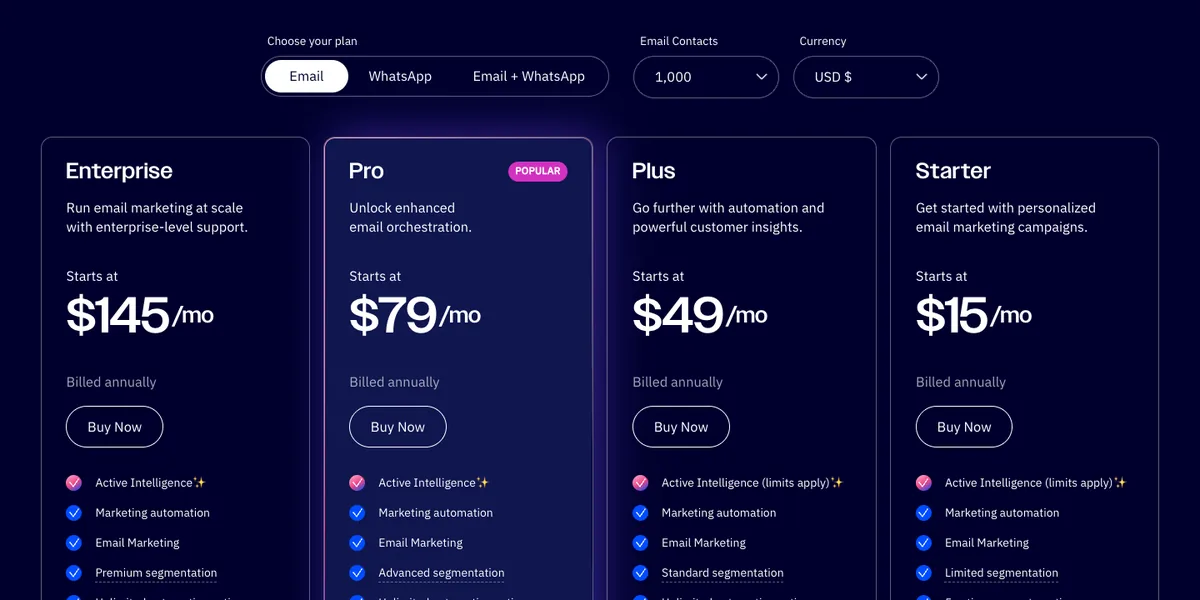
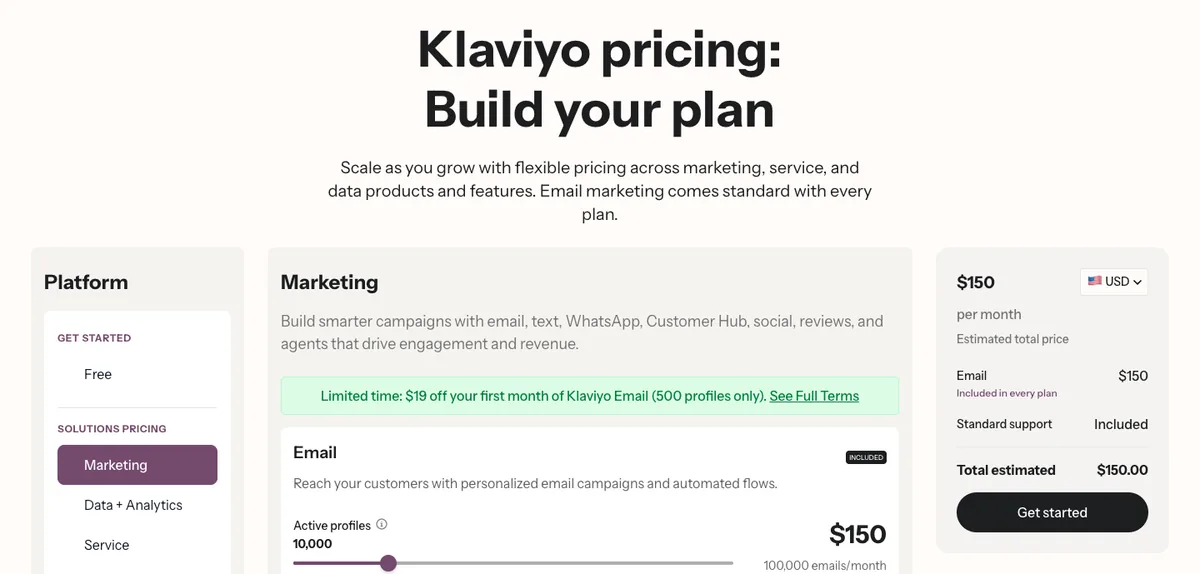
Monthly list prices in USD from each vendor’s pricing page on 10 October 2026. ActiveCampaign is billed annually here, the only billing its page prices; Klaviyo bills monthly.
| Contacts | Klaviyo (email) | ActiveCampaign Starter | ActiveCampaign Plus | ActiveCampaign Pro |
|---|---|---|---|---|
| 1,000 | $30 | $15 | $49 | $79 |
| 5,000 | $100 | $79 | $145 | $205 |
| 10,000 | $150 | $149 | $189 | $375 |
| 50,000 | $720 | Not available* | $609 | $969 |
*Starter tops out at 25,000 contacts. Enterprise is $145 a month at 1,000 contacts and $589 at 10,000, billed annually.
What the table doesn’t show:
- Billing terms don’t match. ActiveCampaign’s pricing page lists annual-billing prices only (checked 10 October 2026), so month-to-month prices aren’t published there. Confirm them in checkout or with sales before you compare against Klaviyo, which bills monthly.
- What Starter leaves out. Starter limits each automation to five actions, has no browse abandonment and offers limited segmentation. Most stores comparing like for like end up on Plus.
- CRM and SMS cost extra. The Pipelines and Sales Engagement CRM add-ons and SMS are priced on top of the plan. Our ActiveCampaign pricing breakdown covers them.
- Who counts. Klaviyo bills active profiles: anyone you can email, including buyers who never subscribed. Since February 2025 your plan must cover the whole count. ActiveCampaign prices on contacts.
So: on email list price, Starter beats Klaviyo to 10,000 contacts, Plus is dearer until about 25,000 and cheaper after, and Pro costs more at every size. Add a sales CRM to the Klaviyo side and ActiveCampaign is usually the cheaper stack for a B2B business.
Deliverability and reporting
Both platforms run strong sending infrastructure. Deliverability in practice depends far more on list hygiene, segmentation and sending behaviour than on the platform. Neither has a structural advantage for a well-run account. Klaviyo’s suppression handling, bounce processing and Email Health dashboard are more visible to a marketer who isn’t a deliverability specialist.
Klaviyo’s reporting is ecommerce-native: revenue by flow and campaign, revenue per recipient, conversion tied to orders, lifetime value tracking and benchmarks. It’s built for a DTC operator who wants to know how much money email made.
ActiveCampaign’s reporting is engagement and sales native: opens, clicks, automation progress, and with the CRM add-ons, pipeline and deal reporting. Revenue reporting needs the ecommerce integration passing order data.
Pros and cons
Klaviyo pros
- Native ecommerce events on every profile, usable in segments, flow triggers and splits
- Deep Shopify, WooCommerce, BigCommerce and Magento integrations with order backfill
- Predicted lifetime value, churn risk and next order date
- SMS on the same profile and in the same flows as email
- Free plan with flows included
Klaviyo cons
- No sales CRM: no deals, pipelines or rep tasks
- Bills every emailable profile, so an unpruned list costs you
- Dearer than ActiveCampaign Starter for small lists
- Built for B2C; lead-nurture B2B funnels fit awkwardly
ActiveCampaign pros
- Marketing automation and a sales CRM from one vendor
- Lead scoring, deal pipelines and account records with the Pipelines add-on
- Starter is cheap for small lists on annual billing
- Strong for long B2B and services nurture sequences
- Connects to Salesforce, Dynamics, Pipedrive and Zoho
ActiveCampaign cons
- Ecommerce depth stops short of Klaviyo’s, and premium store integrations need Pro
- Branching often relies on tags and fields you maintain
- CRM pipelines and SMS are add-ons on top of the plan
- No free plan; Starter caps automations at five actions
- One user on Starter and Plus
Klaviyo questions ActiveCampaign buyers ask
What are the weaknesses of Klaviyo?
For a business weighing ActiveCampaign, the big one is that Klaviyo has no sales CRM. There are no deal pipelines, no account records and no rep tasks, so a team that sells to wholesale buyers or other businesses needs a second tool. It also bills every profile you can email, SMS is billed per message on top, and its default attribution windows can make email look bigger than it is. Our Klaviyo review covers each weakness and how to work around it.
Why is Klaviyo so expensive?
It bills on active profiles, not sends. Since February 2025 your plan must cover every profile you can email, including customers who bought once and never subscribed, so a store with a big customer file pays for all of it. That’s why ActiveCampaign Starter looks cheap next to it at 1,000 contacts ($15 against $30). Suppress profiles that never engage and the gap narrows fast. The full tier table is in our Klaviyo pricing guide.
Who is Klaviyo’s biggest competitor?
It depends on the job. For B2B and sales-led teams, ActiveCampaign and HubSpot, because both pair automation with a CRM. For Shopify stores at growth stage it’s Omnisend, and for small stores Mailchimp. For SMS-first brands it’s Attentive and Postscript. Our Klaviyo alternatives guide compares twelve by use case.
If you’re ready to switch
Moving from ActiveCampaign to Klaviyo is a translation job:
- Export contacts with custom fields and tags. Map behavioural tags (purchase history, product interests) to Klaviyo profile properties, and replace purchase-based tags with segments built on order data.
- Connect your store first. Let Klaviyo backfill order history before you import contacts, so profiles arrive with purchase data attached.
- Rebuild automations as flows. Don’t copy ActiveCampaign logic one for one. Klaviyo’s native triggers usually make the flows simpler.
- Suppress unsubscribes before anything sends. That’s a legal requirement under CAN-SPAM and GDPR, not just good practice.
- Cut over in order and warm up. Don’t send from both platforms at once, and start Klaviyo sends with your most engaged contacts.
Deals and pipelines stay in ActiveCampaign or move to a CRM, because Klaviyo doesn’t hold them. Our ActiveCampaign to Klaviyo migration service runs the whole move in 3 to 4 weeks, fixed scope, starting with a free audit.
The bottom line
Both are solid tools within their domains. The expensive mistake is buying the one that matches your ambition instead of your business model, then configuring around its gaps for years. If you’re not really an ecommerce business, ActiveCampaign is often both the better tool and the better value, and we’ll tell you that before you migrate, not after.
If you’re an ecommerce brand hitting the ceiling on ActiveCampaign’s flows and revenue attribution, that’s what our Klaviyo agency team fixes for a living. Book a free audit and we’ll diagnose your setup first. If ActiveCampaign is the right home for your business, we’ll say so.
Sources
- ActiveCampaign Pricing: plans, contact tiers, billing terms, users, add-ons and plan features (10 October 2026)
- Klaviyo Pricing (email plans and mobile messaging, October 2026)
- Klaviyo Help Center, How Klaviyo billing works
- Klaviyo, Ecommerce Benchmarks
/ Frequently Asked Questions
Q.01 Is ActiveCampaign a CRM? +
/ Answer
Partly, and fully with an add-on. Every ActiveCampaign plan includes contact-level CRM features: contact profiles, custom fields, tags and lists, plus integrations with CRMs such as Salesforce and Pipedrive. Deal pipelines, deal and account records and lead scoring come with its Pipelines add-on, sold on Plus, Pro and Enterprise. Klaviyo calls itself a B2C CRM, but it has no deal pipelines, so a sales team needs a separate CRM alongside it.
Q.02 Is ActiveCampaign cheaper than Klaviyo? +
/ Answer
It depends on the plan. As of 10 October 2026, billed annually, ActiveCampaign Starter is $15 a month at 1,000 contacts against Klaviyo's $30, and $149 against $150 at 10,000. Plus is dearer than Klaviyo up to 10,000 contacts ($189 against $150) and cheaper at 50,000 ($609 against $720). Pro is dearer throughout. For a business that needs a sales CRM, ActiveCampaign is usually the cheaper stack, because Klaviyo needs a second tool for pipelines.
Q.03 Which is better for Shopify, ActiveCampaign or Klaviyo? +
/ Answer
For a Shopify store whose email and SMS run on order, browse and cart data, Klaviyo. Its Shopify integration puts orders, products, checkouts and on-site browsing on one profile and backfills order history, and its flows can branch on any of it. ActiveCampaign connects to Shopify on every plan and adds browse abandonment and product blocks from Plus up, which covers the basics for a store that mainly needs sales follow-up.
Q.04 Does ActiveCampaign have a free plan? +
/ Answer
No. As of 10 October 2026, ActiveCampaign offers a 14-day free trial and a 30-day money-back guarantee, then paid plans from $15 a month for 1,000 contacts billed annually. Klaviyo has a free plan for up to 250 active profiles and 500 emails a month, with flows included.
Q.05 How long does it take to move from ActiveCampaign to Klaviyo? +
/ Answer
Three to four weeks for most accounts. Tags are translated into Klaviyo profile properties, automations are rebuilt as flows rather than copied, unsubscribes are suppressed before anything sends, and sending is warmed up on your most engaged contacts. Deals and pipelines stay behind, because Klaviyo is not a sales CRM.
Shows our articles higher in your Google results. Takes one click.