Klaviyo vs MailerLite (2026): Pricing and Ecommerce Fit
Klaviyo vs MailerLite in 2026: prices from 1,000 to 50,000 subscribers, what each free plan includes, and the point where an online store outgrows MailerLite.

Table of contents
- Klaviyo vs MailerLite at a Glance
- Klaviyo vs MailerLite Pricing (October 2026)
- Why is Klaviyo so expensive?
- MailerLite Is Newsletter-First; Klaviyo Is Ecommerce-First
- Where MailerLite Wins
- Where Klaviyo Wins for Ecommerce
- Pros and Cons
- Klaviyo
- MailerLite
- What are the weaknesses of Klaviyo?
- When to Stay on MailerLite
- When to Migrate to Klaviyo
- Who is Klaviyo’s biggest competitor?
- Practical Recommendation
- Sources
MailerLite is the better choice for newsletters, small lists and businesses that don’t sell products online: it costs less at every list size, $49 a month for 5,000 subscribers on Comfort against Klaviyo’s $100. Klaviyo is the better choice once an online store wants revenue from abandoned cart, post-purchase and other flows driven by order and browsing data.
MailerLite is one of the cleanest entry-level email platforms there is. It’s affordable, well designed, and does newsletters and basic automation well. The question for an ecommerce brand isn’t whether MailerLite is good. It’s whether what it does is enough, or whether you’ve outgrown it.
A note on where we stand: we’re an official Klaviyo partner and we run MailerLite to Klaviyo migrations, so we have a stake. That’s why the cases where MailerLite wins are spelled out below, and why every price comes from the vendors’ own pricing pages, checked on 10 October 2026.
Klaviyo vs MailerLite at a Glance
| Klaviyo | MailerLite | |
|---|---|---|
| Built for | Ecommerce and DTC brands | Newsletters, creators and small businesses |
| Free plan | 250 profiles, 500 emails a month | 250 subscribers, 2,500 emails a month, 2 user seats |
| Paid plans | One email plan priced on active profiles, SMS on top | Comfort (from $12), Power (from $25), Enterprise (custom) |
| Price at 5,000 contacts | $100 a month | $49 (Comfort) or $69 (Power) a month |
| Monthly sends | Ten per profile on paid plans | Comfort: ten times your subscriber tier; Power: unlimited, under fair use |
| Store data | Native Shopify, WooCommerce, BigCommerce, Magento: full order history, catalogue, browsing | Store integrations with shallower event data |
| Segmentation | Behaviour, purchase history and predicted value | Fields, groups, activity and basic purchase data |
| Predictive analytics | Predicted CLV, churn risk, next order date | No |
| Extras | Reviews add-on, SMS, mobile push | Websites, landing pages, digital products and bookings |
| Testing | A/B tests in campaigns and flows | A/B and multivariate testing |
Monthly prices in USD on monthly billing, as of October 2026.
Klaviyo vs MailerLite Pricing (October 2026)
MailerLite is much cheaper than Klaviyo at every list size. Monthly prices in USD, from each vendor’s pricing page on 10 October 2026:
| Subscribers / active profiles | MailerLite Comfort | MailerLite Power | Klaviyo (email) |
|---|---|---|---|
| 1,000 | $19 | $39 | $30 |
| 5,000 | $49 | $69 | $100 |
| 10,000 | $89 | $129 | $150 |
| 25,000 | $179 | $239 | $400 |
| 50,000 | $319 | $389 | $720 |
MailerLite on monthly billing; paying yearly saves 10%. Both have free plans up to 250 contacts.
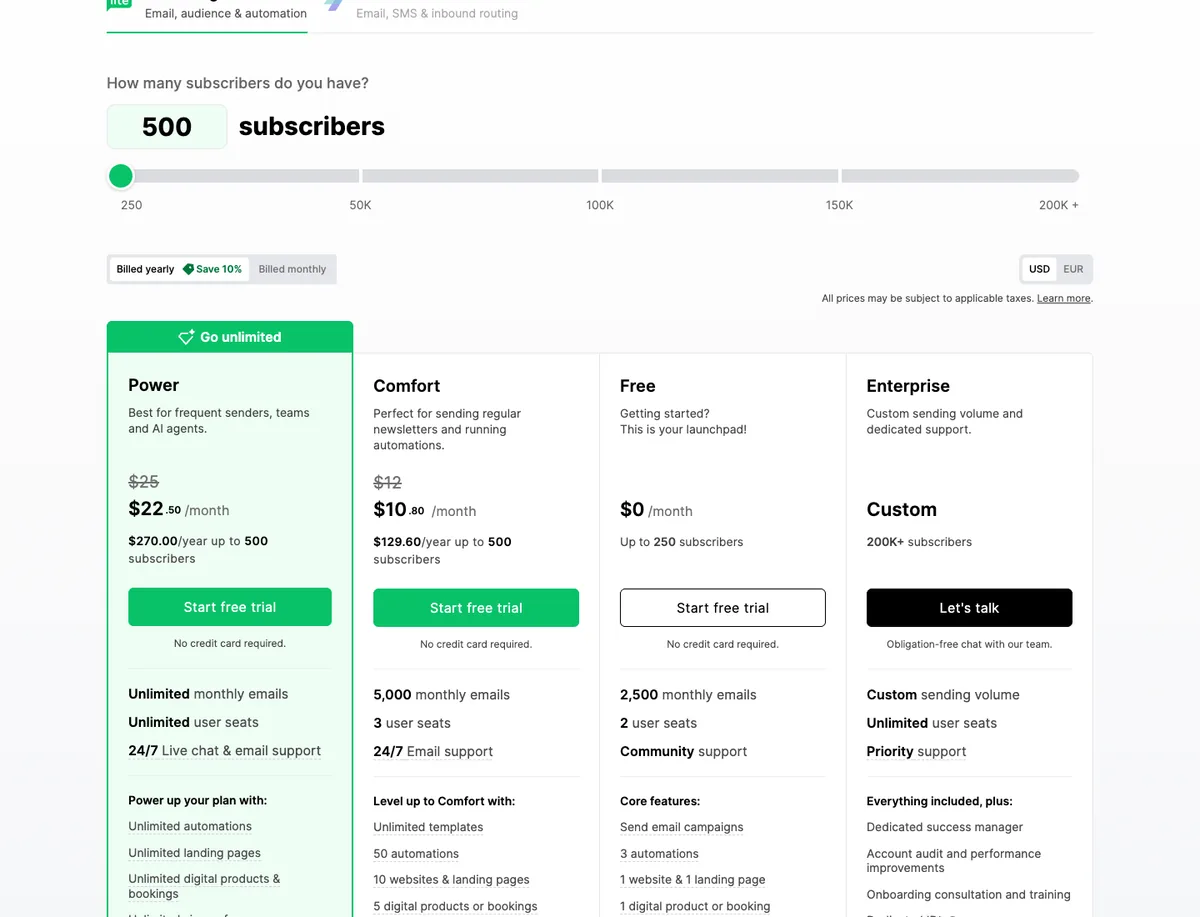
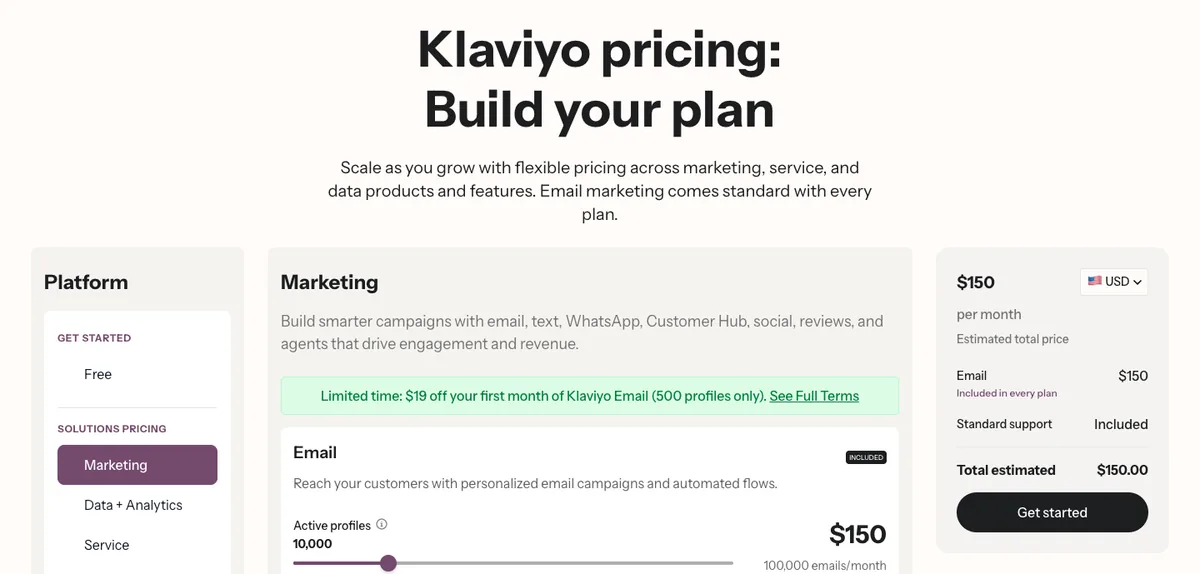
Klaviyo costs roughly 1.6 to 2.3 times MailerLite Comfort. The plans also differ in what they include: MailerLite Comfort caps sends at ten times your subscriber tier and Power lifts the cap; Klaviyo’s paid tiers include ten sends a month per profile, and SMS is a separate monthly plan. Our MailerLite pricing and Klaviyo pricing guides have every tier.
The price gap is real. Klaviyo only earns it back if your email does work MailerLite can’t: flows that branch on what people bought and browsed, and segments built on predicted value. For a store with real order volume that’s usually the case. For a small list or a non-ecommerce business, MailerLite’s price matters more.
Why is Klaviyo so expensive?
Next to MailerLite, it is: $150 against $89 at 10,000 subscribers. You’re paying for the data model. Klaviyo bills on active profiles, everyone you can email, and every profile carries orders, browsing and predictions that flows and segments use. Since February 2025 your plan has to cover that full count, so suppressing people who never engage is the fastest way to cut the bill. The Klaviyo pricing guide shows the tiers and where they jump.
MailerLite Is Newsletter-First; Klaviyo Is Ecommerce-First
MailerLite’s design assumes you’re sending newsletters and broadcasts to a list. The interface is excellent for that. Ecommerce events and store data are there, but they’re not what the product is built around.
Klaviyo’s architecture is built around ecommerce: behavioural events, catalogue integration, predictive analytics and revenue attribution. Newsletters work fine, but they’re not the main use case.
For an online store at any real scale, that difference matters. Most ecommerce email revenue comes from automated flows (welcome, abandoned cart, post-purchase, replenishment, win-back) triggered by behaviour. MailerLite handles autoresponders well, but the triggering depth, store data and segmentation for those flows are limited.
Where MailerLite Wins
Price. Cheaper at every list size, and a generous free plan: 250 subscribers and 2,500 emails a month.
A clean, fast editor. Drag and drop, custom HTML and a simple text editor, all on the free plan. Newsletter design is quick and pleasant.
Ease of use. Simple to set up, simple to send, simple to manage.
Websites, landing pages and digital products. MailerLite includes a website and landing page builder, and Power adds selling digital products and bookings. Small businesses can run more of their marketing in one place.
Testing on a budget. Comfort includes multivariate testing, dynamic emails and campaign auto-resend.
Where Klaviyo Wins for Ecommerce
Store data depth. Klaviyo’s native Shopify integration brings in full order history, the product catalogue and on-site behaviour, and backfills your history on day one.
Behavioural flows. A full ecommerce flow library: welcome, abandoned cart, browse abandonment, post-purchase, replenishment, win-back and back in stock, branching on any profile property or event.
Segmentation. Real-time segments on behaviour, purchase history and predicted properties, combined however you need.
Predictive analytics. Predicted CLV, churn risk and next order date, native to Klaviyo.
SMS on the same profile. Email and SMS in one flow, with one consent record and one report.
Reporting that maps to revenue. Klaviyo reports revenue per recipient, flow contribution and attributed orders.
Pros and Cons
Klaviyo
Pros
- Built on store data: orders, catalogue and browsing on every profile
- Ecommerce flow library with conditional logic
- Predictive analytics and revenue reporting
- SMS and email on one profile
Cons
- Roughly 1.6 to 2.3 times the price of MailerLite Comfort
- Tighter free plan: 500 emails a month
- Steeper learning curve
- No website builder
MailerLite
Pros
- Cheapest of the two at every list size
- Generous free plan with 2,500 emails a month
- Clean editors, websites and landing pages included
- Power plan lifts the send cap
Cons
- Shallower store data and behavioural triggers
- No predictive analytics
- Reporting centred on engagement rather than revenue
What are the weaknesses of Klaviyo?
Against MailerLite, the weaknesses are price and complexity: it costs more at every list size, the free plan is smaller, and it takes longer to learn. Across the board, cost rises with every active profile, SMS is billed per message on top, and it’s built for B2C ecommerce, so it does little for a non-ecommerce business. Our Klaviyo review covers each one.
When to Stay on MailerLite
- Pre-launch or very early ecommerce. You’re building your first list and sending occasional newsletters, with no real automation needs yet.
- A side business or small business with simple email needs. Lists under about 5,000, email isn’t meant to be a main revenue channel, and you mostly broadcast.
- A non-ecommerce business. Services, B2B-light or content. The ecommerce gap doesn’t apply.
When to Migrate to Klaviyo
Migrate when:
- You’re past a few thousand active subscribers and growing
- You want abandoned cart, browse abandonment, post-purchase or replenishment flows that branch on order and product data
- You suspect email should be a bigger share of revenue than it is
- You’re spending on paid acquisition and want email retention to compound it
- You can’t tell from MailerLite’s reports what email contributes to revenue
The move is straightforward: two to three weeks for most accounts, covering templates, automations, contact import and authentication. Our MailerLite to Klaviyo migration page has the detail.
Who is Klaviyo’s biggest competitor?
For small online stores, MailerLite is one of several. The rivals Klaviyo meets most are Mailchimp and Omnisend for small and mid-size stores, Attentive and Postscript for SMS, and Braze and Iterable at enterprise scale. Our Klaviyo alternatives guide compares them by use case.
Practical Recommendation
Online stores where email is meant to drive repeat revenue: Klaviyo. The flows, store data and revenue reporting are what MailerLite’s newsletter-first design wasn’t built for.
Pre-launch stores, small side businesses and non-ecommerce businesses: MailerLite is fine. It does what it does well, for less.
The stores that underperform are the ones that stay on MailerLite past the point where store data matters. If you’re there, or not sure, book a free audit. We’ll review your account and tell you honestly whether the move is worth it.
Sources
Checked 10 October 2026:
- MailerLite, Pricing (plan prices by subscriber tier, monthly and yearly; free plan limits)
- Klaviyo, Pricing
/ Frequently Asked Questions
Q.01 Is Klaviyo better than MailerLite? +
/ Answer
For an online store that wants email to drive repeat purchases, yes. Klaviyo puts every order, product view and cart on one profile, and its flows, segments and predictions use all of it. For newsletters, creators, service businesses and small lists, MailerLite is easier and much cheaper. The deciding question is whether email is a revenue channel driven by store data or a broadcast channel.
Q.02 Is MailerLite cheaper than Klaviyo? +
/ Answer
Yes, at every list size. As of October 2026, MailerLite Comfort costs $19 a month for 1,000 subscribers, $49 for 5,000, $89 for 10,000 and $319 for 50,000 on monthly billing, with 10% off for paying yearly. Klaviyo's email plan is $30, $100, $150 and $720 at the same sizes, so it costs roughly 1.6 to 2.3 times MailerLite Comfort. MailerLite's free plan also allows 2,500 emails a month to Klaviyo's 500.
Q.03 Is MailerLite a CRM? +
/ Answer
Not in the sales sense. MailerLite is an email marketing platform with subscriber management, segmentation, automations, sign-up forms, landing pages and websites. It has no deal pipelines. Klaviyo calls itself a B2C CRM because every profile holds orders, browsing and predicted value, but it isn't a sales CRM either.
Q.04 What are the weaknesses of Klaviyo compared with MailerLite? +
/ Answer
Price, first: roughly 1.6 to 2.3 times MailerLite Comfort at every list size, with SMS billed on top. Its free plan is tighter, at 500 emails a month against MailerLite's 2,500. It has a steeper learning curve, and it has no website builder. Its strengths only pay off if you sell products online and build the flows and segments that use your store data.
Q.05 When should an online store move from MailerLite to Klaviyo? +
/ Answer
When you want abandoned cart, browse abandonment, post-purchase and replenishment flows that branch on order and product data, when you need to see what email contributes to revenue, or when you're adding SMS. Most stores reach that point somewhere past a few thousand subscribers, once email is meant to be a real share of revenue. A typical move takes two to three weeks.
Shows our articles higher in your Google results. Takes one click.