Klaviyo vs SendGrid and Twilio SMS (2026): Which to Use
Klaviyo vs SendGrid and Twilio SMS in 2026: marketing vs transactional email, prices at 5,000 to 50,000 contacts, cost per 1,000 texts, and why stores run both.

Table of contents
- Klaviyo vs SendGrid vs Twilio SMS at a Glance
- Klaviyo vs SendGrid Pricing (October 2026)
- Marketing email: Klaviyo vs SendGrid Marketing Campaigns
- Transactional email: the SendGrid Email API
- Why is Klaviyo so expensive?
- Twilio’s SMS API
- What Twilio SMS costs
- Where Twilio wins
- Where Klaviyo wins for marketing SMS
- Where SendGrid Wins
- Where Klaviyo Wins
- Pros and Cons
- Klaviyo
- Twilio SendGrid
- Twilio SMS API
- What are the weaknesses of Klaviyo?
- The Common Mistake
- When to Use Each
- Who is Klaviyo’s biggest competitor?
- Practical Recommendation
- Sources
Klaviyo is the better choice for ecommerce marketing email and SMS, because flows, segments and revenue reporting come built in and a marketer can run them without engineers. Twilio SendGrid is the better choice for transactional email and developer-built sending, and Twilio’s SMS API for texts your own product sends, which is why the common setup keeps receipts on SendGrid and marketing on Klaviyo.
The two aren’t really rivals. Per Twilio’s customer story, Klaviyo itself sends around 10 billion emails a month through the SendGrid Email API and uses Twilio’s Programmable Messaging for SMS. SendGrid and Twilio are the pipes; Klaviyo is the marketing system on top. The comparison usually comes up when a developer-led team defaults to SendGrid for everything, marketing included, or builds marketing texts on Twilio’s API.
A note on where we stand: we’re an official Klaviyo partner, so we have a stake. That’s why every price below comes from the vendors’ own pricing pages, checked on 10 October 2026, and why we say plainly where SendGrid and Twilio are the right tool.
Klaviyo vs SendGrid vs Twilio SMS at a Glance
| Klaviyo | Twilio SendGrid | Twilio SMS API | |
|---|---|---|---|
| Built for | Marketers at ecommerce brands | Developers (Email API); simple marketing email (Marketing Campaigns) | Developers building messaging into a product |
| What you get | A finished marketing platform: forms, flows, segments, templates, reporting | Email delivery infrastructure, plus a basic marketing email tool | An API to send and receive SMS and MMS |
| Marketing email and flows triggered by store events | Transactional (Email API) and marketing (Marketing Campaigns) | No (that’s SendGrid) | |
| SMS | Built in, with consent capture and flows | No | Yes; you build consent, flows and reporting |
| Store integrations | Native Shopify, WooCommerce, BigCommerce, Magento | Contact sync through integrations or your own code | Your own code, or Twilio Segment |
| Reporting | Revenue per recipient, attributed orders, flow contribution | Delivery, opens, clicks, bounces, spam reports | Delivery status; revenue is yours to build |
| Pricing basis | Active profiles, plus SMS per message | Contacts stored and emails sent | Per message segment, plus carrier and registration fees |
| Price at 10,000 contacts | $150 a month (email) | $25 a month (Marketing Campaigns Basic) | $0.0083 per US SMS segment |
Monthly prices in USD, as of October 2026.
Klaviyo vs SendGrid Pricing (October 2026)
Marketing email: Klaviyo vs SendGrid Marketing Campaigns
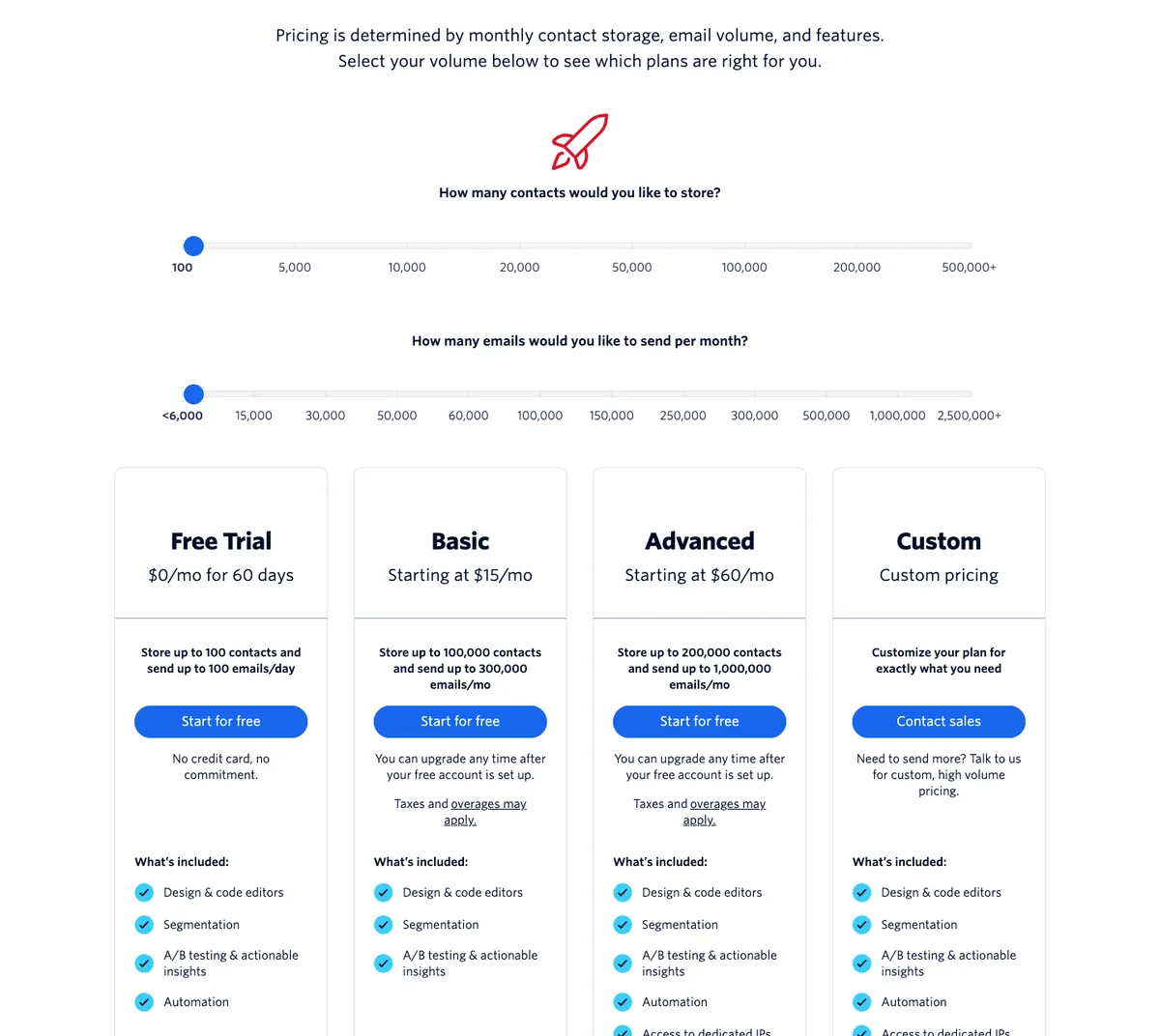
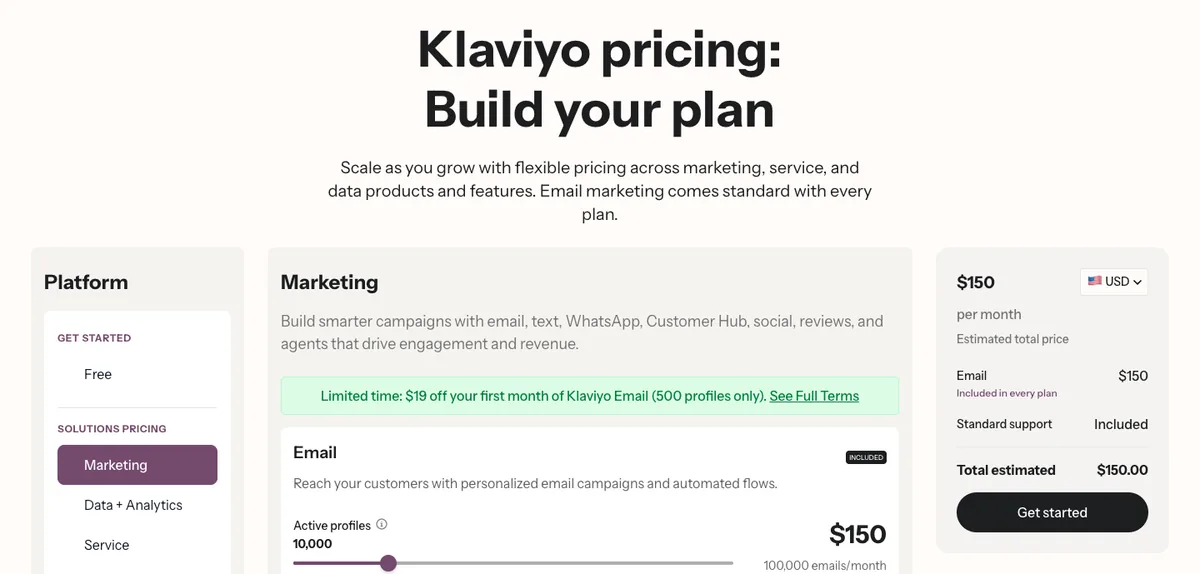
SendGrid Marketing Campaigns prices on contacts stored and emails sent. Klaviyo prices on active profiles, and each tier includes ten emails a month per profile. Monthly list prices in USD, from each vendor’s pricing page on 10 October 2026:
| Contacts | Klaviyo (email) | SendGrid Basic | SendGrid Advanced |
|---|---|---|---|
| 5,000 | $100 (50,000 sends) | $15 (15,000 emails) | $60* (50,000 emails) |
| 10,000 | $150 (100,000 sends) | $25 (30,000 emails) | $60 (50,000 emails) |
| 50,000 | $720 (500,000 sends) | $120 (150,000 emails) | $250 (250,000 emails) |
*Advanced starts at 10,000 contacts. SendGrid Marketing Campaigns has a 60-day free trial at 100 emails a day; Klaviyo is free up to 250 profiles and 500 emails a month.
Transactional email: the SendGrid Email API
The Email API is priced on volume alone. As of October 2026: Essentials is $19.95 a month for 50,000 emails and $34.95 for 100,000; Pro, which includes dedicated IPs, is $89.95 for 100,000 and $249 for 300,000; Premier is quoted. There’s a 60-day free trial at 100 emails a day. For receipts, shipping notices and password resets, that’s hard to beat.
Why is Klaviyo so expensive?
Next to SendGrid, it is: $150 a month against $25 at 10,000 contacts. The difference is what you’re buying. SendGrid stores contacts and sends email. Klaviyo bills on active profiles, everyone you can email, and each profile carries orders, browsing and predictions that its flows and segments use, with revenue reporting on top. Since February 2025 your plan has to cover every active profile, so a list full of people who never open keeps you a tier higher than you need. Suppress them and the bill drops. Every tier is in our Klaviyo pricing guide.
Twilio’s SMS API
Twilio sells building blocks, not a marketing tool:
- Programmable Messaging: an API to send and receive SMS, MMS and other messages.
- Twilio SendGrid: the Email API and Marketing Campaigns, covered above.
- Twilio Segment: a customer data platform that collects events and passes them to other tools.
Every message, rule and report is something your developers wire up. Klaviyo sells the finished layer: SMS consent on its sign-up forms, SMS steps in the same flows as email, and one report for both.
What Twilio SMS costs
US rates on Twilio’s pricing page, as of 10 October 2026:
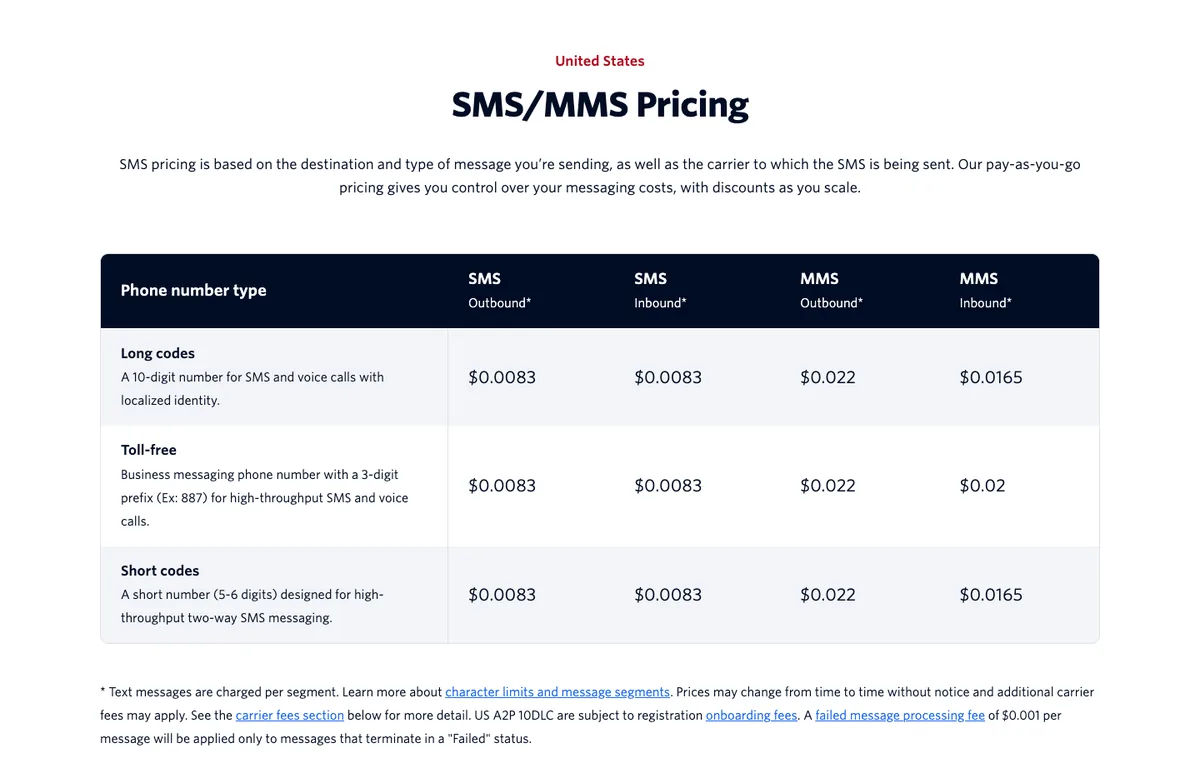
- SMS: $0.0083 per segment, outbound or inbound, on long codes, toll-free numbers and short codes.
- MMS: $0.022 per outbound message.
- Carrier fees on top, per outbound SMS on long codes: $0.0035 on AT&T, $0.0045 on T-Mobile and $0.005 on Verizon.
- A2P 10DLC registration for long-code senders: a one-time brand fee of $4.50 (sole proprietor or low-volume standard) to $46 (standard), a $15 campaign vetting fee, and a monthly campaign fee, $10 for a standard campaign.
- Failed messages cost $0.001 each.
Here’s what that comes to against Klaviyo’s SMS plans, which include carrier fees:
| US texts a month | Twilio (message fee plus carrier fees) | Klaviyo (US toll-free plan) |
|---|---|---|
| 1,000 | $11.80 to $13.30 | $15 |
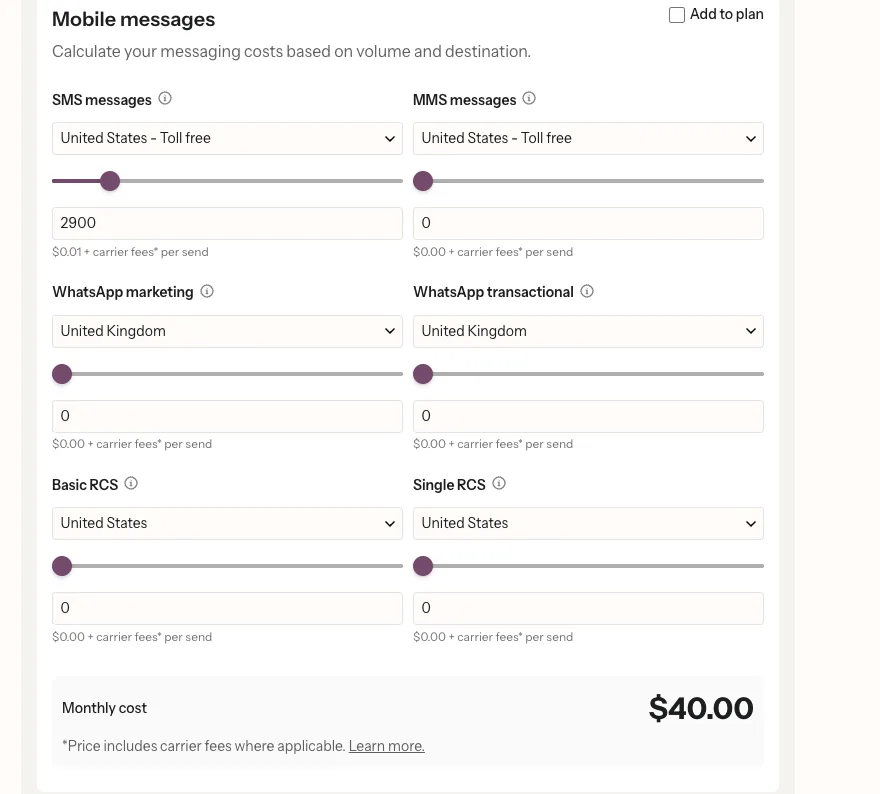
| 2,900 | $34.22 to $38.57 | $40 |
| 10,000 | $118 to $133 | $125 |
Twilio figures assume single-segment texts and exclude 10DLC fees and any volume discount. Klaviyo prices from its calculator, October 2026.
On message cost alone, Twilio is a little cheaper, and volume discounts can widen the gap. On total cost, the comparison flips for most ecommerce brands. With Twilio, consent capture, opt-out handling, flows, segmentation, suppression and revenue reporting are all engineering work you pay for and maintain.
Where Twilio wins
- Messaging that’s part of your product: logins, alerts, delivery updates and two-way support, triggered from your own code.
- Programmable control over every message and route.
- Per-message cost, for teams that already have the engineers to build on it.
Where Klaviyo wins for marketing SMS
- It’s already built. Welcome, abandoned cart, browse, post-purchase and win-back flows with email and SMS steps in the same flow.
- Consent and compliance tooling. Sign-up forms with SMS consent steps, opt-out handling and suppression built in.
- Store data on every profile, ready for segments and dynamic content.
- One report for email and SMS revenue.
Moving marketing texts from Twilio to Klaviyo: export subscribers with consent timestamps and sources, import them with consent preserved and opt-outs suppressed, register your sending numbers in Klaviyo, and rebuild the coded journeys as flows. Keep Twilio for transactional and product messages, and decide which system owns consent so opt-outs are honoured everywhere. This isn’t legal advice; check SMS registration and consent rules for your market with your own counsel.
Where SendGrid Wins
Transactional email at scale. Order confirmations, shipping notifications and account email are what the Email API is built for, and at $19.95 a month for 50,000 emails it’s cheap. Many ecommerce brands run transactional mail through SendGrid (or Postmark, Amazon SES or Mailgun) and marketing through Klaviyo.
Developer-driven workflows. API-first, well documented, and built for email sent from server-side logic.
Low cost per contact for simple marketing email. If you only send newsletters to a clean list, Marketing Campaigns Basic at $25 a month for 10,000 contacts is a fraction of any ecommerce platform.
Inbound parsing and event webhooks for transactional workflows. Klaviyo is focused on outbound marketing.
Where Klaviyo Wins
Marketing automation. A drag-and-drop flow builder and an ecommerce flow library: welcome, abandoned cart, browse abandonment, post-purchase, replenishment, win-back, back in stock. SendGrid Marketing Campaigns has automation, but nothing triggered by your store’s events out of the box.
Store integration. Native Shopify, BigCommerce, WooCommerce and Magento integrations put order history, catalogue and browsing on each profile. SendGrid syncs contacts.
Reporting that maps to revenue. Klaviyo reports revenue per recipient, flow contribution and attributed orders. SendGrid reports delivery and engagement.
Marketer-run. Klaviyo is built for marketers to use without engineering support.
Predictive analytics. Predicted CLV, churn risk and next order date, native to Klaviyo.
Pros and Cons
Klaviyo
Pros
- Store data, flows, segments and revenue reporting built in
- Email and SMS on one profile, in one flow builder
- A marketer can run it without engineers
- Free plan up to 250 profiles
Cons
- Much dearer per contact than SendGrid: $150 against $25 at 10,000
- Not built for high-volume transactional infrastructure
- Cost rises with every active profile, engaged or not
Twilio SendGrid
Pros
- Cheap, reliable transactional email from $19.95 a month
- Developer-first API, webhooks and inbound parsing
- Low-cost Marketing Campaigns for simple newsletters
Cons
- No store-event flows or ecommerce segments out of the box
- Reporting stops at delivery and engagement
- Marketing use usually needs developer help
Twilio SMS API
Pros
- Low per-message cost, with volume discounts
- Full programmable control for product messaging
Cons
- Carrier, 10DLC registration and monthly campaign fees on top
- Consent, flows, segments and reporting are yours to build and maintain
What are the weaknesses of Klaviyo?
Against SendGrid and Twilio, Klaviyo’s weakness is price per contact and per message, and it isn’t the tool for transactional infrastructure at scale. Its other weaknesses apply to every brand: cost rises with active profiles, SMS is billed on top of email, and it’s built for B2C, so sales-led teams need a separate CRM. Our Klaviyo review goes through each one.
The Common Mistake
Developer-led ecommerce teams sometimes put everything on SendGrid and Twilio early, because the dev team owns email and messaging and that’s what they know. As marketing email and SMS become real revenue channels, the setup hits limits:
- Welcome, abandoned cart and post-purchase flows need custom development
- Segmentation is shallow, because the platform isn’t built around order and browsing data
- Reporting doesn’t show what email and SMS contribute to revenue
- Marketers can’t run campaigns without a ticket to engineering
The fix is the standard split: SendGrid (or equivalent) for transactional email, Twilio for product messages, Klaviyo for marketing email and SMS. Moving marketing email from SendGrid to Klaviyo is usually quick, because the marketing setup on SendGrid tends to be small.
When to Use Each
Use SendGrid for order confirmations, shipping notifications, password resets and application email, or if you’re building a custom commerce platform where email is part of the application.
Use Twilio’s SMS API when texts are part of your product: codes, alerts, delivery updates and support conversations.
Use Klaviyo for marketing email and SMS: behavioural flows, segmented campaigns, revenue reporting and testing, run by marketers.
Who is Klaviyo’s biggest competitor?
Not SendGrid or Twilio: they supply Klaviyo’s delivery. For marketing email at small and mid-size stores, Klaviyo’s main rivals are Mailchimp and Omnisend. For SMS it’s Attentive and Postscript, and at enterprise scale Braze and Iterable. Our Klaviyo alternatives guide compares them by use case.
Practical Recommendation
Running marketing email through SendGrid: move marketing to Klaviyo, keep SendGrid for transactional.
Running marketing texts through custom Twilio code: move marketing SMS to Klaviyo, keep Twilio for product messages.
Using both already: keep them separate. Don’t consolidate marketing into SendGrid, and don’t move transactional mail into Klaviyo unless you specifically want Klaviyo’s transactional email option.
If you’re running marketing email or SMS on SendGrid or Twilio and want it on a proper marketing platform, book a free audit. We run ESP migrations to Klaviyo regularly, and our SMS marketing team moves subscribers over with consent intact.
Sources
Checked 10 October 2026:
/ Frequently Asked Questions
Q.01 Is Klaviyo better than SendGrid? +
/ Answer
For ecommerce marketing email, yes. Klaviyo has behavioural flows, segmentation and revenue reporting built in, fed by your store, and a marketer can run it without engineers. For transactional email such as order confirmations, password resets and other code-triggered sends, the Twilio SendGrid Email API is the better tool. They are different categories, and many stores use both.
Q.02 Is SendGrid owned by Twilio? +
/ Answer
Yes. SendGrid is part of Twilio and is sold as Twilio SendGrid, with an Email API for transactional sending and a Marketing Campaigns product for newsletters and simple automations. Twilio completed its acquisition of SendGrid in 2019. Twilio also sells SMS through its Programmable Messaging API and a customer data platform, Twilio Segment.
Q.03 How much does SendGrid cost compared with Klaviyo? +
/ Answer
As of October 2026, SendGrid Marketing Campaigns Basic costs $15 a month for 5,000 contacts, $25 for 10,000 and $120 for 50,000, and Advanced starts at $60. The SendGrid Email API starts at $19.95 a month for 50,000 emails. Klaviyo's email plan is $100 a month at 5,000 active profiles, $150 at 10,000 and $720 at 50,000. SendGrid is far cheaper per contact; Klaviyo's price pays for store data, flows, segmentation and revenue reporting.
Q.04 Is Twilio cheaper than Klaviyo for SMS? +
/ Answer
Per message, slightly. As of October 2026 Twilio charges $0.0083 per US SMS segment plus carrier fees of $0.0035 to $0.005 on the major carriers, so 1,000 single-segment texts cost about $11.80 to $13.30, before 10DLC registration and monthly campaign fees. Klaviyo's plan for 1,000 US toll-free texts is $15 a month with carrier fees included. On Twilio, consent capture, flows, segmentation and reporting are engineering work you pay for separately.
Q.05 Does Klaviyo use SendGrid and Twilio? +
/ Answer
According to Twilio's customer story, Klaviyo sends around 10 billion emails a month through the Twilio SendGrid Email API and uses Twilio's Programmable Messaging API for SMS. The story is undated, so treat it as Twilio's account rather than a current statement from Klaviyo. As a Klaviyo customer you never touch either: you buy Klaviyo, and it handles delivery.
Q.06 Why is Klaviyo more expensive than SendGrid? +
/ Answer
Because they sell different things. SendGrid prices contact storage and email volume: $25 a month covers 10,000 contacts and 30,000 emails on Marketing Campaigns Basic. Klaviyo prices active profiles, $150 a month at 10,000, and each profile carries orders, browsing and predictions that flows and segments use. Since February 2025 your Klaviyo plan must cover every active profile, so suppressing contacts who never engage is the quickest way to cut the bill.
Shows our articles higher in your Google results. Takes one click.