Klaviyo Pricing 2026: Every Tier, SMS Rates and Hidden Costs
Klaviyo pricing calculator and every 2026 tier: free to 250 profiles, $20 a month at 500, $150 at 10,000. SMS rates, add-ons and how to cut your bill.

Table of contents
- Klaviyo pricing at a glance
- Klaviyo pricing calculator
- How Klaviyo pricing works
- What counts as an active profile?
- How the bill is calculated
- The February 2025 billing change (this is the one that catches people out)
- Klaviyo pricing by list size: every email tier (2026)
- What Klaviyo’s free plan includes
- Is Klaviyo free on Shopify?
- Email + SMS: what a combined Klaviyo bill looks like
- Klaviyo SMS, MMS and WhatsApp pricing
- Klaviyo add-ons and what they cost
- Dedicated IPs and enterprise plans
- Klaviyo pricing in Australia and the UK
- Klaviyo vs Omnisend vs Mailchimp: price at three list sizes
- Why is Klaviyo so expensive? The hidden costs
- Is Klaviyo worth it for small brands?
- How to lower your Klaviyo bill
- How to make Klaviyo pay for itself
- The bottom line
- Sources
Klaviyo is free for up to 250 active profiles. After that, the email plan starts at $20 a month for 500 profiles and scales with your list: $150 a month at 10,000 profiles, $400 at 25,000, $720 at 50,000 and $1,380 at 100,000. SMS, WhatsApp and add-ons such as Klaviyo Reviews are billed on top. Every price here is in US dollars, taken from Klaviyo’s pricing page and help centre on 1 October 2026, with the email, SMS and add-on prices rechecked on 10 October. To price your own account, use the calculator below.
That answers the question most brands ask about Klaviyo pricing, and it’s the wrong question. The one that actually decides your return is “how much revenue is our setup pulling out of it?” We have run Klaviyo across 800+ brands and $250M+ in attributed revenue, and the pattern is consistent: the subscription is almost never the expensive part. Under-using it is.
Below: every email tier Klaviyo publishes, what SMS and WhatsApp cost by country, the add-ons, the billing rules that quietly raise invoices, and how to get the bill down without losing revenue.
Klaviyo pricing at a glance
| What you pay for | How it’s priced | Price (October 2026) |
|---|---|---|
| Free plan | Up to 250 active profiles | $0, with 500 emails and $5 of mobile messages a month |
| Email plan | Active profiles | $20 at 500 profiles up to $1,955 at 150,000 |
| Mobile messages | Monthly plan, rate per message by channel and country | From $15 a month (1,000 US texts) |
| Reviews | Orders a month | Free to 50 orders, then from $25 |
| Marketing Analytics | Active profiles | From $100 |
| Customer Hub, Helpdesk, Customer Agent | Profiles, tickets or AI conversations | From $20, $10 and $50 |
| Support packages | Monthly fee | Standard included; Professional from $500 |
Klaviyo pricing calculator
Put in your active profiles, the texts you send each month and any add-ons. The calculator prices them from Klaviyo’s own published price lists, in US dollars, as of October 2026. It also tells you two things Klaviyo’s page doesn’t spell out: how close you are to the next tier, and how many profiles you’d have to suppress to drop one.
/ Your account
Everyone Klaviyo can email, including customers who bought without subscribing.
/ Estimated monthly bill
a month in USD, about $2,940 a year.
- Email: up to 10,500 profiles, 105,000 sends$175
- Mobile messages: 5,000 US toll-free texts$70
Next tier
Room for 100 more active profiles. At 10,501 the email plan goes to $200 a month, $25 more.
Drop a tier
Suppress 400 profiles to drop to the 10,000 tier at $150 for email. Your bill falls by $25 a month, $300 a year.
That is $2,940 a year. Enter it as your platform cost in our Klaviyo ROI calculator to see what the account has to earn.
Worked example: 10,400 active profiles and 5,000 US texts a month, no add-ons.
This is an estimate, not a quote. It leaves out:
- Tax, which Klaviyo calculates at checkout where it applies.
- Short code fees, which are billed outside the messaging plan.
- MMS, WhatsApp, and texts to countries other than the US, Australia and the UK.
- Advanced KDP, enterprise packages, Enterprise support and dedicated IPs.
- Flexible overages, and the difference you pay when an upgrade lands mid-cycle.
- Promotions, such as $19 off the first month of the 500-profile plan.
- Your bank’s fee for paying in US dollars, if your card is in another currency.
- The cost of running the account: your team’s time or an agency.
Texts to more than one country are added into a single mobile plan here, because one plan covers every country. Klaviyo’s own calculator prices one country at a time and suggests asking its sales team for multi-country estimates, so treat a mixed-country figure as a guide.
How Klaviyo pricing works
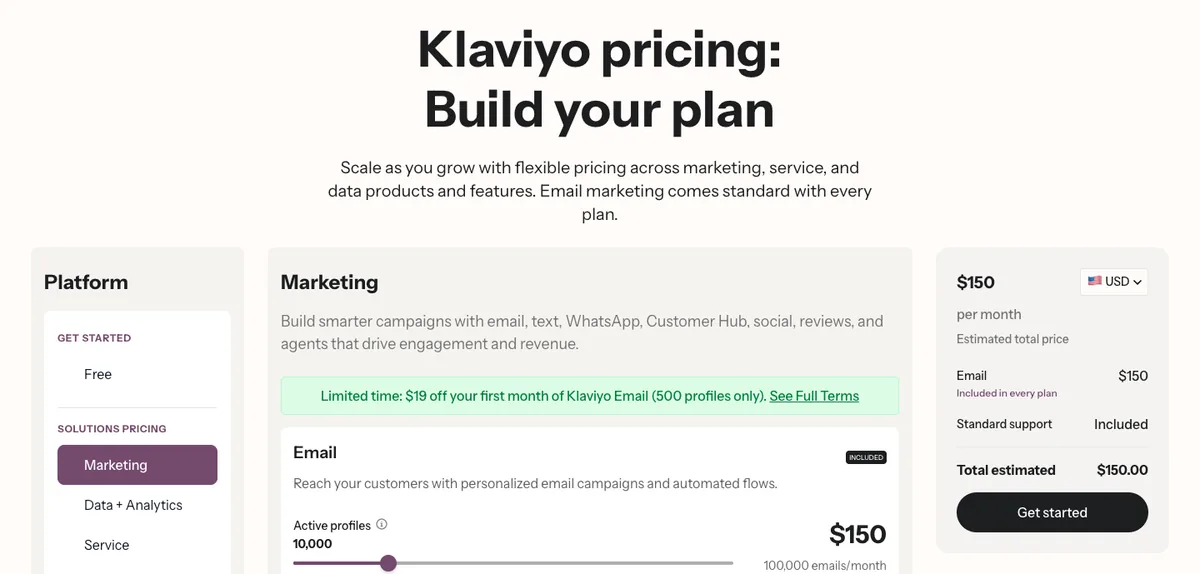
Klaviyo prices on active profiles, not on emails sent. Your email plan is set by how many active profiles you carry, and each paid tier includes 10 emails a month for every profile it covers: the 10,000-profile plan comes with 100,000 sends. Everything else, from SMS to reviews, is a separate line added to that base plan.
What counts as an active profile?
An active profile is anyone Klaviyo can email. Klaviyo’s billing guide says that means any emailable profile regardless of consent status: your subscribers, plus people who gave you an email address without opting in, such as a customer who checked out on Shopify and never ticked the marketing box. The same guide defines billable profiles as those that can receive at least one type of marketing, through a valid email address or phone number, and aren’t suppressed or deleted.
What doesn’t count: suppressed and deleted profiles. Unsubscribes are suppressed, anyone you suppress yourself is suppressed, and Klaviyo suppresses an address automatically after a hard bounce or more than seven soft bounces in a row. Suppressed profiles stay in your account for reporting; they just stop counting toward the bill. Suppression isn’t permanent: a profile is unsuppressed if it resubscribes or someone removes the suppression by hand, and once it can be emailed again it counts again.
How the bill is calculated
- Monthly, in advance. Your billing date is the day you started a paid plan, and each invoice covers the month ahead.
- Your plan must cover your active profiles. If you’re over at the end of a billing cycle, Klaviyo moves you up to a tier that fits, an automatic upgrade. To avoid it, you have to be back under the limit at least 24 hours before the cycle renews.
- Upgrades are immediate; downgrades aren’t. An upgrade applies straight away and you pay the difference for that month. A downgrade waits for the next cycle, there are no mid-cycle refunds, and Klaviyo won’t let you pick a plan smaller than your current profile count.
- Counts lag. After you suppress or delete profiles, your count can take up to 72 hours to refresh.
- Every email that leaves counts. Delivered and bounced emails use your send allowance; skipped emails and double opt-in confirmations don’t.
- Going over your send limit triggers your billing preference: automatic upgrade, a one-off flexible overage for the next tier’s capacity, or a pause until the next cycle. Klaviyo itself says flexing usually costs more than upgrading if you need the volume every month.
The February 2025 billing change (this is the one that catches people out)
On 18 February 2025, Klaviyo introduced what it calls profile plan compliance: every customer paying by credit card must be on an email plan that matches or exceeds their active profile count. Before that, your plan didn’t have to cover every emailable profile in the account. Now it does, and Klaviyo moves you up at the next billing cycle if it doesn’t. Customers on contracts are billed under their contract terms.
That means the dead weight in your database now sits in your billable count. In aerodynamics terms, an unengaged list is pure weight. It was always a tax on your deliverability. Klaviyo’s billing model made it a tax on your invoice too. If your list is full of people who haven’t opened anything in a year, you are paying to store them and hurting your inbox placement at the same time. That is a fast, free win most brands leave on the table: a proper list clean can cut your bill and lift your engagement in the same move.
The same update added two optional billing preferences: flexible sending for seasonal spikes, and auto-downgrade when your profile count qualifies for a lower tier. Neither switches on by itself.
Klaviyo pricing by list size: every email tier (2026)
Klaviyo’s calculator publishes 49 paid email tiers. Here they all are, in USD per month, as of October 2026 (rechecked on 10 October). Each row covers active profiles up to the number shown.
| Active profiles (up to) | Price a month | Email sends a month |
|---|---|---|
| 250 | Free | 500 |
| 500 | $20 | 5,000 |
| 1,000 | $30 | 10,000 |
| 1,500 | $45 | 15,000 |
| 2,500 | $60 | 25,000 |
| 3,000 | $70 | 30,000 |
| 3,500 | $80 | 35,000 |
| 5,000 | $100 | 50,000 |
| 5,500 | $110 | 55,000 |
| 6,000 | $130 | 60,000 |
| 6,500 | $140 | 65,000 |
| 10,000 | $150 | 100,000 |
| 10,500 | $175 | 105,000 |
| 11,000 | $200 | 110,000 |
| 11,500 | $225 | 115,000 |
| 12,000 | $250 | 120,000 |
| 12,500 | $275 | 125,000 |
| 13,000 | $300 | 130,000 |
| 13,500 | $325 | 135,000 |
| 15,000 | $350 | 150,000 |
| 20,000 | $375 | 200,000 |
| 25,000 | $400 | 250,000 |
| 26,000 | $425 | 260,000 |
| 27,000 | $450 | 270,000 |
| 28,000 | $475 | 280,000 |
| 30,000 | $500 | 300,000 |
| 35,000 | $550 | 350,000 |
| 40,000 | $600 | 400,000 |
| 45,000 | $650 | 450,000 |
| 50,000 | $720 | 500,000 |
| 55,000 | $790 | 550,000 |
| 60,000 | $860 | 600,000 |
| 65,000 | $930 | 650,000 |
| 70,000 | $1,000 | 700,000 |
| 75,000 | $1,070 | 750,000 |
| 80,000 | $1,140 | 800,000 |
| 85,000 | $1,205 | 850,000 |
| 90,000 | $1,265 | 900,000 |
| 95,000 | $1,325 | 950,000 |
| 100,000 | $1,380 | 1,000,000 |
| 105,000 | $1,440 | 1,050,000 |
| 110,000 | $1,495 | 1,100,000 |
| 115,000 | $1,555 | 1,150,000 |
| 120,000 | $1,610 | 1,200,000 |
| 125,000 | $1,670 | 1,250,000 |
| 130,000 | $1,725 | 1,300,000 |
| 135,000 | $1,785 | 1,350,000 |
| 140,000 | $1,840 | 1,400,000 |
| 145,000 | $1,900 | 1,450,000 |
| 150,000 | $1,955 | 1,500,000 |
| More than 150,000 | Contact sales | Contact sales |
Three things to know before you budget:
- The price doesn’t rise evenly. Anywhere from 6,501 to 10,000 profiles costs $150. Then the price climbs $25 for every 500 profiles, to $325 at 13,500 and $350 at 15,000, before flattening again: 25,000 profiles cost $400. If you sit just above a boundary, a small cleanup drops you a tier.
- Above 150,000 active profiles the calculator stops and Klaviyo quotes through sales.
- Promotions come and go. On 10 October 2026 Klaviyo was offering $19 off the first month of the 500-profile plan.
What Klaviyo’s free plan includes
The free plan has no time limit. It covers up to 250 active profiles and 500 email sends a month, plus $5 of mobile messages and $5 of Composer (Klaviyo’s AI agent) usage a month. You get flows, segmentation, sign-up forms, the drag-and-drop editor, built-in reporting and the integrations library.
You don’t get Klaviyo’s logo removed from your emails, generative AI for segments and content, predictive analytics, or email support after your first 60 days. Go over 250 profiles or 500 sends and Klaviyo stops sending until you upgrade, trim the list or the next monthly cycle starts. It’s a genuine test bed for a new store. It isn’t a way to run an established one.
Is Klaviyo free on Shopify?
Up to 250 active profiles, yes. The Klaviyo app is free to install from the Shopify App Store, and the free plan above applies unchanged. The catch is who counts: Shopify customers who checked out without subscribing are still emailable profiles, so a store’s customer file can pass 250 well before its subscriber list does. After that it’s $20 a month at 500 profiles. If you want free email inside Shopify itself, that’s Shopify Messaging: 10,000 emails a month free, then $1 per 1,000 (October 2026). We compare the two in Klaviyo vs Shopify Email.
Email + SMS: what a combined Klaviyo bill looks like
Klaviyo doesn’t sell a bundled email-and-SMS plan. You choose an email plan by profiles, then add a mobile messaging plan sized to how many texts you send and where, and you can change the two independently. Here’s what the two lines add up to with US toll-free texts, as of 10 October 2026:
| Active profiles | Email only | + 5,000 US texts | + 10,000 US texts |
|---|---|---|---|
| 1,000 | $30 | $100 | $155 |
| 5,000 | $100 | $170 | $225 |
| 10,000 | $150 | $220 | $275 |
| 25,000 | $400 | $470 | $525 |
| 50,000 | $720 | $790 | $845 |
Klaviyo SMS, MMS and WhatsApp pricing
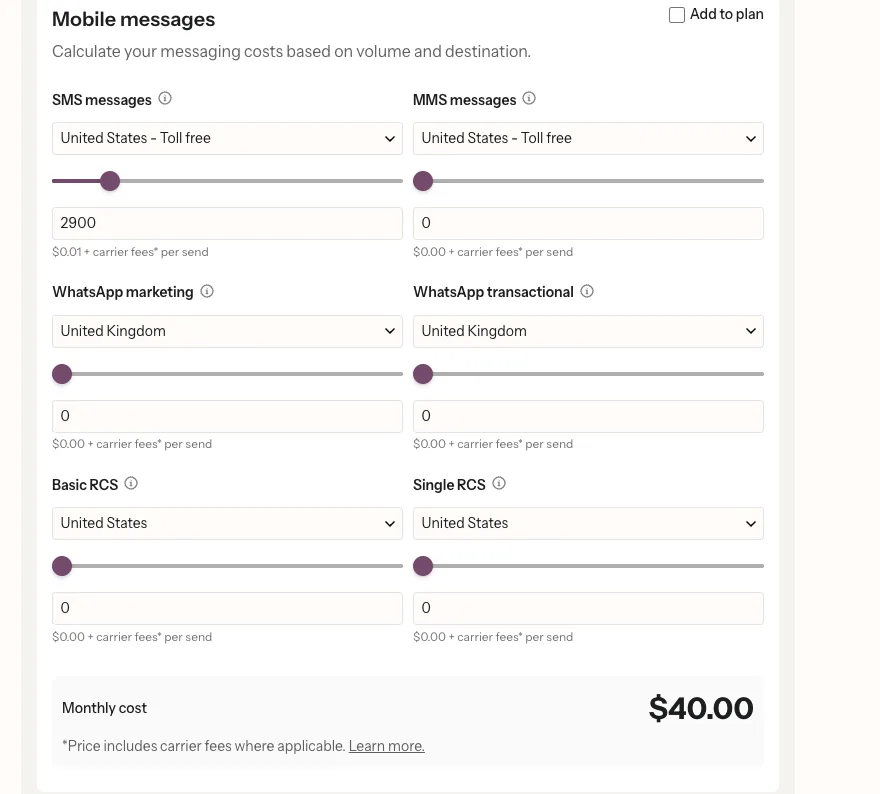
Since 13 July 2026, Klaviyo has sold mobile messaging as a monthly plan in dollars, replacing its old credit system, with a per-message rate that depends on the channel, the destination country and, for US and Canadian SMS, whether you send from a toll-free number or a short code. Carrier fees are built into the plan price, there are around 70 plan sizes, and unused spend doesn’t roll over. Our Klaviyo SMS pricing guide has the full detail.
Monthly plan cost from Klaviyo’s calculator, USD, rechecked on 10 October 2026:
| Texts a month | US toll-free | US short code* | Australia | UK |
|---|---|---|---|---|
| 1,000 | $15 | $15 | $30 | $70 |
| 5,000 | $70 | $60 | $130 | $295 |
| 10,000 | $125 | $115 | $250 | $575 |
| 20,000 | $240 | $215 | $480 | $1,115 |
*Short codes carry a separate monthly fee, billed outside the messaging plan.
At 1,000 US toll-free texts the calculator shows about $0.011 a message plus provider fees of roughly $0.004; the $15 plan price already includes both, and Klaviyo’s help centre says carrier fees never appear as separate invoice lines.
Other channels, at 1,000 messages a month:
| Channel and destination | Monthly cost |
|---|---|
| US MMS (toll-free) | $45 |
| Australia MMS | $145 |
| UK WhatsApp marketing | $105 |
| Australia WhatsApp marketing | $140 |
| UK WhatsApp transactional | $45 |
| US WhatsApp marketing | Not available |
| UK MMS | Not available |
What drives the number:
- Segments. A text holds 160 characters, or 70 with an emoji; longer messages bill per segment.
- WhatsApp is charged per delivered marketing or utility template, following Meta’s model.
- Failed deliveries are billable. Skipped messages and inbound replies aren’t.
- One plan covers every channel and country, so price the total if you send to several. Klaviyo suggests asking sales for multi-country estimates.
- Short codes are for volume: they have higher throughput, and Klaviyo recommends one once you’re texting more than about 95,000 people a month.
- Flexible overages on mobile are only available on plans of $490 a month or more.
Klaviyo add-ons and what they cost
Klaviyo sells far more than email now. These are the prices its pricing calculator showed on 10 October 2026; each is optional and billed on its own meter.
| Add-on | Billed on | Price a month |
|---|---|---|
| Reviews (Shopify and WooCommerce only) | Orders eligible for a review request | Free to 50; $25 for 250; $90 for 1,000; $175 for 2,000; $300 for 3,500; $500 for 10,000 |
| Marketing Analytics (labelled Personalisation on the pricing page) | Active profiles | $100 up to 13,500; $120 at 25,000; $216 at 50,000; $414 at 100,000 |
| Advanced Klaviyo Data Platform (KDP) | Total profiles, including suppressed | $500 at 100,000; $2,500 at 500,000; $4,765 at 1 million |
| Customer Hub | Active profiles | $20 up to 10,000; $50 at 25,000; $86 at 50,000 |
| Helpdesk | Support tickets | $10 for 50; $98 for 500; $185 for 1,000 |
| Customer Agent | Resolved AI conversations | First 50 free; $50 for 75; $350 for 500 |
| Social marketing | Active profiles | $50 up to 10,000; $125 to 25,000; $200 to 50,000 |
| Composer (AI marketing agent) | Usage | $5 of usage free; $20 a month; extra at $10 per 1,000 credits |
A few things the table hides:
- Service prices can change. On 10 October 2026 the calculator showed Customer Hub, Helpdesk and Customer Agent at the prices above, with no separate list price. Klaviyo says early buyers of its Service products lock in an introductory price list for as long as they stay subscribed, and pay the then-current list price if they cancel and come back.
- Some add-ons move with your list. Marketing Analytics and Customer Hub go up and down with your active profile count automatically; you can’t switch that off.
- Advanced KDP counts everyone, suppressed profiles included, and charges a usage fee if you outgrow your tier.
- Support. Standard support (email, plus live chat on weekdays) is included with paid plans. Professional support starts at $500 a month and Enterprise support at $1,800.
Composer is covered in more depth in our Klaviyo AI review.
Dedicated IPs and enterprise plans
Klaviyo doesn’t publish a price for a dedicated IP. Its help centre says dedicated IPs are only for accounts that qualify, you ask your Customer Success Manager, and a new IP takes about 30 to 40 days to warm. For most smaller stores the shared pool is fine: Klaviyo monitors it and removes harmful senders, and a dedicated IP only works if you send high volume on a steady cadence.
Enterprise is quote-only. Klaviyo sells two packages, Klaviyo Standard and Klaviyo Advanced. Advanced bundles advanced personalisation, data warehouse sync, advanced data management, Customer Hub and Social into one price based on active profiles, with email, SMS and push sends bought separately.
Klaviyo pricing in Australia and the UK
Klaviyo doesn’t localise its prices for Australia or the UK. As of 10 October 2026, its Australian and UK pricing pages show the same US dollar tiers as the US page, and the calculator offers no Australian dollar or pound option. Klaviyo has said its listed prices are in US dollars and that’s the currency you’re billed in; your bank converts the charge, so check what your card charges for foreign-currency payments. Where tax applies, Klaviyo calculates it at checkout.
What does change by country is messaging. Texts to Australian numbers cost twice the US rate: $30 a month for 1,000 and $250 for 10,000. UK texts cost more again, $70 for 1,000 and $575 for 10,000, and MMS isn’t available to UK numbers. WhatsApp marketing, which Klaviyo doesn’t offer to US numbers, is $105 per 1,000 messages to the UK and $140 to Australia.
Klaviyo vs Omnisend vs Mailchimp: price at three list sizes
Monthly list prices in USD, checked on each vendor’s pricing page on 1 October 2026. Email plans only, monthly billing, no promotions.
| List size | Klaviyo | Omnisend Standard / Pro | Mailchimp Essentials / Standard |
|---|---|---|---|
| 5,000 | $100 | $81 / $90 | $75 / $100 |
| 25,000 | $400 | $282 / $400 | $270 / $310 |
| 50,000 | $720 | $413 / $715 | $385 / $450 |
What the table doesn’t show:
- Who gets counted. Klaviyo bills profiles you can email. Omnisend doesn’t bill unsubscribed contacts. Mailchimp bills subscribed, unsubscribed and non-subscribed contacts, so a Mailchimp list carrying years of unsubscribes can sit a tier or two above its real size.
- What’s capped. Mailchimp Essentials stops automations at four flow steps. Omnisend Standard allows 12 emails a month per contact in your tier, and Pro is unlimited under fair use. Klaviyo allows 10 per profile.
- SMS. New Omnisend accounts can only buy SMS on Pro. Mailchimp sells SMS credits that expire monthly. Klaviyo adds a mobile plan to any paid email plan.
- Promotions. Omnisend takes 30% off if you pay three months upfront, and Mailchimp was offering 15% off the first 12 months at 10,000+ contacts.
So Omnisend Standard is cheaper at every size, and Mailchimp Standard from about 10,000 contacts up. Omnisend Pro and Klaviyo are close from about 3,000 contacts upward. Whether the gap matters depends on what Klaviyo’s segmentation and flows earn you. We’re an official partner of both Klaviyo and Omnisend, and the detail is in our Klaviyo vs Mailchimp and Klaviyo vs Omnisend comparisons.
Why is Klaviyo so expensive? The hidden costs
At the bottom of the range it isn’t: at 5,000 profiles Klaviyo costs the same $100 as Mailchimp Standard. It gets expensive in five places.
- You pay for people you don’t mail. Active profiles include every emailable profile, whatever their consent status. A customer who bought once and never subscribed still counts.
- Upgrades are automatic; downgrades aren’t. Go over your tier and Klaviyo moves you up at the next billing cycle. Shrink your list and you stay put until you choose a lower plan yourself.
- The 10,000 to 15,000 band. The email price more than doubles across it, from $150 to $350, while the next 10,000 profiles add only $50.
- Add-ons that grow with your list. Marketing Analytics, Customer Hub and Social marketing are priced on active profiles, so they rise as you grow.
- Mobile spend that expires. Unused SMS dollars don’t roll over, Australian texts cost twice the US rate and UK texts close to five times, and failed deliveries are billed.
Then there’s the cost nobody puts on the invoice: the people who run it. If you’re budgeting for outside help, here’s what an email marketing agency costs on top of the platform.
Is Klaviyo worth it for small brands?
Here is the maths that makes the subscription look trivial.
Klaviyo’s 2026 benchmarks, drawn from more than 183,000 Klaviyo customers, show automated flows generate nearly 41% of email revenue from just 5.3% of sends, with revenue per recipient nearly 18 times higher than campaigns. Our target for a well-run DTC account is 30 to 40% of revenue from email and SMS.
Run the numbers on a store doing $2M a year. If email is doing its job at ~35% of revenue, that is $700K of the top line moving through a channel that costs a couple of hundred dollars a month to operate. The Klaviyo bill is a rounding error against the revenue the platform is capable of driving. The expensive line item is not the $150 invoice. It is the difference between an account pulling 12% of revenue from email and one pulling 35%.
We see this on real accounts constantly. When we helped Better Body Co. move email from around 10% of revenue to the 20-25% target range, the brand closed 2021 at $100M SGD in total revenue, and the platform fee never once entered the conversation. When Relaxium added $3M a year in incremental email and SMS revenue, nobody was optimising the subscription. They were optimising the campaigns: cadence, segmentation and who got mailed.
For a small brand the maths is simpler still. Under 250 profiles, Klaviyo is free. At 1,000 profiles it’s $30 a month, so with a $60 average order, one or two extra orders a month from a welcome or abandoned cart flow cover it. Run your own numbers through our Klaviyo ROI calculator.
So the honest answer: Klaviyo is worth it if you are going to actually use the flows, the segmentation, and the deliverability tooling. If you are going to send one newsletter a month and never build a flow, you are paying for a Formula 1 car to drive to the shops, and a cheaper tool is fine (see our Klaviyo alternatives, or compare Mailchimp pricing and Omnisend pricing). We say that plainly in our Klaviyo vs Drip and Klaviyo vs ActiveCampaign breakdowns, and in our full Klaviyo review.
How to lower your Klaviyo bill
Klaviyo’s bill tracks the size of your database, not your revenue. That makes it the easiest place to apply the rule the method Pete built on: we win by removing things, not adding them. In order:
- Find your tier boundary. Compare your active profile count with the tier table above. If you sit just over a line, a few hundred suppressions drop you a tier, and the 10,000 to 15,000 band is where that pays most.
- Suppress profiles that have never engaged. Klaviyo publishes its own definition of a safe-to-suppress profile: created at least 180 days ago, sent at least five emails in the last 72 weeks, and never opened, clicked, visited the site, viewed a product, started a checkout or ordered. Those people aren’t customers. They’re weight. Because iOS made opens unreliable, some dead profiles will show an open and slip through; clicks, site visits and orders are the signals we trust.
- Sunset before you suppress. Klaviyo recommends one last sunset flow first: two or three emails with a clear way to stay subscribed, then suppress anyone who doesn’t respond. Our sunset flow guide has the build.
- Keep list cleaning and suppression separate. Excluding people who haven’t engaged in 90 days from campaigns protects deliverability. Suppressing people who never engaged at all cuts the bill. Klaviyo treats them as different jobs, and so should you.
- Time it. Suppress at least three days before your billing date. Counts take up to 72 hours to refresh, and you need to be under the limit 24 hours before the cycle turns.
- Downgrade yourself. Klaviyo only downgrades automatically if you’ve switched on auto-downgrade, which works with flexible sending. Otherwise, pick the lower tier in Billing once your count drops.
- Match overages to your calendar. Flexible overages suit a one-off Black Friday spike. If you go over every month, upgrade instead.
- Right-size mobile. Size the SMS plan to real volume, since unused spend expires. Keep texts under 160 characters, and drop emojis unless they earn their place: one emoji cuts a segment to 70 characters.
- Audit add-ons. Anything priced on active profiles grows on its own. If nobody uses it, cancel it.
Here’s what that’s worth. A store with 13,400 active profiles pays $325 a month for email. If 3,400 of those profiles have never opened, clicked or bought, suppressing them moves the account to the 10,000 tier at $150. That’s $175 a month, $2,100 a year, saved by removing people who were never going to buy, and the sends you stop making to them were dragging on your inbox placement anyway.
How to make Klaviyo pay for itself
Cutting the bill is the easy half. The subscription pays for itself the day your flows are engineered instead of switched on out of the box. In order of impact:
- Build the flows that carry the revenue. Welcome, abandoned cart, browse abandonment, post-purchase, and win-back. This is the 5% of sends that drives ~41% of the revenue. If these are the default templates, you are leaving most of the money on the table. See our flow automation approach.
- Measure revenue per recipient, not open rate. Open rate is a leading indicator that iOS made unreliable anyway. The number that tells you whether Klaviyo is earning its keep is revenue per recipient and flow contribution percentage.
- Fix deliverability first. Validity’s 2026 benchmark put average global inbox placement at 87.2% in 2025, so roughly one in eight marketing emails still misses the inbox. If a chunk of your list cannot see what you send, no pricing tier will save the ROI. Get deliverability right before you spend on creative.
Klaviyo is an engineered system. Priced against what a well-built account earns, it is one of the cheapest lines on your P&L. Priced against a badly-built one, it feels expensive, because a badly-built account earns nothing.
The bottom line
Klaviyo costs $20 to $150 a month for most stores between 500 and 10,000 profiles, $400 at 25,000 and $720 at 50,000, with SMS and add-ons on top, all in US dollars. The February 2025 shift to billing on every active profile means a clean, engaged list now saves you money twice. But the real cost of Klaviyo is never the invoice. It is the gap between what your account earns today and what it should earn, and that gap is almost always execution, not price.
If you want to know exactly how much revenue your Klaviyo account is leaving on the table, get a free audit. We measure the gap in dollars and send you a written 90-day plan to close it, whether you work with us or not. That is what our Klaviyo agency team does every day.
Sources
- Klaviyo Pricing: free plan, email tiers and send limits, mobile messaging calculator, add-on calculators, support packages, enterprise plans and promotions (1 and 10 October 2026)
- Klaviyo Pricing, Australia and Klaviyo Pricing, UK: US dollar pricing on regional pages (1 and 10 October 2026)
- Klaviyo Help Center, How Klaviyo billing works: active profiles, profile enforcement, upgrades and downgrades, overages, add-on billing
- Klaviyo Help Center, FAQ: Feb 18 billing changes
- Klaviyo Help Center, Understanding active profile management in Klaviyo: inactivity segment, suppression, send limits
- Klaviyo Help Center, FAQ 7/13 Mobile Messaging Update
- Klaviyo Help Center, Understand Klaviyo’s mobile messaging system: carrier fees, rollover
- Klaviyo Help Center, Understanding SMS sending numbers: short code costs
- Klaviyo Help Center, Understanding dedicated vs. shared IPs
- Klaviyo Community, Klaviyo billing: billing currency
- Klaviyo email marketing benchmarks and the Klaviyo Benchmark Report
- Omnisend Pricing and Mailchimp Pricing (1 October 2026)
- Shopify App Store, Klaviyo: Email Marketing & SMS (free to install) and Shopify Messaging (10 October 2026)
- Validity, 2026 Email Deliverability Benchmark Report
/ Frequently Asked Questions
Q.01 How much does Klaviyo cost per month? +
/ Answer
As of October 2026, Klaviyo is free for up to 250 active profiles. Paid email plans start at $20 a month for 500 profiles, then $30 for 1,000, $100 for 5,000, $150 for 10,000, $400 for 25,000, $720 for 50,000 and $1,380 for 100,000. Above 150,000 profiles Klaviyo quotes through sales. SMS, WhatsApp and add-ons such as Reviews are billed on top, and all prices are in US dollars.
Q.02 Can I use Klaviyo for free? +
/ Answer
Yes. Klaviyo's free plan has no time limit and covers up to 250 active profiles, 500 email sends a month, $5 of mobile messages a month and $5 of Composer usage, as of October 2026. Emails carry Klaviyo branding, predictive analytics and generative AI are paid features, and email support ends after 60 days. Go over either limit and Klaviyo stops sending until you upgrade, reduce your profiles or the next monthly cycle starts.
Q.03 Why is Klaviyo so expensive? +
/ Answer
Mostly because of what it counts. Klaviyo bills on active profiles: everyone you can email, including customers who bought without subscribing, not just the people you actually mail. Since February 2025 your plan must cover that count, so a list full of people who never engage pushes you up tiers. Omnisend Standard is cheaper at every list size and Mailchimp Standard from about 10,000 contacts up. Suppressing profiles that have never engaged is the fastest way to cut the bill.
Q.04 What are the hidden costs with Klaviyo? +
/ Answer
The email plan is the visible part. On top sit SMS, MMS and WhatsApp, priced per message by country; add-ons such as Reviews, Marketing Analytics, Customer Hub, Helpdesk, Customer Agent, Social marketing and Composer; short code fees; and support packages from $500 a month. The quieter costs are automatic tier upgrades when your profile count grows, mobile spend that does not roll over, and a steep price band between 10,000 and 15,000 profiles. The biggest cost is usually the time or agency help needed to run it well.
Q.05 Is Mailchimp cheaper than Klaviyo? +
/ Answer
On list price, usually. As of October 2026, Mailchimp Standard costs $100 a month at 5,000 contacts, the same as Klaviyo, then $310 against $400 at 25,000 and $450 against $720 at 50,000. Mailchimp Essentials is cheaper again but caps automations at four flow steps. Mailchimp also bills unsubscribed contacts, while Klaviyo bills only profiles you can email, so compare billable counts rather than headline list sizes.
Q.06 How much does Klaviyo Reviews cost per month? +
/ Answer
Klaviyo Reviews is free for up to 50 orders a month. Paid plans are $25 a month for 250 orders, $90 for 1,000, $175 for 2,000, $300 for 3,500 and $500 for 10,000, per Klaviyo's pricing calculator in October 2026. It is billed separately from email and SMS, counts orders that become eligible for a review request, and is only available for Shopify and WooCommerce stores.
Q.07 How much does Klaviyo SMS cost? +
/ Answer
As of October 2026, Klaviyo's calculator prices US SMS from a toll-free number at $15 a month for 1,000 texts, $70 for 5,000, $125 for 10,000 and $240 for 20,000, carrier fees included. International texts cost more: 1,000 a month is $30 to Australia and $70 to the UK. SMS is a monthly plan added to your email plan, unused spend does not roll over, and the free plan includes $5 of messages a month.
Q.08 What is Klaviyo's pricing in Australia? +
/ Answer
The same as everywhere else, in US dollars. As of October 2026, Klaviyo's Australian pricing page lists USD prices with no local-currency option: free up to 250 active profiles, then $20 a month for 500 profiles, $150 for 10,000 and $400 for 25,000. Your card is charged in USD and your bank converts it. Texts to Australian numbers cost twice the US rate: $30 a month for 1,000 and $250 for 10,000.
Q.09 What is Klaviyo's pricing in the UK? +
/ Answer
Klaviyo bills UK customers in US dollars too. As of October 2026, its UK pricing page shows the same USD tiers as the US page, with no pound option: free up to 250 active profiles, then $20 a month for 500 profiles, $150 for 10,000 and $400 for 25,000. Your bank converts the charge. Texts to UK numbers cost far more than US ones: $70 a month for 1,000 and $575 for 10,000. MMS isn't available to UK numbers, and WhatsApp marketing to the UK is $105 per 1,000 messages.
Q.10 Is Klaviyo free on Shopify? +
/ Answer
Up to a point. The Klaviyo app is free to install from the Shopify App Store, and the free plan works on Shopify as it does anywhere else: up to 250 active profiles, 500 email sends and $5 of mobile messages a month, as of October 2026. Past 250 emailable profiles you need a paid plan, from $20 a month at 500. Shopify customers who bought without subscribing still count as active profiles, so a store's customer file can pass the free limit before its subscriber list does.
Q.11 What are the weaknesses of Klaviyo? +
/ Answer
Cost scales with active profiles, including people who bought without subscribing, so the bill grows with your customer file. SMS is billed per message on top of email. It is built for B2C ecommerce, so sales-led B2B teams need a separate CRM. Reporting uses attribution windows that can overstate email's share if left on defaults. And some categories are restricted: prescription products are prohibited on every channel, and CBD and cannabis are prohibited on SMS in the US and Canada.
Q.12 Who is Klaviyo's biggest competitor? +
/ Answer
It depends on the job. For small ecommerce stores it is Mailchimp and Omnisend. For SMS it is Attentive and Postscript. At enterprise scale it is Braze, Iterable and Salesforce Marketing Cloud. For B2B and sales-led teams it is HubSpot and ActiveCampaign. For Shopify-native ecommerce email and SMS at growth stage, Omnisend is the closest like-for-like alternative, and on list price Omnisend Standard is cheaper than Klaviyo at every list size.
Q.13 Is Klaviyo legit? +
/ Answer
Yes. Klaviyo is a publicly traded company (NYSE: KVYO) headquartered in Boston, founded in 2012, and reported more than 205,000 customers as of 30 June 2026. It is one of the most widely used email and SMS platforms for ecommerce, with native integrations for Shopify, WooCommerce, BigCommerce and Magento.
Shows our articles higher in your Google results. Takes one click.