Klaviyo vs Omnisend (2026): Which Is Right for Your Store?
Omnisend vs Klaviyo in 2026: prices at five list sizes (checked 10 October), SMS costs, pros and cons, and who should pick which, from a partner of both.

Table of contents
- Klaviyo vs Omnisend at a glance
- Who should pick which
- Klaviyo vs Omnisend pricing (October 2026)
- What SMS costs on each
- Automation and flows
- Segmentation
- Templates and email design
- Reporting and integrations
- Pros and cons
- Klaviyo pros
- Klaviyo cons
- Omnisend pros
- Omnisend cons
- Who Omnisend is actually better for
- Who needs Klaviyo
- Klaviyo questions Omnisend shoppers ask
- What are the weaknesses of Klaviyo?
- Why is Klaviyo so expensive?
- Who is Klaviyo’s biggest competitor?
- The bottom line
- Sources
Omnisend is the better pick for smaller Shopify stores and lean teams that want solid email, SMS and push automation for less money: its Standard plan undercuts Klaviyo at every list size. Klaviyo is the better pick once email and SMS carry a real share of your revenue and you need predictive segmentation, real-time profile data and a bigger integration catalogue to grow it.
That’s the verdict. The rest of this page is the receipts: prices at five list sizes checked on both vendors’ pricing pages on 10 October 2026, what each platform does better, and where each one stops.
A note on where we stand: Email Optimize is an official partner of both Klaviyo and Omnisend, and we run client programs on each. Klaviyo carries most of our accounts. Omnisend carries the ones where it fits better. Whichever you pick, we have no reason to steer you.
Klaviyo vs Omnisend at a glance
| Klaviyo | Omnisend | |
|---|---|---|
| Built for | Ecommerce brands that run retention on order, browsing and predictive data | Ecommerce stores, mostly Shopify, that want email, SMS and push in one simple tool |
| Free plan | 250 active profiles, 500 emails a month | 250 contacts, 500 emails a month |
| Entry paid plan | $20 a month (500 profiles) | Standard, $16 a month (500 contacts) |
| Price at 10,000 contacts | $150 | Standard $132, Pro $150 |
| Price at 50,000 contacts | $720 | Standard $413, Pro $715 |
| Who you pay for | Active profiles: anyone you can email; suppressed and unsubscribed profiles don’t count | Subscribers plus non-subscribers who receive automated messages; unsubscribers don’t count |
| Email sends | 10 a month per profile in your tier | Standard 12 per contact; Pro unlimited under fair use |
| SMS | Monthly messaging plan on any paid plan, from $15 for 1,000 US texts | Pro only (new accounts since 4 May 2026), from $0.009 to $0.007 a US text |
| Segmentation | Predicted lifetime value, churn risk and next order date; segments update in real time | Purchase, engagement and contact properties; solid for the basics |
| Templates | Average stock templates, strong dynamic product blocks | Strong ecommerce template library out of the box |
| Integrations | 350+ pre-built | Fewer, covers the common Shopify stack |
| Best fit | Stores where email and SMS drive 20%+ of revenue and someone will build on the data | Stores under about $500K a year, lean teams, simpler catalogues |
Prices in USD a month, monthly billing, no promotions, as of 10 October 2026.
Who should pick which
| If you… | Pick | Why |
|---|---|---|
| Run a Shopify store under about $500K a year with a small team | Omnisend | Cheaper at every list size on Standard, quicker to learn, and the templates look good with little design work. |
| Want push notifications alongside email and SMS | Omnisend | Web push is included on every plan, unlimited on Standard and Pro. |
| Sell regulated products such as peptides or CBD | Whichever platform signs off in writing | Both have acceptable use policies, and a suspended account takes your list and flows with it. |
| Have 30,000+ subscribers and run VIP, win-back and replenishment programs at once | Klaviyo | Predictive segments and real-time profiles carry that load. Omnisend gets stretched. |
| Want SMS driven by the same data as email, on any paid plan | Klaviyo | Klaviyo’s messaging plan works on any paid plan. Omnisend SMS now needs Pro. |
| Run a large catalogue with product recommendations in flows | Klaviyo | Dynamic blocks and catalogue data go further. |
| Use Recharge, a loyalty platform and a reviews app together | Klaviyo | The bigger integration catalogue feeds them all into one profile. |
Klaviyo vs Omnisend pricing (October 2026)
At low list sizes, Omnisend is the better deal. Full stop. Monthly list prices in USD, from each vendor’s pricing page on 10 October 2026:
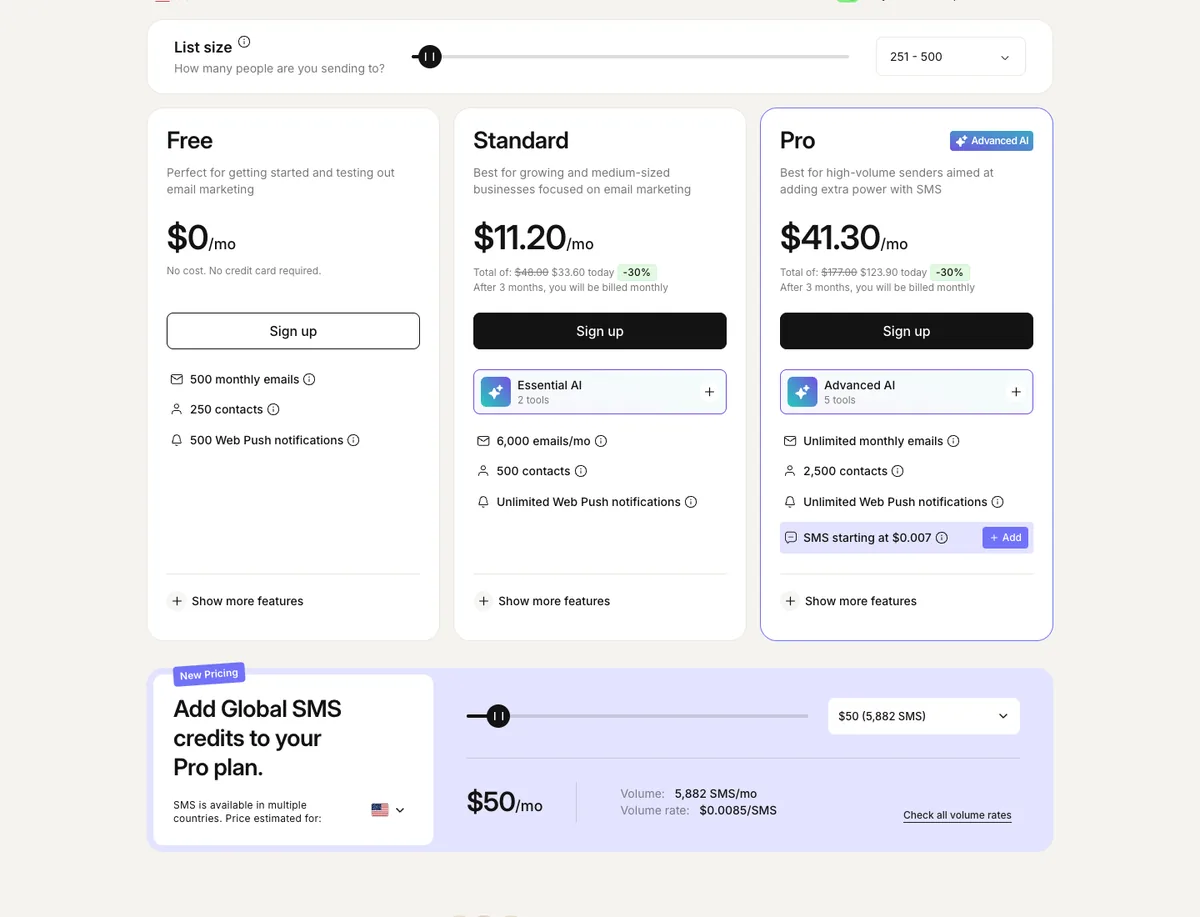
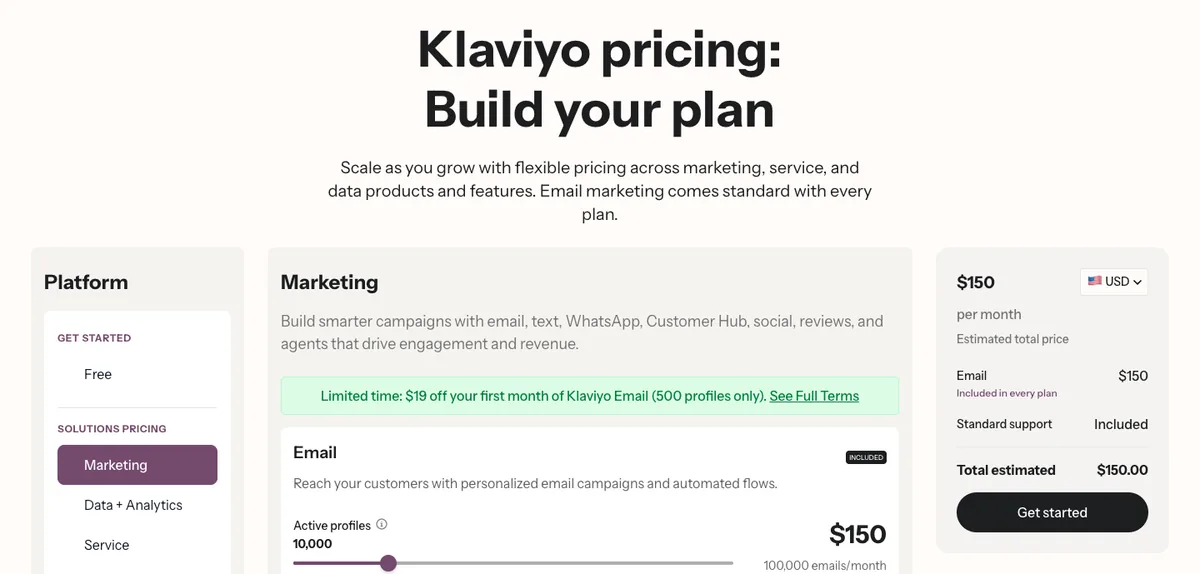
| Contacts | Klaviyo (email) | Omnisend Standard | Omnisend Pro |
|---|---|---|---|
| 1,000 | $30 | $20 | $59 |
| 5,000 | $100 | $81 | $90 |
| 10,000 | $150 | $132 | $150 |
| 25,000 | $400 | $282 | $400 |
| 50,000 | $720 | $413 | $715 |
What the table doesn’t show:
- Omnisend Standard is cheaper everywhere. The gap is $10 a month at 1,000 contacts and $307 at 50,000. Omnisend’s pricing guide has every tier.
- Omnisend Pro and Klaviyo are close from about 5,000 contacts. Pro is $90 against $100 at 5,000, level at $150 at 10,000, and $715 against $720 at 50,000. If you need Omnisend’s SMS, Pro is the plan you’re comparing.
- Both bill people who never subscribed. Klaviyo counts every profile you can email, including customers who bought without ticking the box. Omnisend counts subscribers plus non-subscribers who receive automated messages. Unsubscribes drop out of both.
- Promotions. Omnisend takes 30% off the first three months if you pay them upfront, once. Klaviyo was offering $19 off the first month of its 500-profile plan. Budget on full price.
What SMS costs on each
Klaviyo sells a monthly mobile messaging plan on top of any paid email plan: $15 a month for 1,000 US toll-free texts, $70 for 5,000, carrier fees included (Klaviyo SMS pricing). Omnisend sells SMS credits only on Pro, at $0.009 a US text under $50 a month of spend, $0.0085 from $50, $0.008 from $1,000 and $0.007 from $10,000.
Worked example, 5,000 contacts and 5,000 US texts a month: Klaviyo is $100 for email plus $70 for SMS, so $170. Omnisend is $90 for Pro plus a $50 SMS credit pack (5,882 texts at $0.0085), so $140. Omnisend wins on price. It no longer wins by default, though, because Standard can’t send SMS at all.
Automation and flows
Both platforms cover the flows that make the money: welcome series, abandoned cart, browse abandonment, post-purchase and win-back.
Omnisend has a drag-and-drop flow builder that is genuinely easy to use. You can add conditional splits, time delays and channel switches between email, SMS and push. For most standard flows it does the job well.
Klaviyo flows can branch on any profile property, any custom event, any predicted metric and any segment membership. A post-purchase flow that sends a different upsell sequence to customers in the top 20% of predicted lifetime value is a Klaviyo build, not an Omnisend one.
For a simple catalogue and linear customer journeys, Omnisend’s automation is enough. For a complex catalogue, tiered customer segments or revenue targets that depend on precise targeting, Klaviyo’s depth earns its price.
Segmentation
This is where the gap is clearest.
Omnisend segments cover the basics well: purchase behaviour, engagement history, contact properties and campaign activity. Useful for targeted sends and exclusion lists.
Klaviyo adds:
- Predictive analytics: expected next purchase date, predicted lifetime value, churn risk
- Cross-channel data: email engagement, SMS consent, on-site behaviour and purchase history in one segment
- Real-time membership: segments update as profile data changes
- Nested AND/OR/NOT logic across any property or event
Run a VIP program, a win-back for lapsed high-value customers and a reactivation sequence for 180-day non-buyers at the same time on a 30,000-subscriber list, and you need Klaviyo’s segmentation. Omnisend won’t hold up at that level of complexity.
Templates and email design
Omnisend’s template library is strong. Templates are modern, ecommerce-focused and easy to edit. For a team without a designer, Omnisend’s out-of-the-box emails often look better than Klaviyo’s default templates.
Klaviyo’s power is in dynamic blocks: product recommendations, recently viewed items and catalogue data pulled into each email. If you won’t use those, Omnisend produces better-looking emails faster. If you’re on Klaviyo and want the polish anyway, that’s a design and copy job, not a reason to switch.
Reporting and integrations
Klaviyo’s reporting goes further: configurable attribution windows, revenue per recipient by flow and campaign, A/B tests compared on revenue, and predicted lifetime value trends across the list. Omnisend covers opens, clicks, attributed revenue for campaigns and flows, and SMS metrics. That’s enough at an earlier stage.
Klaviyo lists 350+ pre-built integrations, including Recharge, Yotpo, Okendo, LoyaltyLion and Attentive, and their data lands on the same profile. Omnisend’s list is shorter but covers the apps most Shopify stores run.
Pros and cons
Klaviyo pros
- Predictive lifetime value, churn risk and next-order date on every profile, usable in segments and flow splits
- Real-time profile with every order, product view and checkout
- SMS on any paid plan, inside the same flows and reports as email
- 350+ integrations feeding one profile
- Deep revenue reporting by flow, campaign and segment
Klaviyo cons
- Dearer than Omnisend Standard at every list size
- Bills every emailable profile, so an unpruned list costs you
- Stock templates are only average
- Takes longer to learn properly
- Restricted categories: prescription products on every channel, CBD and cannabis on SMS in the US and Canada
Omnisend pros
- Cheapest of the two at every list size on Standard
- Easy flow builder and strong templates
- Web push included on every plan
- Free migration and 24/7 support listed on every plan
Omnisend cons
- SMS only on Pro for new accounts, billed as a separate credits subscription
- Segmentation and predictive analytics stop short of Klaviyo’s
- Smaller integration catalogue
- Pro costs about the same as Klaviyo from 5,000 contacts up
Who Omnisend is actually better for
- Smaller stores (under about $500K revenue, under 10,000 subscribers) where Klaviyo’s cost premium doesn’t yet pay for itself in extra revenue
- Tight budgets, where Standard keeps the email bill down (bearing in mind SMS now needs Pro)
- Teams with limited email expertise, where the simpler interface and templates shorten the learning curve
- Straightforward catalogues, where predictive segmentation isn’t a real differentiator
- Brands that need SMS as a broadcast channel rather than a precisely segmented one
- Some categories Klaviyo restricts. Klaviyo’s Acceptable Use Policy (updated 9 April 2026) prohibits prescription and pharmaceutical products on every channel, and prohibits CBD and cannabis on SMS and MMS in the US and Canada. Other uses, such as email, are reviewed case by case. Omnisend has its own limits: its Acceptable Use Policy (updated 30 April 2026) prohibits prescription medications, including drugs sold for research purposes, on every channel, and cannabis, THC and CBD on SMS. So for peptides and other regulated products, the platform’s policy is checked and its written sign-off obtained first, before any build on either platform.
If that’s you, start with Omnisend. It’s a legitimate platform, not a compromise. Reassess as revenue grows.
Who needs Klaviyo
- High-SKU catalogues where product recommendations and dynamic content drive real revenue
- Stores above $1M revenue where predictive targeting, churn scoring and cross-sell sequencing produce measurable lift
- Subscription businesses on Recharge or similar, where integration depth matters
- Lists of 30,000+, where the segmentation and analytics justify the cost
- Teams that will build on it. Klaviyo rewards work. If nobody will build conditional flows and segment-driven campaigns, the advantage is wasted
Already on Omnisend and landing in this list? Our Omnisend to Klaviyo migration moves the account without breaking flows or deliverability.
Klaviyo questions Omnisend shoppers ask
What are the weaknesses of Klaviyo?
Next to Omnisend, three stand out. Price: Klaviyo costs more than Omnisend Standard at every list size, and it bills every profile you can email, including buyers who never subscribed. Learning curve: Omnisend is quicker to learn, while Klaviyo’s segment logic, flow filters and attribution settings take weeks to use well. Category limits: prescription products are prohibited on every channel, and CBD and cannabis on SMS in the US and Canada. Our Klaviyo review covers the full list and the workarounds.
Why is Klaviyo so expensive?
Because it bills on active profiles, not sends, and since February 2025 your plan has to cover the whole count. A store carrying years of people who never open pays for all of them. Against Omnisend Standard that shows up as $18 more a month at 10,000 contacts and $307 more at 50,000. Against Omnisend Pro the gap mostly disappears. Suppressing profiles that never engage is the fastest way to cut the bill, and our Klaviyo pricing guide shows how.
Who is Klaviyo’s biggest competitor?
For Shopify-native ecommerce email and SMS at growth stage, it’s Omnisend: the closest like-for-like alternative, cheaper on Standard and built for the same stores. For small stores it’s also Mailchimp, for SMS it’s Attentive and Postscript, and at enterprise scale it’s Braze and Iterable. Our Klaviyo alternatives guide ranks twelve of them by use case.
The bottom line
If you’re a smaller ecommerce brand and Klaviyo’s cost is a genuine stretch, Omnisend is the right call. Run it well and reassess when the list and revenue grow.
If you’re at $1M+ and want email and SMS near our target for a well-run DTC account, 30-40% of revenue, Klaviyo’s segmentation, predictive analytics and integrations are worth the difference.
The question isn’t which platform is better. It’s which one your store needs right now. Not sure where you sit? Book a free audit and we’ll give you a straight answer. We build on both, so the answer is the one that fits your store.
Sources
- Omnisend Pricing (plans, list-size tiers and SMS rates, 10 October 2026)
- Omnisend Help Center, Pricing Plans 2026: billable contacts, email credits, SMS on Pro, legacy Pro retirement on 26 October 2026, 30% starter discount (10 October 2026)
- Klaviyo Pricing (email plans and mobile messaging calculator, October 2026)
- Klaviyo Help Center, How Klaviyo billing works
- Klaviyo, Acceptable Use Policy (updated 9 April 2026)
- Omnisend, Acceptable Use Policy (updated 30 April 2026)
- Omnisend, Terms of Use
/ Frequently Asked Questions
Q.01 Which is better, Klaviyo or Omnisend? +
/ Answer
For a smaller Shopify store or a lean team, Omnisend usually is: it is cheaper, easier to learn and has strong templates. For a store where email and SMS already drive a real share of revenue, Klaviyo is, because its predictive segments, real-time profile data and larger integration catalogue give you more to grow with. Neither is a bad choice. The question is which one your store will actually use.
Q.02 Is Omnisend cheaper than Klaviyo? +
/ Answer
On email, yes. As of 10 October 2026, Omnisend Standard is $20 a month at 1,000 contacts against $30 for Klaviyo, $81 against $100 at 5,000, $132 against $150 at 10,000 and $413 against $720 at 50,000. Omnisend Pro, the plan you need for SMS, costs about the same as Klaviyo from 5,000 contacts up: $150 against $150 at 10,000 and $715 against $720 at 50,000.
Q.03 Can you send SMS on Omnisend's Standard plan? +
/ Answer
Not on a new account. Since 4 May 2026, Omnisend sells SMS only on Pro, as a separate SMS credits subscription, with US rates from $0.009 down to $0.007 a text depending on monthly spend. Legacy Pro plans with bundled SMS credits move to the new model on 26 October 2026. Klaviyo sells a monthly messaging plan on any paid email plan.
Q.04 Can I use Klaviyo for peptides or CBD? +
/ Answer
Check Klaviyo's Acceptable Use Policy (updated 9 April 2026) first. Prescription and pharmaceutical products are prohibited on every channel. CBD and cannabis are prohibited on SMS and MMS in the US and Canada, and other uses, such as email, are reviewed case by case. Peptides are not named, but catalogues close to those lines carry review risk, and a suspended account takes your list and flows with it. Omnisend is not an automatic fallback: its Acceptable Use Policy (updated 30 April 2026) prohibits prescription medications, including drugs sold for research purposes, on every channel. For any regulated catalogue we check both platforms' policies and get the platform's written sign-off before we build.
Q.05 Is it hard to move from Omnisend to Klaviyo? +
/ Answer
Not if you plan it. Contacts, consent status and suppressions move by export and import, the Shopify integration backfills order history into Klaviyo, and flows are rebuilt rather than copied. Run the cutover in one go so nobody gets two abandoned cart emails, and warm up sending on your most engaged profiles first. Most standard accounts move in two to three weeks.
Shows our articles higher in your Google results. Takes one click.