Klaviyo vs Braze vs Iterable (2026): Ecommerce vs Enterprise
Klaviyo vs Braze vs Iterable in 2026: mid-market ecommerce vs enterprise, why only Klaviyo publishes prices, where Braze and Iterable win, and when to switch.

Table of contents
- Klaviyo vs Braze vs Iterable at a Glance
- Pricing: Klaviyo Publishes Its Prices, Braze and Iterable Don’t
- Why is Klaviyo so expensive?
- Where Braze and Iterable Win
- Where Klaviyo Wins for Ecommerce
- Iterable: Where It Fits Against Klaviyo and Braze
- Pros and Cons
- Klaviyo
- Braze
- Iterable
- What are the weaknesses of Klaviyo?
- When to Choose Each
- Who is Klaviyo’s biggest competitor?
- What Brands Get Wrong
- Migration Either Direction
- The AI Question
- Practical Recommendation
- Sources
Klaviyo is the better platform for ecommerce brands whose retention revenue comes mostly from email and SMS: it connects to your store natively, publishes its prices and can be running flows within weeks. Braze and Iterable are the better platforms for app-first and enterprise brands, where push, in-app messages and journeys across many channels drive engagement and a team with engineering support runs them.
Braze and Iterable sit in the same category: customer engagement platforms that orchestrate email, SMS, push, in-app and web messages from one place, sold through sales teams. Klaviyo is an ecommerce-first B2C CRM that puts email, SMS and mobile push on one customer profile, fed by your store. Klaviyo reported more than 205,000 customers as of 30 June 2026.
A note on where we stand: we’re an official Klaviyo partner, so we have a stake. That’s why this page spells out where Braze and Iterable win, and why every price on it comes from the vendors’ own sites, checked on 10 October 2026.
Klaviyo vs Braze vs Iterable at a Glance
| Klaviyo | Braze | Iterable | |
|---|---|---|---|
| Built for | Ecommerce and DTC brands, from small Shopify stores to large brands | App-first and enterprise consumer brands | Growth-stage and enterprise brands running cross-channel programmes |
| Channels | Email, SMS, MMS, RCS, WhatsApp, mobile push, in-app forms | Email, SMS, WhatsApp, push, in-app messages, Content Cards, web | Email, SMS, push, in-app and web messaging |
| Store data | Native Shopify, WooCommerce, BigCommerce and Magento integrations, order history backfilled | Sent in through integrations, SDKs and APIs | Sent in through integrations, SDKs and APIs |
| Pricing | Published: free to 250 profiles, then by active profiles | Not published: monthly active users plus message credits, quoted by sales | Not published: quoted after a demo |
| How you buy | Self-serve, or through sales above 150,000 profiles | Sales-led | Sales-led |
| Who runs it | A marketer, in-house or agency | A lifecycle team with engineering support | A lifecycle team with engineering support |
| Wins when | Store revenue from email and SMS is the goal | The app is the main channel | Several channels, including the app, need one journey |
As of October 2026, from each vendor’s site.
Pricing: Klaviyo Publishes Its Prices, Braze and Iterable Don’t
Braze doesn’t publish prices. Its pricing page lists four plans, Go, Select, Pro and Enterprise, and says pricing scales with monthly active users, plus “Action Credits” that messages and AI features draw down: an SMS may cost 1 credit, a WhatsApp message 5. To see a number, you fill in a form.
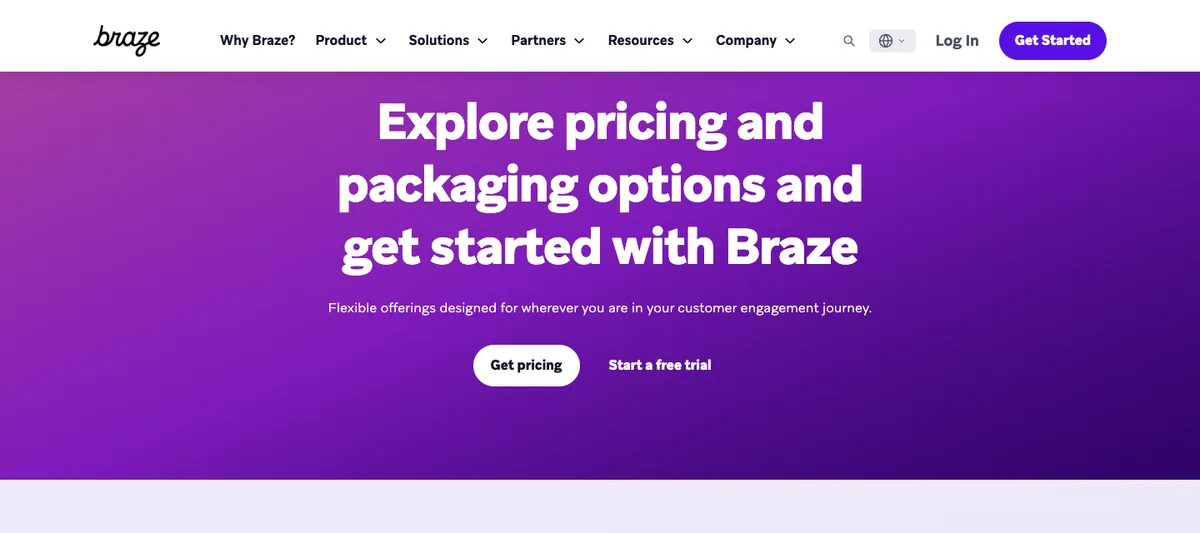
Iterable doesn’t publish prices either. It has no public pricing page (iterable.com/pricing sends you to the home page, as of October 2026), and every route leads to “Book a demo”.
Klaviyo publishes its email prices by active profiles. Monthly list prices in USD, from Klaviyo’s pricing page:
| Active profiles | Klaviyo (email) | Email sends included | Braze | Iterable |
|---|---|---|---|---|
| 10,000 | $150 | 100,000 | Quote only | Quote only |
| 50,000 | $720 | 500,000 | Quote only | Quote only |
| 100,000 | $1,380 | 1,000,000 | Quote only | Quote only |
As of October 2026. SMS and other mobile messages are billed on top of Klaviyo’s email plan. Above 150,000 profiles, Klaviyo quotes through sales too.
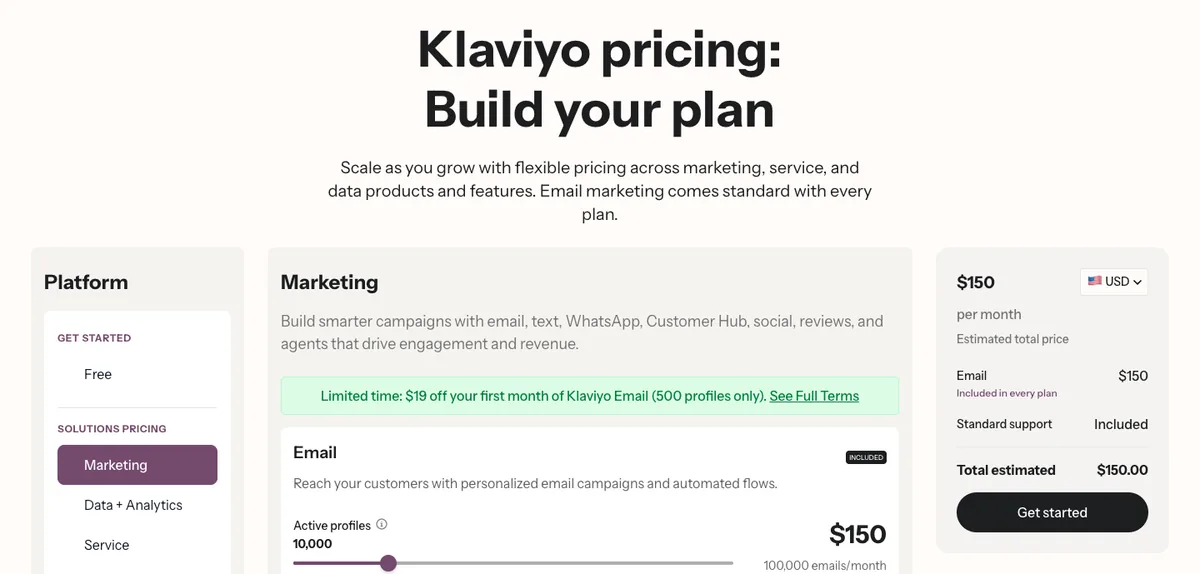
That gives you one fixed point. Ask Braze and Iterable to quote your monthly active users, send volume and channels, add the implementation work they propose, and compare the total with Klaviyo’s published price plus the agency or in-house time you’d need to run it. At the very top end all three are a negotiation: Klaviyo’s enterprise packages, Klaviyo Standard and Klaviyo Advanced, are quote-only as well.
Why is Klaviyo so expensive?
Next to Braze and Iterable, it usually isn’t: it’s the only one of the three you can price without a sales call. It feels expensive because it bills on active profiles, meaning everyone you can email, and since February 2025 your plan has to cover that full count. A big file of past customers who never open keeps you a tier or two higher than you need to be. Suppressing them is the fastest saving. Our Klaviyo pricing guide has every tier and the maths on cutting the bill.
Where Braze and Iterable Win
App channels. Both are built for brands whose customers live in a mobile app. Braze runs push, in-app messages, Content Cards and web messages from the same journey builder as email and SMS. Klaviyo now sends mobile push and shows in-app forms as popups, flyouts and full-page messages, but it has no equivalent of Content Cards, and app-first journeys are not where it’s strongest.
Orchestration across many channels. When one journey has to choose between push, in-app, email and SMS for each person, Braze and Iterable are the specialists.
Large team workflows. Both are designed for lifecycle, product and growth teams working in one account, with the permissions and approval steps that needs. Klaviyo suits a smaller marketing team or an agency.
Custom data and developer flexibility. Both take custom events and data from your app and warehouse, and give engineers APIs and SDKs to build with. If your most important data isn’t ecommerce data, that flexibility matters.
AI decisioning. Braze expanded its per-customer decisioning through its 2025 acquisition of OfferFit: choosing the message, the timing and the channel for each profile. It’s aimed at teams with the volume and data to feed it.
Where Klaviyo Wins for Ecommerce
Store data out of the box. Connect Shopify, WooCommerce, BigCommerce or Magento and orders, products, checkouts and browsing land on each profile, with your order history backfilled. On Braze or Iterable that data has to be piped in and modelled.
Time to value. A Klaviyo account can have welcome, abandoned cart, browse abandonment and post-purchase flows live within weeks, built from the pre-built flow library. Braze and Iterable usually start with an implementation project that involves engineers.
A price you can see. Free to 250 profiles, $150 a month at 10,000, $1,380 at 100,000. No sales cycle until you pass 150,000 profiles.
Ecommerce reporting. Revenue per recipient, placed order rate and flow contribution are standard reports, not custom builds.
Ecommerce predictions. Predicted CLV, churn risk and expected next order date are calculated from purchase data on every qualifying profile, ready for segments and flow filters.
People who know it. With 205,000+ customers, Klaviyo has a large pool of ecommerce marketers and specialists who already run it.
Iterable: Where It Fits Against Klaviyo and Braze
Iterable is closer to Braze than to Klaviyo. It’s a cross-channel engagement platform for growth-stage and enterprise brands that run email, SMS, push, in-app and web messaging from one place, with a strong focus on custom data and developer-led workflows. If Braze is on your shortlist, Iterable is usually the other name on it, and the Klaviyo comparison runs the same way.
Where Iterable beats Klaviyo:
- Cross-channel journeys that include push and in-app messages for app users.
- Custom data depth. Its event-based data model handles non-commerce events and developer-built integrations well.
- Content operations at scale: reusable content blocks and templates for many campaigns running across channels at once.
- Team structures with permissions and approvals for larger marketing organisations.
Where Klaviyo beats Iterable:
- Native store integrations, with order events, catalogue sync and predictive analytics working from day one.
- Speed and cost for an ecommerce brand: published prices and no required implementation project.
- Ecommerce-specific predictions and reporting, rather than general-purpose models you configure.
- Built-in reviews. Klaviyo Reviews is a first-party add-on; on Iterable, reviews come from a separate tool.
Iterable or Braze? Both are quote-only and both need engineering support. Brands choose between them on app channel depth, data model fit and the quote. That’s outside what we run day to day, so we won’t pretend to referee it. If your shortlist is Iterable and Klaviyo, the deciding question is the same as for Braze, below.
Pros and Cons
Klaviyo
Pros
- Native Shopify, WooCommerce, BigCommerce and Magento integrations, with order history backfilled
- Published pricing and a free plan up to 250 profiles
- Email, SMS and mobile push on one profile, in one flow builder
- Predicted CLV, churn risk and next order date built in
- A large pool of marketers and agencies who already know it
Cons
- Thinner app channels: push and in-app forms, but no Content Cards or app-first journey depth
- Built for B2C ecommerce, so non-commerce data takes more work
- Cost rises with every active profile, engaged or not
- Default attribution windows can flatter email if left unchanged
Braze
Pros
- The deepest app channels of the three: push, in-app messages, Content Cards and web
- One journey across many channels, with AI decisioning on top
- Built for large lifecycle teams and custom data
Cons
- No published prices: monthly active users plus message credits, quoted by sales
- Store data has to be integrated and modelled
- Usually needs engineers to implement and maintain
Iterable
Pros
- Cross-channel journeys, including push and in-app
- A flexible, event-based data model
- Content tools for large, multi-channel teams
Cons
- No public pricing page: demo and quote only
- Ecommerce data and predictions need setting up
- The same engineering dependency as Braze
What are the weaknesses of Klaviyo?
Against Braze and Iterable, the weakness is the app. Klaviyo sends mobile push and shows in-app forms, but if most of your engagement happens inside a mobile app, it gives you less to work with. Its other weaknesses apply to every brand: cost rises with active profiles, SMS is billed per message on top, and it’s built for B2C, so sales-led teams need a separate CRM. Our Klaviyo review covers each one and how to plan around it.
When to Choose Each
Choose Braze or Iterable if:
- Your mobile app is the main channel. Push and in-app messages matter more than email and SMS.
- You’re an enterprise with a large lifecycle team running journeys across several channels and business units.
- Your most important data isn’t ecommerce data, and engineers will build custom events and integrations.
Choose Klaviyo if:
- Email and SMS drive most of your retention revenue
- Your store runs on Shopify, WooCommerce, BigCommerce or Magento
- You want to be live within weeks, with a price you can see before you talk to anyone
- A marketer or an agency, not an engineering team, will run it
The question we’d ask first: what share of your retention revenue comes from email and SMS today, and what share from push and in-app? If it’s mostly email and SMS, Klaviyo is almost always the answer. The bigger the app’s share, the stronger Braze’s and Iterable’s case.
Who is Klaviyo’s biggest competitor?
It depends on the job. At enterprise scale it’s Braze, Iterable and Salesforce Marketing Cloud, and they win when an app or a large cross-functional team is involved. For small and mid-size online stores the usual rivals are Mailchimp and Omnisend; for SMS, Attentive and Postscript. Our Klaviyo alternatives guide compares them by use case. For the managed retail option, see Klaviyo vs Listrak.
What Brands Get Wrong
Choosing Braze or Iterable too early. Mid-market ecommerce brands sometimes pick an enterprise platform because it sounds more sophisticated. What they get is a long implementation, a bigger bill and ecommerce features they have to rebuild. Klaviyo would have shipped faster and cost less.
Staying on Klaviyo too long. For an app-first brand whose push and in-app messages carry real retention revenue, Klaviyo’s app channels become the constraint. That’s the point to talk to Braze or Iterable.
Migration Either Direction
Klaviyo to Braze or Iterable: A major project. It needs a project manager, marketing operations and engineering time, and is usually run with the vendor’s professional services team or a specialist consultancy. We don’t run these moves.
Braze or Iterable to Klaviyo: Happens when a brand realises its use case is ecommerce retention rather than enterprise multichannel. Email and SMS move to Klaviyo; app channels stay where they are or move to a separate tool. Our migration team handles the Klaviyo side.
The AI Question
Both camps sell AI hard, and it has become a common evaluation criterion. The honest read, as of 2026: Braze’s AI decisioning is ahead for per-customer decisions across channels, choosing the message, the timing and the channel for each profile. It is also aimed squarely at enterprise teams with the message volume and data infrastructure to feed it.
Klaviyo AI is narrower and more ecommerce-shaped: predictive CLV, churn risk and next order date, AI-generated segments and subject lines, and send-time optimisation. For a DTC brand on Shopify, that covers most of what AI can usefully do with your data today.
Neither AI stack changes the structural answer. If your retention revenue is email and SMS on an ecommerce platform, Klaviyo’s AI works on the data you actually have. If you’re orchestrating five channels across millions of app users, Braze’s and Iterable’s decisioning has more to work with.
Practical Recommendation
For ecommerce brands where email and SMS drive retention: Klaviyo. Native store integrations, published pricing and weeks to value.
For app-first and enterprise brands where push and in-app carry real revenue: Braze or Iterable. Get quotes from both, and compare them on app channel depth, data fit and total cost including implementation.
If you’d like a second opinion on which fits, book a free audit. We work in Klaviyo, and we’ll tell you if Braze or Iterable is the better answer.
Sources
Checked 10 October 2026:
- Braze, Pricing
- Iterable (no public pricing page; iterable.com/pricing redirects to the home page)
- Klaviyo, Pricing
- Klaviyo Help Center, How to send a push notification campaign
- Klaviyo Help Center, How to add a push notification to a flow
- Klaviyo Help Center, How to create an in-app form
/ Frequently Asked Questions
Q.01 Is Braze or Iterable better than Klaviyo? +
/ Answer
For an ecommerce brand whose retention revenue comes from email and SMS, no. Klaviyo connects to Shopify and other store platforms natively, publishes its prices and can run a full set of flows within weeks. Braze and Iterable are stronger when a mobile app drives engagement and a large team runs push, in-app messages and journeys across several channels. Ask what share of retention revenue comes from email and SMS: if it's most of it, Klaviyo is usually the better fit.
Q.02 How much do Braze and Iterable cost compared with Klaviyo? +
/ Answer
Braze and Iterable don't publish prices. As of October 2026, Braze's pricing page lists four plans (Go, Select, Pro and Enterprise) priced on monthly active users plus message credits, and quotes them through a sales form. Iterable has no public pricing page and sells through demos. Klaviyo publishes its prices: free up to 250 active profiles, then $150 a month at 10,000 profiles, $720 at 50,000 and $1,380 at 100,000 for email, with SMS billed on top.
Q.03 Does Klaviyo have push notifications and in-app messages like Braze? +
/ Answer
Partly. Klaviyo sends mobile push campaigns and push steps inside flows from your iOS or Android app, and shows in-app forms as popups, flyouts or full-page messages. Braze goes further with in-app messages, Content Cards and journeys that choose between push, in-app, email and SMS for each user, and Iterable is built for the same cross-channel job. If your app is the main channel, that depth matters. If your store is, it usually doesn't.
Q.04 What are the weaknesses of Klaviyo compared with Braze and Iterable? +
/ Answer
Its app channels are thinner: push and in-app forms exist, but there is no equivalent of Braze's Content Cards and less depth for app-first journeys. It is built for B2C ecommerce, so non-commerce data takes more work. Cost rises with every active profile, and SMS is billed per message on top. Its default attribution windows can also overstate email's share of revenue if left unchanged.
Q.05 Who is Klaviyo's biggest competitor? +
/ Answer
It depends on the segment. At enterprise scale it is Braze, Iterable and Salesforce Marketing Cloud, which win when a mobile app or a large cross-functional team is involved. For small and mid-size ecommerce brands it is Mailchimp and Omnisend, and for SMS it is Attentive and Postscript. Braze and Iterable rarely compete with Klaviyo for a Shopify store below enterprise scale.
Shows our articles higher in your Google results. Takes one click.