Klaviyo vs Drip (2026): Pricing, Features and Which to Pick
Klaviyo vs Drip in 2026: prices from 2,500 to 50,000 people on both vendors' sites, why Drip has no native SMS yet, and which ecommerce brands each suits.

Table of contents
- Klaviyo vs Drip at a Glance
- Klaviyo vs Drip Pricing (October 2026)
- Why is Klaviyo so expensive?
- Where Drip Wins
- Where Klaviyo Wins
- Pros and Cons
- Klaviyo
- Drip
- What are the weaknesses of Klaviyo?
- When to Choose Drip
- When to Choose Klaviyo
- Who is Klaviyo’s biggest competitor?
- Migration Either Direction
- Practical Recommendation
- Sources
Klaviyo is the better choice for most ecommerce brands, because it runs email and SMS on one profile, with deeper predictive segments and a far larger ecosystem of apps and specialists. Drip is the better choice, and usually the slightly cheaper one, for an email-only store that wants every feature at one price: $39 a month for up to 2,500 people against Klaviyo’s $60, as of October 2026.
Drip is one of the original ecommerce email platforms, and says it’s trusted by 6,000+ brands. It and Klaviyo once chased the same mid-market DTC brands. Since then Klaviyo has pulled ahead on SMS, predictive analytics and integrations, while Drip has stayed focused on email, on-site pop-ups and a simple, all-features pricing model.
A note on where we stand: we’re an official Klaviyo partner, so we have a stake. That’s why the cases where Drip wins are spelled out below, and why every price comes from the vendors’ own pricing pages, checked on 10 October 2026.
Klaviyo vs Drip at a Glance
| Klaviyo | Drip | |
|---|---|---|
| Built for | Ecommerce and DTC brands | Ecommerce brands |
| Pricing basis | Active profiles | Active people on your list |
| Price at 2,500 / 10,000 / 50,000 | $60 / $150 / $720 | $39 / $154 / $699 |
| Free plan | Yes: 250 profiles, 500 emails a month | No: 14-day free trial |
| Email sends | Ten per profile a month on paid plans | Unlimited up to 30,000 people |
| SMS | Built in, priced per message | None native; third-party tools |
| Channels | Email, SMS, MMS, RCS, WhatsApp, mobile push | Email, on-site pop-ups, social |
| Integrations | 350+, with native Shopify, WooCommerce, BigCommerce and Magento | Shopify, WooCommerce, BigCommerce and 90+ more |
| Predictive analytics | Predicted CLV, churn risk, next order date | Less developed |
| Support | Email and chat on paid plans | Email support; live chat on plans from $99 a month |
Monthly prices in USD, as of October 2026.
Klaviyo vs Drip Pricing (October 2026)
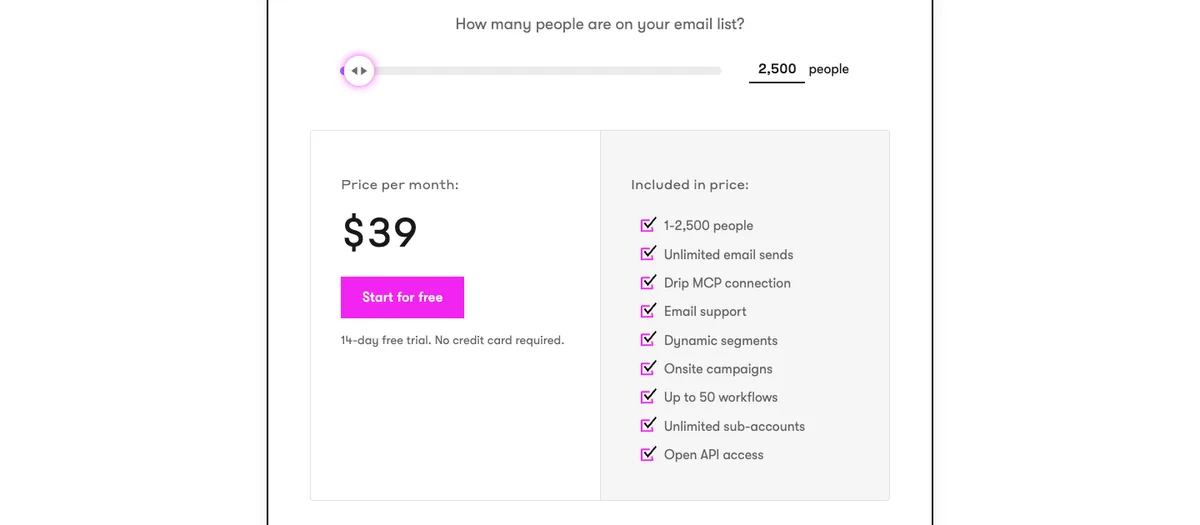
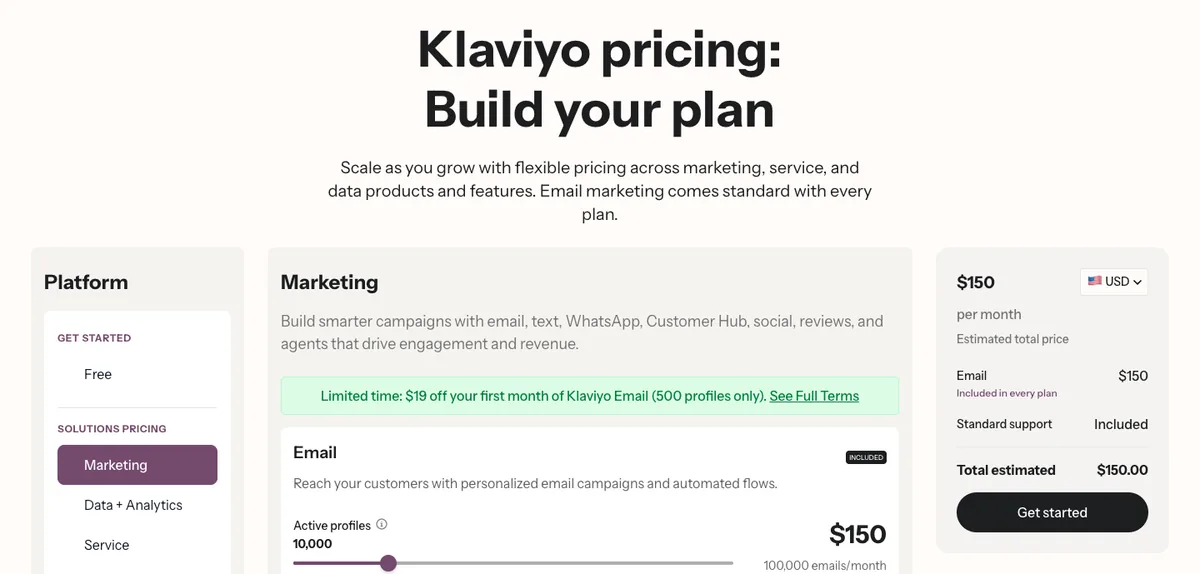
Drip sells one plan with every feature, priced on the number of people on your list. Klaviyo prices its email plan on active profiles and sells SMS on top. Monthly list prices in USD, from each vendor’s pricing page on 10 October 2026:
| People / active profiles | Drip | Klaviyo (email) |
|---|---|---|
| 2,500 | $39 | $60 |
| 5,000 | $89 | $100 |
| 10,000 | $154 | $150 |
| 25,000 | $369 | $400 |
| 50,000 | $699 | $720 |
| 100,000 | $1,199 | $1,380 |
Three things the table doesn’t show:
- Sends. Drip includes unlimited email sends on paid plans up to 30,000 people (not during the trial); above that, the allowance is 12 times your list tier. Klaviyo’s paid tiers include ten sends a month per profile: 100,000 at 10,000 profiles, which is plenty for most stores.
- What’s included. Drip’s price covers every feature. Klaviyo’s email plan covers email; SMS, Reviews and other add-ons cost extra.
- Free options. Klaviyo is free up to 250 profiles. Drip has no free plan, only a 14-day trial with no card required.
So Drip is $11 to $31 a month cheaper at most list sizes, Klaviyo is $4 cheaper at 10,000, and the gap only gets material past 50,000. For most brands between $1M and $10M in revenue, the platform fee isn’t what decides it. What you can build is. Full detail in our Drip pricing and Klaviyo pricing guides.
Why is Klaviyo so expensive?
Next to Drip, it mostly isn’t: within about $30 a month up to 50,000 profiles. It feels expensive because it bills on active profiles, everyone you can email, and since February 2025 your plan has to cover that full count. A list carrying years of people who never open pushes you up tiers, and SMS is billed on top. Suppress the people who never engage and the bill drops. Our Klaviyo pricing guide shows where the tier jumps are.
Where Drip Wins
Everything included. One price, every feature, unlimited sends up to 30,000 people. No upsell walls.
A slightly lower bill at most list sizes, as the table shows.
Visual workflow builder. Drip’s automation builder is well designed for visual thinkers, with pre-built playbooks for welcome, abandoned cart and win-back.
Revenue reporting from day one. Drip has always traced orders back to the email that earned them, shown clearly across campaigns and workflows.
A focused product. Email, on-site pop-ups and social, without SMS, reviews or a dozen add-ons. For a brand that wants email only, the narrower scope is a feature.
Lower learning curve for some teams. Marketers used to classic drip-campaign concepts find Drip’s terminology intuitive.
Where Klaviyo Wins
SMS as a native product. Klaviyo runs email and SMS in one flow (send the cart email, then a text if it isn’t opened) on one profile with one attribution model. On Drip you run a separate SMS tool and stitch the data back together, at least until Drip’s announced SMS product ships.
Predictive analytics. Klaviyo calculates predicted CLV, churn risk and next order date for qualifying profiles, and they plug straight into segments and flow filters. Drip’s equivalents are less developed and less central to the product.
Integration ecosystem. Klaviyo integrates with 350+ tools (Recharge, Yotpo, Postscript, LoyaltyLion, Triple Whale and more), usually in more depth than Drip does for the same tools.
Specialists who know it. Far more marketers, agencies and email marketing consultants work in Klaviyo than in Drip, so hiring or contracting help is easier.
First-party add-ons. Klaviyo Reviews and other first-party products sit on the same profile. Drip handles these through integrations.
Pros and Cons
Klaviyo
Pros
- Email and SMS on one profile, in one flow builder
- Predicted CLV, churn risk and next order date built in
- 350+ integrations and a large pool of specialists
- Free plan up to 250 profiles
Cons
- A little dearer than Drip at most list sizes
- Paid plans include ten sends per profile a month; Drip’s are unlimited up to 30,000 people
- Add-ons such as SMS and Reviews cost extra
- Steeper learning curve past basic flows
Drip
Pros
- One price, every feature, unlimited sends up to 30,000 people
- Slightly cheaper at most list sizes
- Strong visual workflow builder and revenue reporting
Cons
- No native SMS as of October 2026
- No free plan, only a 14-day trial
- Smaller ecosystem and talent pool
- Live chat support only on plans from $99 a month
What are the weaknesses of Klaviyo?
Against Drip, the weaknesses are price and limits: a little more per month at most sizes, a monthly send allowance where Drip has none, and add-ons on top of the base plan. Across the board, its cost rises with every active profile, SMS is billed per message, and it’s built for B2C ecommerce, so sales-led teams need a separate CRM. Our Klaviyo review covers each one and how to plan around it.
When to Choose Drip
- You’re already on Drip and it’s working. No structural reason to migrate if the programme is healthy and the platform isn’t holding growth back.
- You want email only, with no plans for SMS, and like one price for everything.
- Visual workflow design is a priority for your team.
When to Choose Klaviyo
Most ecommerce brands choosing today should default to Klaviyo:
- You want SMS in the same flows and reports as email
- You want predictive segments without building them
- You rely on a wide app stack around your store
- You want a large pool of people who can run the account
Who is Klaviyo’s biggest competitor?
For ecommerce email, Drip is one of several. The rivals Klaviyo meets most are Mailchimp and Omnisend for small and mid-size stores, Attentive and Postscript for SMS, and Braze and Iterable at enterprise scale. Our Klaviyo alternatives guide compares them by use case.
Migration Either Direction
Drip to Klaviyo: Workflows are rebuilt as Klaviyo flows, subscribers move with engagement data, templates are rebuilt. Typically two to three weeks. We run this regularly as part of wider Klaviyo engagements.
Klaviyo to Drip: Less common. Brands sometimes consider it for cost or simplicity. Drip offers migration calls for incoming stores.
Practical Recommendation
New ecommerce brands choosing today: Klaviyo. Native SMS, predictive analytics and the larger ecosystem, for a price within about $30 a month of Drip up to 50,000 profiles.
Brands on Drip with a healthy programme: stay if it’s working.
Brands on Drip with an underperforming programme: diagnose first. The problem is more often execution than platform, and Drip produces good results when it’s run well. If the platform is the constraint, Klaviyo is the natural next step.
If you’d like your Drip account reviewed before deciding, book a free audit. We diagnose the programme before recommending anything, and if the fix is execution rather than platform, we’ll say so. If it is the platform, our Klaviyo agency team runs the migration and the rebuild.
Sources
Checked 10 October 2026:
- Drip, Pricing (calculator at 2,500 to 100,000 people)
- Drip, February and March 2026 release notes (SMS consent element and upcoming SMS product)
- Klaviyo, Pricing
/ Frequently Asked Questions
Q.01 Which is better for DTC ecommerce brands, Drip or Klaviyo? +
/ Answer
For a brand that wants email and SMS automation on one profile, with revenue attribution and predictive segments, Klaviyo. It also has the bigger ecosystem: 350+ integrations against Drip's 90+, and far more specialists who know it. Drip is a competent, slightly cheaper choice for an email-only store that wants every feature included at one price.
Q.02 Does Drip have SMS marketing? +
/ Answer
Not natively, as of October 2026. Drip's pricing page lists email, social and on-site pop-ups, and its February and March 2026 release notes describe SMS through third-party tools while calling a Drip SMS product upcoming. Klaviyo runs email and SMS in the same flow on the same profile, which is the main structural gap between the two today.
Q.03 Is Drip cheaper than Klaviyo? +
/ Answer
Usually, by a little. As of October 2026, Drip costs $39 a month for up to 2,500 people, $89 at 5,000, $154 at 10,000, $369 at 25,000 and $699 at 50,000, with unlimited email sends up to 30,000 people and every feature included. Klaviyo's email plan is $60, $100, $150, $400 and $720 at the same sizes. So Drip is $11 to $31 a month cheaper at most sizes, and Klaviyo is $4 cheaper at 10,000.
Q.04 How hard is it to migrate from Drip to Klaviyo? +
/ Answer
It's one of the easier ESP migrations: subscribers move with their engagement data, workflows are rebuilt as Klaviyo flows and templates are rebuilt. A typical timeline is two to three weeks. The main work is redesigning automations around Klaviyo's behavioural triggers and predictions rather than copying the old workflows one to one.
Q.05 What are the weaknesses of Klaviyo compared with Drip? +
/ Answer
Klaviyo costs a little more at most list sizes, includes ten email sends per profile a month on paid plans where Drip's sends are unlimited up to 30,000 people, and sells SMS and Reviews as add-ons. It also has a steeper learning curve once you move past basic flows. In return you get native SMS, predictive analytics and a much larger ecosystem.
Shows our articles higher in your Google results. Takes one click.