Mailchimp Pricing 2026: Every Plan and the Real Cost
Mailchimp pricing, October 2026: free to 250 contacts, then Essentials from $13, Standard from $20 and Premium from $350 a month. Every tier and hidden cost.

Table of contents
- How much does Mailchimp cost?
- Mailchimp’s plans at a glance
- Mailchimp’s Pay As You Go plan
- Mailchimp cost by list size
- The hidden costs in Mailchimp pricing
- 1. Unsubscribed contacts count towards your bill
- 2. Overages bill automatically
- 3. Send limits are a multiple of your tier
- 4. SMS is a separate, expiring credit purchase
- 5. Transactional email is a separate product
- Is it worth paying for Mailchimp?
- When Mailchimp is cheaper than Klaviyo, and when Klaviyo pays for itself
- Who is Mailchimp’s biggest competitor?
- What is a cheaper alternative to Mailchimp?
- How to lower your Mailchimp bill today
- Thinking about moving to Klaviyo?
- Sources
Mailchimp costs $13 a month for Essentials, $20 a month for Standard and $350 a month for Premium at the smallest contact tier, and it’s free for up to 250 contacts (USD, Mailchimp’s pricing page on 10 October 2026). Price rises with your contact count: a 5,000-contact list pays $75 on Essentials or $100 on Standard, and 50,000 contacts pay $385, $450 or $815 a month.
That’s the pricing page. The invoice is more complicated: the contact count includes people who unsubscribed, overages bill automatically, and SMS is a separate credit add-on that expires every month.
Every plan price below was checked on Mailchimp’s own pricing page on 10 October 2026; plan limits come from its help centre (contact and send limits re-checked on 10 October 2026). We run Klaviyo for ecommerce brands, so we will also tell you plainly when Mailchimp is the cheaper, better call.
How much does Mailchimp cost?
Free up to 250 contacts. Above that, the three paid plans start at $13 (Essentials), $20 (Standard) and $350 (Premium) a month and climb with your contact band. Essentials and Standard come with a 14-day free trial. Premium’s floor is its 10,000-contact price, which is why it shows $350 even for a 500-contact list.
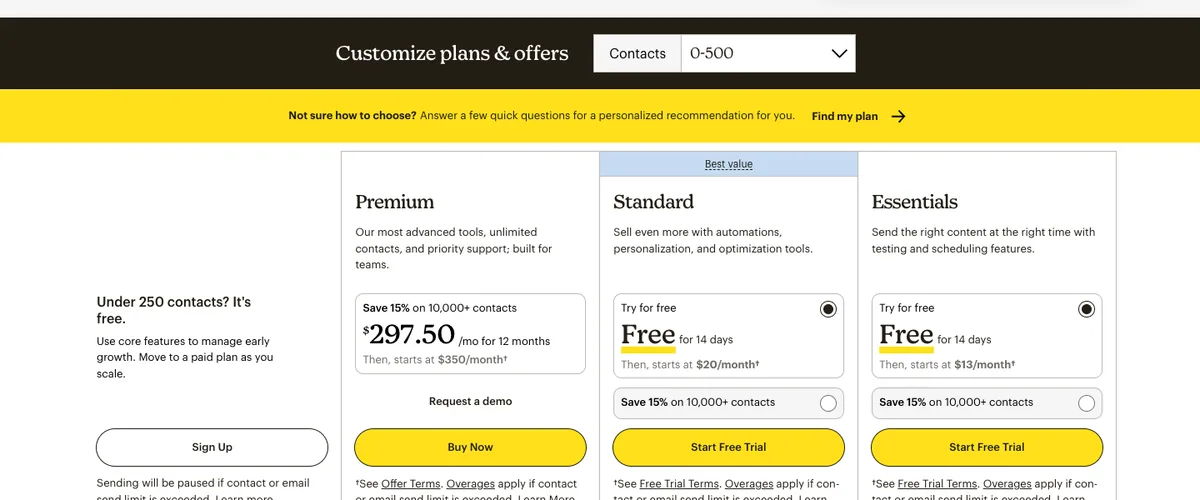
Mailchimp bills per contact tier rather than per email. Pick a band (0–500, 501–1,500, 2,501–5,000 and so on), and your plan price and monthly send allowance are both set by the top of that band.
Mailchimp’s plans at a glance
| Free | Essentials | Standard | Premium | |
|---|---|---|---|---|
| Starting price | $0 | $13/mo | $20/mo | $350/mo |
| Contact range | Up to 250 | 500 to 50,000 | 500 to 100,000 | 10,000 to 200,000 |
| Monthly email sends | 500 (250/day) | 10x contact tier | 12x contact tier | 15x contact tier |
| Users | 1 | 3 | 5 | Unlimited |
| Audiences | 1 | 3 | 5 | Unlimited |
| Automation flows | Not included | Up to 4 flow steps | Up to 200 flows | Up to 200 flows |
| SMS | Not available | SMS add-on | SMS + MMS add-on | SMS + MMS add-on |
| Support | Email, first 30 days | 24/7 email and chat | 24/7 email and chat | Phone and priority |
Source: mailchimp.com/pricing/marketing (prices, 10 October 2026) and Mailchimp’s “About Mailchimp Pricing Plans” help article (contact ranges and send limits re-checked 10 October 2026; seats, audiences, flows and support as listed in September 2026). The help article caps Premium at 200,000 contacts; larger lists get custom pricing from sales.
Free is for testing. There are no automation flows, sending pauses if you pass 250 contacts or 500 sends, and you get one seat.
Essentials removes Mailchimp branding and adds A/B testing and scheduling, but automations stop at four flow steps. That is enough for a two-email welcome series. It is not enough for a proper abandoned cart, browse abandonment and post-purchase programme.
Standard is the plan most stores end up on. It unlocks up to 200 flows, predictive segmentation, send-time optimisation, dynamic content and custom reports.
Premium starts at 10,000 contacts, so $350 a month is the floor even on a smaller list. It adds unlimited seats, phone support and a higher send multiple.
Mailchimp’s Pay As You Go plan
There is a fourth way to pay. Instead of a monthly plan, you can buy email credits: one credit per email per contact, so a send to 1,000 contacts uses 1,000 credits. Credits expire after 12 months, and the plan comes with the same features as Essentials. Mailchimp says it’s best for infrequent senders (pricing page and help centre, 10 October 2026).
Credit prices aren’t listed on those pages; you see them when you choose the plan. It suits a list you email a few times a year. A store sending weekly campaigns plus flows burns through credits fast, so price it against Essentials or Standard before you buy.
Mailchimp cost by list size
These are Mailchimp’s monthly list prices in USD for each contact band, as shown on its pricing calculator on 10 October 2026. The Klaviyo column is Klaviyo’s email plan at the same count, from klaviyo.com/pricing in October 2026.
| Contacts | Essentials | Standard | Premium | Klaviyo (email) |
|---|---|---|---|---|
| 500 | $13 | $20 | $350* | $20 |
| 1,500 | $26.50 | $45 | $350* | $45 |
| 5,000 | $75 | $100 | $350* | $100 |
| 10,000 | $110 | $135 | $350 | $150 |
| 25,000 | $270 | $310 | $620 | $400 |
| 50,000 | $385 | $450 | $815 | $720 |
| 100,000 | Not available | $800 | $1,025 | $1,380 |
*Premium’s minimum tier is 10,000 contacts, so smaller lists still pay the 10,000-contact price.
Two notes before you compare rows:
- Promotions move the first-year number. On 10 October 2026 Mailchimp offered 15% off the first 12 months on plans with 10,000+ contacts (for example, Standard at 10,000 contacts showed $114.75 for 12 months, then $135). Budget on the full price.
- Local currency is indicative. Australian visitors see AUD on the page, but Mailchimp states that local-currency prices are based on the USD exchange rate and the amount charged follows the USD rate on your billing day.
On sticker price alone, Mailchimp Standard and Klaviyo run level up to about 5,000 contacts, then Mailchimp pulls ahead at larger lists. The next section is why the sticker price is not the whole story.
The hidden costs in Mailchimp pricing
1. Unsubscribed contacts count towards your bill
Mailchimp’s help centre defines a contact as “subscribed, unsubscribed, and non-subscribed”. Everyone in your audience counts toward your tier, including people who opted out years ago and people who bought once without consenting to marketing.
A store with 8,000 subscribed contacts and 4,000 unsubscribes is billed as 12,000 contacts, which is the 10,001–15,000 band. Klaviyo bills on active profiles you can actually email (explained in our Klaviyo pricing guide), so the same store compares very differently once you count properly.
The fix: archive unsubscribed and long-dead contacts regularly. It is the single biggest lever on a Mailchimp invoice.
2. Overages bill automatically
If you pass your contact limit or your monthly send allowance, Mailchimp doesn’t stop your campaigns; it adds an overage charge to your bill. Paid plans keep sending; the Free plan pauses sending instead. A big import before Black Friday can quietly move you up a band for the month.
3. Send limits are a multiple of your tier
Essentials gives 10 sends per contact per month, Standard 12 and Premium 15, calculated on the top of your band. At 5,000 contacts on Standard that is 60,000 emails a month, enough for about two campaigns a week plus flows. Stores that send daily during a sale can hit the ceiling.
4. SMS is a separate, expiring credit purchase
SMS is an add-on to paid plans in selected countries, and you must apply and be approved before you can buy credits. Credits are bought in monthly blocks, renew automatically on your billing date, and unused credits expire and do not roll over.
Credit cost per message depends on the destination. Mailchimp’s help centre lists 1 credit per SMS and 3 per MMS in the US, 3 per SMS in Canada, 4 in Australia and 5 in the UK. MMS is only available on Standard and Premium, to US and Canadian contacts.
Block prices are shown in your account’s currency and country, so we can’t give a universal price. Viewed from Australia in September 2026, the SMS add-on started at A$20 a month for 1,000 credits, with 10,000 credits at A$129.20. At 4 credits per Australian SMS, 10,000 credits covers about 2,500 texts.
5. Transactional email is a separate product
Order confirmations and receipts sent through the API use Mailchimp Transactional (formerly Mandrill), a paid add-on available on Standard and Premium. If you run a Shopify store, your platform usually sends those instead, but check before you assume they are covered.
Is it worth paying for Mailchimp?
Yes, if your email programme is mostly newsletters and a short welcome series. Mailchimp is easy to learn, the templates are decent, and Essentials is cheap for small lists.
It gets harder to justify for ecommerce once you need behaviour-based flows and segments built on order data. Essentials caps automations at four steps, so most stores land on Standard, and that is where Klaviyo’s pricing becomes directly comparable.
When Mailchimp is cheaper than Klaviyo, and when Klaviyo pays for itself
Here is the honest version.
Mailchimp is the cheaper, sensible choice when:
- You send a newsletter or two a month and don’t need behavioural flows. Essentials at $13 to $110 a month for up to 10,000 contacts is good value.
- Your list is clean. If you archive unsubscribes and dead contacts regularly, Mailchimp Standard beats Klaviyo’s list price from about 10,000 contacts upward.
- You are not an ecommerce business, or ecommerce is a sideline. A lot of Klaviyo’s value is tied to store data.
Klaviyo tends to pay for itself when:
- Flows carry your revenue. Klaviyo’s own benchmark report shows automated flows earn far more per recipient than campaigns. If you need abandoned cart, browse abandonment, post-purchase and win-back flows with real branching logic, that is Klaviyo’s home ground.
- You segment on purchase behaviour. Predicted next order date, product affinity and customer lifetime value segments are native in Klaviyo. On Mailchimp you work harder for less.
- Your Mailchimp list carries a lot of unsubscribes. Once you compare billable contacts properly, the list-price gap narrows or disappears.
- You want email and SMS on one profile. Klaviyo’s mobile messaging sits in the same flow builder and reporting; see our Klaviyo SMS pricing breakdown.
The subscription is rarely the expensive part of email. When Relaxium added $3M a year in incremental email and SMS revenue, nobody was optimising the platform fee; they were optimising the flows. If your store is at the point where flows matter, a $50-a-month price difference is a rounding error against what a well-built programme returns.
For a feature-by-feature view, read our Klaviyo vs Mailchimp comparison. If you plan to run both for a while, our Klaviyo and Mailchimp integration guide covers the handover.
Who is Mailchimp’s biggest competitor?
It depends on what you use Mailchimp for:
- Ecommerce stores: Klaviyo. It’s where stores tend to go once abandoned cart, browse and post-purchase flows carry real revenue, because its segments and flows run on order data. See Klaviyo vs Mailchimp.
- Cheaper newsletters: MailerLite and Brevo. MailerLite is cheaper per subscriber and doesn’t bill unsubscribes; Brevo prices on emails sent. See Klaviyo vs MailerLite.
- Shopify stores on a budget: Omnisend, which is built around store data. See Klaviyo vs Omnisend.
- Small businesses that also run events: Constant Contact, which bundles event registration and phone support. See our Constant Contact pricing guide.
- B2B and sales-led teams: ActiveCampaign and HubSpot, which pair automation with a CRM. See Klaviyo vs ActiveCampaign and Klaviyo vs HubSpot.
What is a cheaper alternative to Mailchimp?
It depends on what you are actually buying:
- Cheaper newsletters: MailerLite charges $49 a month for 5,000 subscribers on Comfort, about half of Mailchimp Standard, and doesn’t bill unsubscribed contacts.
- Big list, low frequency: Brevo prices on email volume, not contacts, so a large list emailed monthly can be very cheap.
- Ecommerce on a budget: Omnisend Standard is $81 a month at 5,000 contacts, and doesn’t bill unsubscribes.
- Ecommerce at scale: Klaviyo, for the flow and segmentation depth above.
Our Klaviyo alternatives guide runs the same exercise from the other direction.
How to lower your Mailchimp bill today
- Archive unsubscribed and cleaned contacts. They are billable on Mailchimp.
- Remove contacts with no engagement in 12 months. Run a re-engagement send first, then archive non-responders. Our list cleaning guide has the process.
- Check your tier boundary. Sitting at 5,050 contacts puts you in the 5,001–10,000 band. Pruning 51 contacts drops you a tier.
- Buy SMS credits you’ll use. They expire monthly, so size the block to your real send volume.
- Downgrade seats and audiences you don’t use. Multiple audiences often mean the same person billed twice.
Thinking about moving to Klaviyo?
If your Mailchimp account has outgrown newsletters and you want flows that earn their keep, our Mailchimp to Klaviyo migration service moves your lists, consent history, templates and flows without breaking deliverability. Not sure it’s worth it yet? Get a free audit and we will tell you honestly whether switching pays back for your store.
Sources
- Mailchimp Pricing Plans (prices by contact band, 10 October 2026)
- About Mailchimp Pricing Plans (contact definitions, plan limits, overages, Pay As You Go; 10 October 2026)
- Mailchimp Pay As You Go (credit use and expiry, 10 October 2026)
- Mailchimp SMS pricing and About SMS Marketing Credits
- Klaviyo Pricing
/ Frequently Asked Questions
Q.01 How much does Mailchimp cost per month? +
/ Answer
As of October 2026, Mailchimp's paid plans start at $13 a month (Essentials), $20 a month (Standard) and $350 a month (Premium) for the smallest contact tier. Price rises with your contact count: at 5,000 contacts Essentials is $75 and Standard $100, and at 50,000 contacts Essentials is $385, Standard $450 and Premium $815 a month.
Q.02 Is Mailchimp free? +
/ Answer
Mailchimp has a free plan for up to 250 contacts and 500 email sends a month, with a 250-send daily cap, one seat and email support for the first 30 days. It does not include marketing automation flows or SMS, and sending is paused if you exceed the contact or send limit. It suits testing, not running a store's email programme.
Q.03 Why is Mailchimp so expensive now? +
/ Answer
Mostly because of how it counts contacts. Mailchimp includes subscribed, unsubscribed and non-subscribed contacts in your billable count, and bills overages automatically when you pass your tier. A list that has never been cleaned can sit one or two tiers higher than the number of people you can actually email. Archiving dead contacts is the quickest way to cut the bill.
Q.04 What does Mailchimp cost per year? +
/ Answer
Multiply the monthly price by twelve: Standard at 5,000 contacts is $100 a month, or $1,200 a year, and at 25,000 contacts it is $310 a month, or $3,720 a year (as of October 2026). Mailchimp was offering 15% off the first 12 months for accounts with 10,000+ contacts, and a 15% discount for nonprofits and charities.
Q.05 Does Mailchimp charge for unsubscribed contacts? +
/ Answer
Yes. Mailchimp's own plan definitions state that subscribed, unsubscribed and non-subscribed contacts are all included in your contact count. That is different from Klaviyo, which bills on active profiles you can email, and from Omnisend and MailerLite, which don't bill for unsubscribed contacts. Archive contacts you no longer need to keep them out of your billable total.
Q.06 Is Mailchimp cheaper than Klaviyo? +
/ Answer
On list price at the same contact count, Mailchimp's Standard plan is similar or slightly cheaper: $100 against $100 at 5,000 contacts, and $450 against $720 at 50,000 (as of October 2026). But Mailchimp bills unsubscribed contacts and caps Essentials automations at four steps. For ecommerce stores that live on flows and segmentation, Klaviyo usually earns back the difference.
Q.07 What is a cheaper alternative to Mailchimp? +
/ Answer
For simple newsletters, MailerLite is cheaper at most list sizes: $49 a month for 5,000 subscribers on its Comfort plan against Mailchimp Standard's $100. Brevo, which prices on email volume rather than contacts, can be cheaper again for large lists you email rarely. For ecommerce automation, Omnisend and Klaviyo are the usual moves up, not down.
Q.08 What is the cheapest email marketing platform? +
/ Answer
It depends on list size and how often you send. Free plans, as of 10 October 2026: Mailchimp (250 contacts, 500 sends a month), MailerLite (250 subscribers, 2,500 emails a month), Omnisend (250 contacts, 500 emails a month) and Brevo (300 emails a day), plus 10,000 free emails a month with Shopify Messaging. Paid, at 500 contacts billed monthly: MailerLite Comfort $12, Mailchimp Essentials $13, Omnisend Standard $16 and Klaviyo $20. Brevo prices on emails sent, from $9 a month for 5,000, so it can be cheapest for a big list you email rarely.
Q.09 What is Mailchimp mainly used for? +
/ Answer
Email newsletters and marketing campaigns for small businesses: sign-up forms, landing pages, templates and basic automations, with SMS as a paid add-on in selected countries. It connects to Shopify and other stores, but it isn't built around order data the way Klaviyo and Omnisend are, so ecommerce brands that live on flows usually move on as they grow.
Shows our articles higher in your Google results. Takes one click.